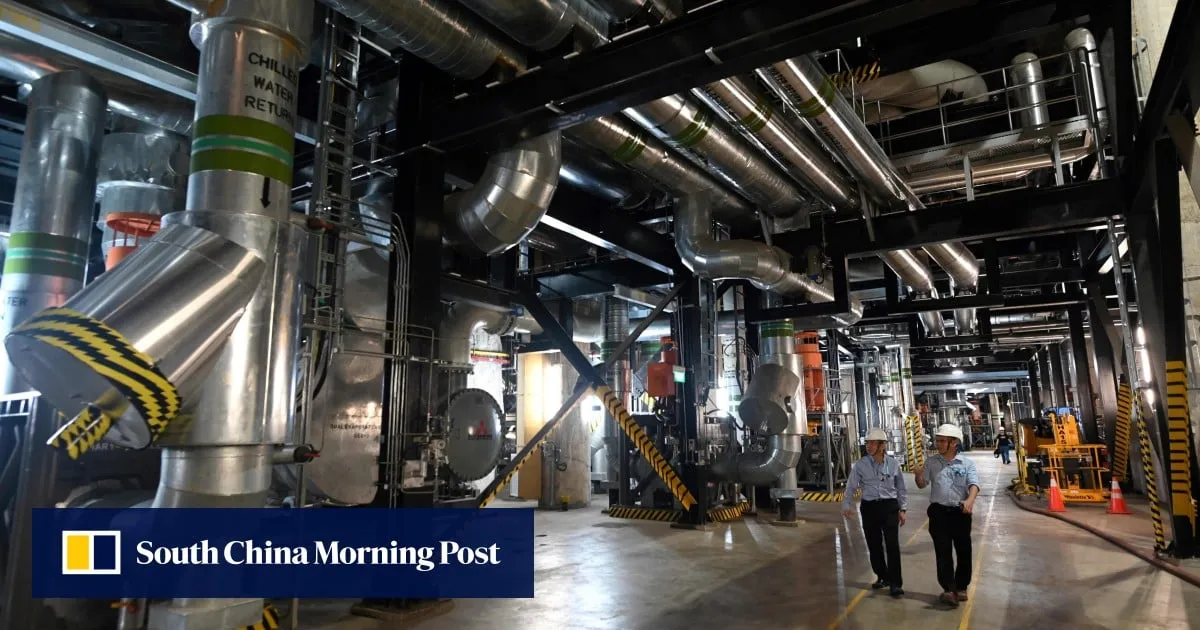
Deep underneath Singapore’s northeastern district of Punggol, a 5km (three-mile) network of metal pipes roars as it pumps chilled water to cool offices and classrooms overhead.The 140-year-old concept known as District Cooling uses less electricity than centralised air conditioners – a major advantage for a resource-starved tropical island-nation that has to import nearly all its energy and where temperatures are rising twice as fast as the global average.The city state has laid pipes beneath at least eight neighbourhoods so far, with the Marina Bay network – the world’s largest underground system – having begun operations in 2006. More buildings will be linked up to that system, and separate facilities are being rolled out in other parts of the city by firms like Keppel-eaas" class="entity-link entity-organization" data-entity-id="142762" data-entity-type="organization">Keppel EaaS.A Keppel employee checks reverse osmosis membrane pipes at a desalination plant in Singapore. Photo: ReutersThe roll-out comes as Energy Security takes centre stage in countries, including Singapore, that are reeling from energy shortages caused by the Iran-war" class="entity-link entity-event" data-entity-id="107864" data-entity-type="event">US-Iran war, while also bracing for an exceptionally hot summer due to a projected “Super El Nino”. District Cooling is a solution that is gaining traction around the world, particularly in the Middle East, and is projected to grow to a US$60 billion market by 2034 by one estimate.
SRCSouth China Morning Post
LANGEN
LEANCenter-Right
WORDS209
ENT12
TUE · 2026-06-09 · 01:27 GMTBRIEF NSR-2026-0609-82852
NSR-2026-0609-82852News Report·EN·Technology
Forget air-con, Singapore looks underground for a cooler future
Singapore is implementing district cooling systems, a 140-year-old concept, to combat rising temperatures and reduce electricity consumption. This technology involves pumping chilled water through underground pipe networks to cool buildings, offering a more energy-efficient alternative to individual air conditioners.
BloombergSouth China Morning PostFiled 2026-06-09 · 01:27 GMTLean · Center-RightRead · 1 min
South China Morning PostFIG 01
Reading time
1min
Word count
209words
Sources cited
1cited
Entities identified
12entities
Quality score
100%
§ 01
Briefing Summary
AI-generatedNEWSAR · AI
Singapore is implementing district cooling systems, a 140-year-old concept, to combat rising temperatures and reduce electricity consumption. This technology involves pumping chilled water through underground pipe networks to cool buildings, offering a more energy-efficient alternative to individual air conditioners. The nation has already established these systems in at least eight neighborhoods, including the world's largest underground network in Marina Bay, which began operations in 2006. This initiative is particularly advantageous for Singapore, a tropical island nation that imports most of its energy and is experiencing warming at twice the global average. The expansion of district cooling is also influenced by global energy security concerns and the anticipation of a hot summer.
Confidence 0.90Sources 1Claims 5Entities 12
§ 02
Article analysis
Model · rule-basedFraming
Technology
Environmental
Tone
Measured
AI-assessed
CalmNeutralAlarmist
Factuality
0.80 / 1.00
Factual
LowHigh
Sources cited
1
Limited
FewMany
§ 03
Key claims
5 extracted01
Temperatures in Singapore are rising twice as fast as the global average.
statistic
Confidence
1.00
02
The Marina Bay district cooling network is the world's largest underground system.
factual
Confidence
1.00
03
Singapore has laid pipes beneath at least eight neighborhoods for district cooling.
factual
Confidence
1.00
04
District cooling uses less electricity than centralized air conditioners.
factual
Confidence
1.00
05
District cooling is projected to grow to a US$60 billion market by 2034.
statisticone estimate
Confidence
0.80
§ 04
Full report
1 min read · 209 words§ 05
Entities
12 identifiedKey playerOppositionContextPositiveNeutralNegative
Organizations2
Locations5
§ 06
Keywords & salience
9 termsdistrict cooling
1.00
energy security
0.80
climate change
0.70
singapore
0.70
underground infrastructure
0.60
super el nino
0.50
tropical island
0.50
energy shortages
0.40
keppel eaas
0.40
§ 07
Topic connections
Interactive graph Network visualization showing 51 related topics
View Full Graph Person Organization Location Event|Click node to navigate|Edge numbers = shared articles