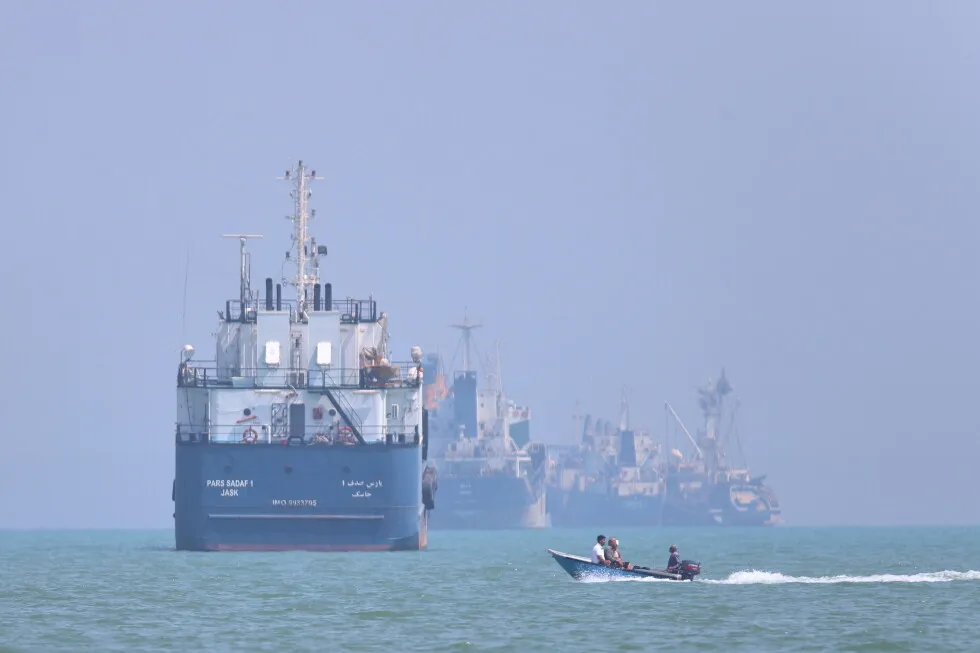
Iran’s Kharg Island is key to its oil exports. Targeting it carries major risks 1 of 3 | A small motorboat passes anchored vessels in the Strait of Hormuz off Bandar Abbas, Iran, Thursday, June 11, 2026.(Amirhosein Khorgooi/ISNA via AP) 2 of 3 | A person stands on shallow water as cargo and commercial vessels are anchored in the Strait of Hormuz off Bandar Abbas, Iran, Monday, June 8, 2026. (Amirhosein Khorgooi/ISNA via AP) 3 of 3 | A person sits on shallow water as cargo and commercial vessels are anchored in the Strait of Hormuz off Bandar Abbas, Iran, Monday, June 8, 2026. (Amirhosein Khorgooi/ISNA via AP) By SAM METZ Updated 7:09 PM MESZ, June 11, 2026 Add AP News on Google Add AP News as your preferred source to see more of our stories on Google. Share Share Facebook Copy Link copied Print Email X LinkedIn Bluesky Flipboard Pinterest Reddit Iran’s Kharg Island, home to a terminal through which the country exports most of its oil, has emerged as a focus of the war launched in late February by the United States and Israel. Strikes on oil infrastructure on Kharg — or a ground invasion — would severely curb Iran’s oil exports, a key source of revenue for the Islamic Republic. An assault would also mark a major escalation that could provoke even heavier retaliatory attacks on Gulf Arab infrastructure and further drive up oil prices. The skyrocketing cost of fuel is already threatening the world economy. U.S. President Donald Trump said strikes in mid-March “obliterated” Kharg’s military assets but did not target the island’s oil infrastructure. He warned that if Iran continued disrupting traffic through the Strait of Hormuz, he would reconsider the decision to spare energy targets on the island. The AP is committed to delivering independent news coverage from all corners of the globe. By creating a free account, you help us understand our readers and strengthen our journalism. Create a free account Sign in to existing account How we use your information Help with registration Continue without registering Then on Thursday, Trump said in a social media post that the U.S. would “assume total control” of Iran’s oil and gas industries, including the Kharg Island terminal, in the “not too distant future.” The president made the post as escalating attacks between the countries pushed the Middle East closer to the resumption of a full-scale war. His latest threats emerged at a time when efforts to negotiate an end to the war appear to be stuck. Citing fallout from Iran war, World Bank cuts forecast for global economic growth 2 MIN READ US producer prices spike in May as soaring energy prices fuel largest yearly jump since 2022 2 MIN READ US jobless aid filings rise to 229,000 last week, remain historically low despite Iran war headwinds 2 MIN READ The island is on the other side of the Persian Gulf from U.S. bases in Kuwait and Saudi Arabia. A U.S. occupation of it would put American troops in a stationary position just 33 kilometers (21 miles) off Iran’s coast. That’s well within range of Iranian drones and missiles, if the Islamic Republic is willing to inflict damage on its own territory. The small coral island is especially important because Iran’s coastline is mostly too shallow for tanker ships to dock. The U.S. has imposed a naval blockade on Iranian ports, which has impeded Iran’s efforts to export oil, mainly to China, through the Strait of Hormuz, even as Iranian attacks have closed the vital waterway to most traffic. The destruction or loss of the island would deny the government a major revenue source, but it would also remove even more oil from world markets at a time of soaring prices. The destruction of the terminal would further damage Iran’s already weakened economy and undermine any efforts at postwar reconstruction. Iran has continued to exert control over the strait, through which a fifth of the world’s traded oil passed before the war. Meanwhile, the U.S. has sent thousands of soldiers and Marines to the region. Kharg Island has storage tanks and housing for thousands of workers. Gazelles roam freely near the refineries and depots. It also is home to a medieval Portuguese fortress and the ruins of one of the oldest Christian monasteries in the Persian Gulf. SAM METZ Metz covers Morocco, Algeria, Tunisia and points beyond for The Associated Press. mailto
SRCAssociated Press (AP)
LANGEN
LEANCenter
WORDS737
ENT12
THU · 2026-06-11 · 17:23 GMTBRIEF NSR-2026-0611-83643
NSR-2026-0611-83643News Report·EN·Conflict
Iran’s Kharg Island is key to its oil exports. Targeting it carries major risks
Iran's Kharg Island, a critical hub for the country's oil exports, has become a focal point in the ongoing war involving the United States and Israel. Targeting the island's oil infrastructure, or attempting a ground invasion, would significantly reduce Iran's oil revenue and could lead to a major escalation, including retaliatory attacks on Gulf Arab infrastructure and further increases in global oil prices.
Associated Press (AP)Filed 2026-06-11 · 17:23 GMTLean · CenterRead · 3 min
Associated Press (AP)FIG 01
Reading time
3min
Word count
737words
Sources cited
1cited
Entities identified
12entities
Quality score
100%
§ 01
Briefing Summary
AI-generatedNEWSAR · AI
Iran's Kharg Island, a critical hub for the country's oil exports, has become a focal point in the ongoing war involving the United States and Israel. Targeting the island's oil infrastructure, or attempting a ground invasion, would significantly reduce Iran's oil revenue and could lead to a major escalation, including retaliatory attacks on Gulf Arab infrastructure and further increases in global oil prices. U.S. President Donald Trump has indicated a potential U.S. takeover of Iran's oil industries, including the Kharg Island terminal, in the near future. The island's strategic importance lies in its deep-water port, essential for oil tanker access, and its role in Iran's economy. Any disruption to Kharg Island would severely impact Iran's finances and global oil markets.
Confidence 0.90Sources 1Claims 5Entities 12
§ 02
Article analysis
Model · rule-basedFraming
Conflict
Economic Impact
Tone
Mixed Tone
AI-assessed
CalmNeutralAlarmist
Factuality
0.70 / 1.00
Factual
LowHigh
Sources cited
1
Limited
FewMany
§ 03
Key claims
5 extracted01
Trump said the U.S. would “assume total control” of Iran’s oil and gas industries, including the Kharg Island terminal, in the “not too distant future.”
quoteDonald Trump
Confidence
1.00
02
U.S. President Donald Trump said strikes in mid-March “obliterated” Kharg’s military assets but did not target the island’s oil infrastructure.
quoteDonald Trump
Confidence
1.00
03
Iran’s Kharg Island is key to its oil exports, a major source of revenue for the Islamic Republic.
factual
Confidence
0.90
04
Strikes on oil infrastructure on Kharg Island or a ground invasion would severely curb Iran’s oil exports.
factual
Confidence
0.85
05
An assault on Kharg Island would mark a major escalation that could provoke heavier retaliatory attacks and further drive up oil prices.
prediction
Confidence
0.75
§ 04
Full report
3 min read · 737 words§ 05
Entities
12 identifiedKey playerOppositionContextPositiveNeutralNegative
Organizations1
Locations7
Events1
§ 06
Keywords & salience
8 termsoil exports
1.00
kharg island
1.00
strait of hormuz
0.90
us-iran war
0.80
oil infrastructure
0.70
escalation
0.60
oil prices
0.50
donald trump
0.40
§ 07
Topic connections
Interactive graph Network visualization showing 51 related topics
View Full Graph Person Organization Location Event|Click node to navigate|Edge numbers = shared articles