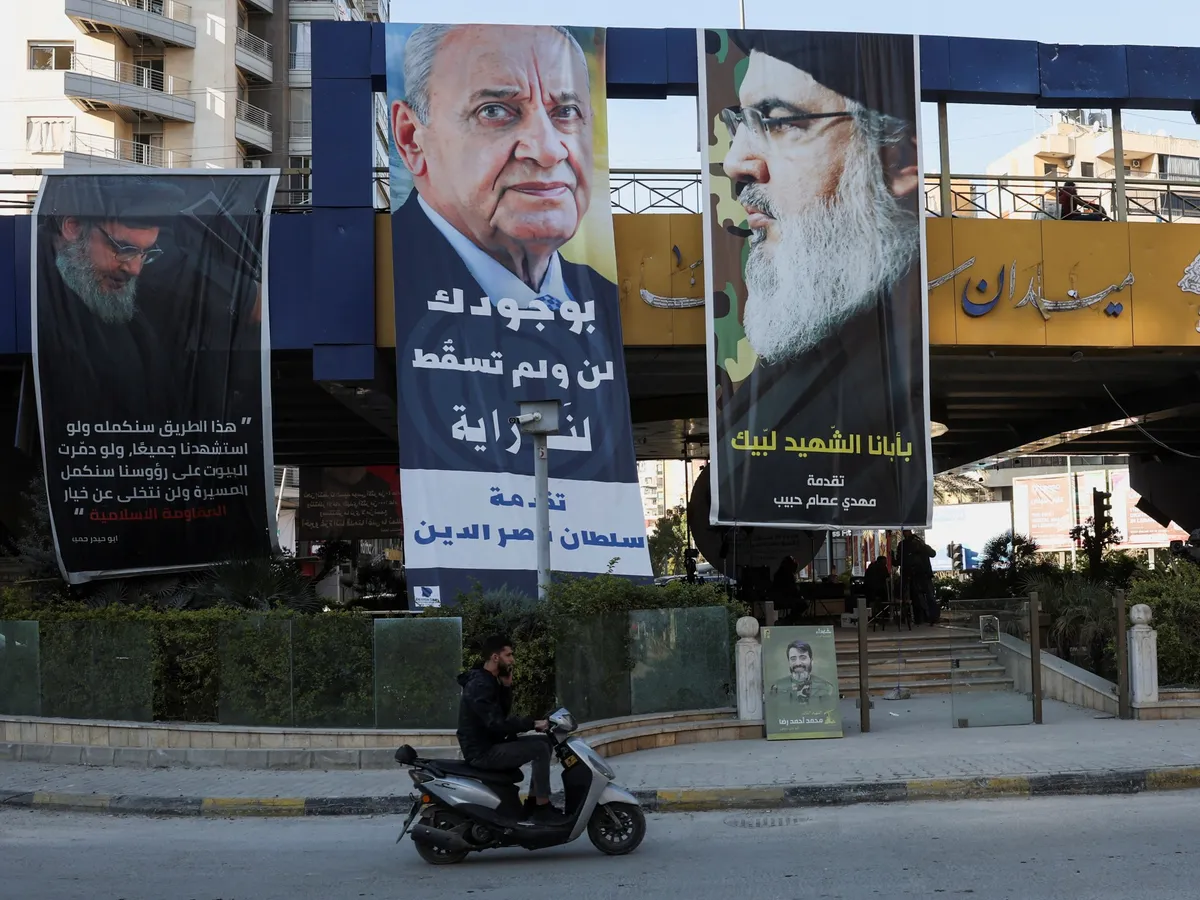
A person rides a motorbike past a poster depicting Lebanese Parliament Speaker Nabih Berri and late Hezbollah leader Hassan Nasrallah in Beirut's southern suburbs, December 2, 2024 [Mohamed Azakir/Reuters]Published On 11 Jun 2026Beirut, Lebanon – As Israel’s war on Lebanon passes the 100-day mark, the partnership between the country’s two main Shia blocs – the Amal Movement and the Hezbollah armed and political group – appears firm.The Amal Movement, led by Lebanon’s Speaker of Parliament Nabih Berri, has historically been the key domestic ally of Hezbollah, which is backed by Iran. But a parallel track of negotiations between the US and Iran on the one hand, and Israel and Lebanon on the other, has seen Tehran’s support for its regional proxies has come under the spotlight, which could have serious implications for Hezbollah.It is unlikely that Amal will abandon its close relations with Hezbollah anytime soon, but the movement’s representation in parliament, and Berri’s important constitutional role, mean it could consolidate its role as patron of the Shia community within state institutions. But Souhayb Jawhar, a Lebanese analyst with Badil, sees that the uncertain future Lebanon currently faces means there will be fundamental implications for both Hezbollah and Amal’s futures.“In practice, Amal has been the most prominent political and institutional representative of the Shia within the Lebanese state for years, even during the height of Hezbollah’s power,” Jawhar told Al Jazeera.“If Hezbollah’s role continues to decline or if it remains preoccupied with internal restructuring, Amal’s position will likely be further strengthened in managing the relationship between the Shia community and the Lebanese state, as well as between the community and external actors.”Amal’s historyAmal, the Arabic acronym of the movement’s militia name, the Lebanese Resistance Regiments, also translates to “hope”. It was cofounded by Musa Sadr, a revolutionary Iranian-born Shia leader, and Hussein al-Husseini, a former Lebanese speaker of parliament, as the Movement of the Deprived in 1974.Following Berri’s takeover of the party in 1980, many of the group’s more religious contingent switched to the newly emerged Hezbollah, and the two sides fought one another for territory during the Lebanese civil war. Today, the two groups are allied, although tensions exist among some of their followers.“Hezbollah established itself as a dominant player due to its military strength, regional influence, and financial and organisational capabilities, making it the most influential force in strategic decisions within the Shia community,” Jawhar said.“However, this does not mean that Amal has lost its fundamental position. It has maintained the largest share of official Shia representation within the state, its administrations, and institutions, and Nabih Berri remains the most prominent Shia figure in managing Lebanon’s political balance.”Berri often serves as a conduit between Hezbollah and foreign diplomats or administrations that do not have direct relations with the movement, highlighting this interdependence.Amal after BerriOn March 2, Israel intensified its war on Lebanon after Hezbollah fired six rockets across the border in response to the assassination of Iran’s Supreme Leader Ayatollah Ali Khamenei two days earlier.The attacks ended a one-sided ceasefire agreed in November 2024 between the two sides, with about 10,000 ceasefire violations by Israel.After an intense 66-day assault by Israel, which saw 4,000 people killed, including much of Hezbollah’s military leadership and its longtime leader Hassan Nasrallah, many analysts believed the Iran-backed movement was battered and beaten.A new political leadership of President Joseph Aoun and Prime Minister Nawaf Salam moved to disarm the group, a move that, while backed by some Lebanese, was also fiercely opposed by many others, including Hezbollah supporters.On March 2, Israel relaunched its assault on Beirut, even though the war had never stopped for the people of southern Lebanon, with the Lebanese government subsequently banning Hezbollah’s military activities.The cabinet’s decision – which was even backed by two Amal ministers – was viewed as evidence that Hezbollah was domestically and regionally weakened.Berri is often seen wearing a plastic face shield, leading some to speculate that the 88-year-old speaker is in poor health and raising questions about Amal’s future.“I’m not very sure about Amal’s formidability, especially after Berri passes away,” Karim Safieddine, a nonresident fellow at the Tahrir Institute, told Al Jazeera.Amal not filling in for HezbollahDespite doubts over Hezbollah’s abilities, the movement has still managed to engage in drone attacks and clashes with Israel despite the government banning their activities, three months ago. For his part, Berri remains quiet and waiting for regional developments – including how the US-Iran war plays out – before making definitive statements.“Amal is thinking about this purely from a populistic, opportunistic perspective, because they’re not actually a real game-changer,” Safieddine said.“Every statement [Berri] makes is related to how he positions himself within the dominant trends within the Shia community, and he’s using the media in a very manipulative way. He rarely makes his own statements, he does so very discreetly, and sends in signals here and there.”Still, many analysts believe Beirut will struggle to disarm Hezbollah as long as the Iranian Islamic Revolutionary Guard Corps (IRGC) backs the group and Israel’s invasion of Lebanon continues. That doesn’t mean, however, that Hezbollah’s position in Lebanon is as strong as it was before 2023.“Hezbollah’s current weakening creates an opening for Amal to re-emerge as a central political force, especially because Hezbollah will find it difficult to oppose an Amal role that protects Shia interests while avoiding direct confrontation with the state or international mediators,” Imad Salamey, a Lebanese political analyst, told Al Jazeera.While Hezbollah’s weapons and proximity to Iran make it a controversial force in Lebanon and with Western and Gulf allies, Amal doesn’t carry the same baggage. Berri himself has acted as a conduit between Hezbollah and the US and Europe. Notably, he negotiated on behalf of Hezbollah during the 2024 ceasefire talks with the US and France, which passed on messages to Israel.“Amal can try to present itself as a more ‘acceptable’ Western partner because it speaks the language of state institutions, negotiation, and reconstruction, while still retaining credibility within parts of the Shia community,” Salamey said.
SRCAl Jazeera
LANGEN
LEANCenter
WORDS998
ENT12
THU · 2026-06-11 · 19:20 GMTBRIEF NSR-2026-0611-83671
NSR-2026-0611-83671Analysis·EN·Political Strategy
What is the Amal Movement, Lebanon’s other Shia party?
The Amal Movement, led by Lebanese Parliament Speaker Nabih Berri, is Lebanon's other major Shia party and a historical ally of Hezbollah. While their partnership appears firm amidst ongoing conflict with Israel, the future of both groups is uncertain due to regional negotiations and potential shifts in Iranian support.
Justin SalhaniAl JazeeraFiled 2026-06-11 · 19:20 GMTLean · CenterRead · 4 min
Al JazeeraFIG 01
Reading time
4min
Word count
998words
Sources cited
1cited
Entities identified
12entities
Quality score
100%
§ 01
Briefing Summary
AI-generatedNEWSAR · AI
The Amal Movement, led by Lebanese Parliament Speaker Nabih Berri, is Lebanon's other major Shia party and a historical ally of Hezbollah. While their partnership appears firm amidst ongoing conflict with Israel, the future of both groups is uncertain due to regional negotiations and potential shifts in Iranian support. Amal has historically served as the primary institutional representative of the Shia community within the Lebanese state, even during Hezbollah's peak influence. Berri often acts as a liaison between Hezbollah and foreign entities. Despite speculation about Berri's health and Amal's future formidability after his passing, the movement has maintained significant representation within state institutions, positioning it to potentially consolidate its role in managing relations between the Shia community and the state, as well as external actors.
Confidence 0.90Sources 1Claims 5Entities 12
§ 02
Article analysis
Model · rule-basedFraming
Political Strategy
Conflict
Tone
Measured
AI-assessed
CalmNeutralAlarmist
Factuality
0.60 / 1.00
Mixed
LowHigh
Sources cited
1
Limited
FewMany
§ 03
Key claims
5 extracted01
Amal has been the most prominent political and institutional representative of the Shia within the Lebanese state for years.
quoteSouhayb Jawhar
Confidence
0.95
02
Amal was cofounded by Musa Sadr and Hussein al-Husseini as the Movement of the Deprived in 1974.
factual
Confidence
0.90
03
Amal has historically been the key domestic ally of Hezbollah, which is backed by Iran.
factual
Confidence
0.90
04
The Amal Movement and Hezbollah are the country’s two main Shia blocs and appear firm in their partnership.
factual
Confidence
0.90
05
If Hezbollah’s role continues to decline or if it remains preoccupied with internal restructuring, Amal’s position will likely be further strengthened.
predictionSouhayb Jawhar
Confidence
0.70
§ 04
Full report
4 min read · 998 words§ 05
Entities
12 identifiedKey playerOppositionContextPositiveNeutralNegative
People4
Organizations3
Locations4
§ 06
Keywords & salience
8 termsamal movement
1.00
hezbollah
0.90
shia community
0.80
lebanese state
0.70
nabih berri
0.60
lebanese politics
0.50
iran
0.50
israel's war on lebanon
0.40
§ 07
Topic connections
Interactive graph No topic relationship data available yet. This graph will appear once topic relationships have been computed.