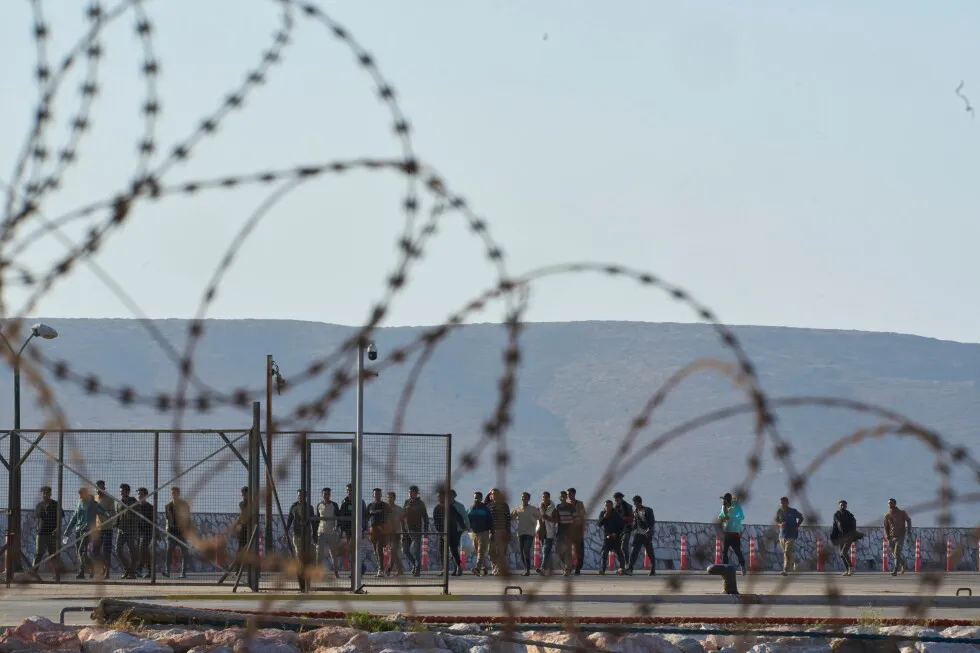
What to know about the EU’s new rules on migration and asylum as they come into effect 1 of 3 | Migrants rescued south of Crete walk after their arrival at the the port of Lavrio, Greece, on July 10, 2025. (AP Photo/Petros Giannakouris, File) 2 of 3 | A Federal Police officer escorts a group of migrants who illegally crossed the border from Poland into Germany during a patrol in a forest near Forst, southeast of Berlin, Germany, on Oct. 11, 2023. (AP Photo/Markus Schreiber, File) 3 of 3 | Frontex Contingent Commander Georgios Pyliaros takes pictures of Frontex officers from the Guardia di Finanza OPV Osum as they prepare in their speedboat to be lowered into the sea during a patrol in the Aegean Sea near Heraklion, Crete, Greece, Feb. 16, 2026. (AP Photo/Lefteris Pitarakis, File) By MENELAOS HADJICOSTIS, RENATA BRITO and SAM McNEIL Updated 7:08 AM MESZ, June 12, 2026 Add AP News on Google Add AP News as your preferred source to see more of our stories on Google. Share Share Facebook Copy Link copied Print Email X LinkedIn Bluesky Flipboard Pinterest Reddit BRUSSELS (AP) — The European Union is set to implement a new set of rules Friday governing how each of its 27 member states will deal with Irregular Migration and Asylum Seekers. The European Migration and Asylum Pact is the culmination of years of grueling negotiations that overhauled the previous system, which was widely considered a failure and gave far-right parties a potent issue to win votes. All EU members were meant to be prepared for Friday’s implementation by adapting laws, training staff and beefing up border infrastructure. But even the European Commission admits no member is completely ready. Human rights advocates warn the pact could add to the difficulties of Asylum Seekers face while trying to find safe haven in the EU. Under the new rules, foreigners will be screened at EU borders for up to seven days before they are admitted. Asylum Seekers from countries listed as “safe” by the EU or pose a “security threat” will go through faster asylum procedures of three months instead of six. Some applicants may be kept at the border while their cases are processed. They will be given only one chance to appeal a rejected application. Ahead of G7, Carney softens tone toward Trump with trade talks at stake 3 MIN READ Here’s how to avoid heat-related illnesses and stay cool this summer 2 MIN READ Europe’s central bank raises rates to fight inflation from Iran war, the Fed to decide next week 3 MIN READ The European Commission says some member states still need to implement a new biometric database called Eurodac that will register and store information of adults and children as young as 6. Many more countries need to set up border facilities to handle screening, asylum processing and detentions. Work also is needed to ensure there are independent rights monitoring at the border, the commission said. One of the pillars of the new pact is to speed up voluntary and forced returns of rejected Asylum Seekers by automatically issuing return orders when an application is rejected. A clear political priority of the center and far-right politicians who swept to power in 2024 across the EU, returnees are slated to be sent to countries deemed safe like Syria and Bangladesh. The European Agency for Asylum said there were about 802,000 pending first-time asylum applications in March. Member states also are working with EU lawmakers to allow for the creation of “return hubs” in third countries where they can send migrants who can’t be repatriated. Questions about deportation centers are being quietly negotiated between a group of five nations and potential partners abroad. Among the most contentious issues that has divided EU countries was sharing responsibility for Asylum Seekers, especially in times of crisis. Because migrants must apply for asylum in the first EU country they enter, front line countries along the Mediterranean like Greece and Italy have long complained they bear the weight of irregular arrivals. Citing their inability to cope under pressure, these countries allowed passage of many migrants to northern and western Europe without permission. This shifted some of the burden onto northern countries like Germany and Sweden that saw asylum applications soar to record levels, bringing their migration systems to the brink of collapse. The new pact includes a solidarity mechanism to ensure border countries aren’t left on their own. Other EU members will either take in a share of Asylum Seekers or offer financial support to compensate. Countries can also offset their share if they receive migrants through secondary movements, meaning when a migrant arrives in one country and moves on to another. But not all member states were happy with this solution. Poland for example suspended the right to asylum since early 2025 citing the weaponization of migration on its border with Belarus. Originally a temporary measure, it has been extending the suspension since. Hungary’s new prime minister Péter Magyar is continuing many of the hardline immigration policies of his predecessor, Viktor Orbán, including a refusal to take in migrants. But Magyar has said he would realign Hungary’s asylum procedures to avoid being fined 1 million euros daily for Orban’s policy that broke the bloc’s asylum rules. The commission has admitted work on implementing the pact will continue after June 12 since no country is fully ready. “It won’t be a like a light switch turning on on June 12,” said Susan Fratzke, a senior policy analyst with the Migration Policy Institute. “Some of these things will take time.” The lack of clarity and consistency is problematic, said Susanna Zanfrini, director of the International Rescue Committee’s Italy office. That ambiguity “creates uncertainty for both people seeking protection and the organizations supporting them at the very moment they most need clear information about their rights, options, and access to support to survive, recover and rebuild their lives,” she said. Human rights advocates have criticized the new rules, arguing they undermine the right to seek asylum by rushing assessments. They say accelerated procedures introduce racial profiling while denying international protection to applicants with legitimate claims, while also warning of an expected spike in prolonged detentions at EU borders. Judith Sunderland, senior refugee and migrant rights adviser at Human Rights Watch, said the new pact “slams the door in the face of people who deserve to be treated with dignity and to have a fair hearing of their claims for protection.” Lukas Gehrke, the Brussels chief for the International Organization For Migration, said regardless of how many people are sent out of the EU, many migrants will remain while losing integration funding under the new budget for the pact. “If we under focus on this, the failure of integration becomes a self-fulfilling prophecy,” he said. Hadjicostis reported from Nicosia, Cyprus, and Brito reported from Barcelona, Spain. Claudia Ciobanu in Warsaw, Poland, contributed to this report. MENELAOS HADJICOSTIS Hadjicostis covers a challenging and ever-evolving region where the interests of Europe and the Middle East, West and East intersect with consequences that reverberate globally. He is based in Cyprus. twitter instagram mailto RENATA BRITO Brito leads international migration coverage for The Associated Press. She is based out of Barcelona, Spain. twitter instagram mailto SAM McNEIL McNeil covers Europe and beyond with a focus on conflict and the environment. twitter instagram facebook mailto
SRCAssociated Press (AP)
LANGEN
LEANCenter
WORDS1 231
ENT12
FRI · 2026-06-12 · 06:23 GMTBRIEF NSR-2026-0612-83804
NSR-2026-0612-83804News Report·EN·Legal & Judicial
What to know about the EU’s new rules on migration and asylum as they come into effect
The European Union is implementing a new Migration and Asylum Pact on Friday, overhauling its previous system for handling irregular migration and asylum seekers. The pact introduces faster border screening procedures, allowing for up to seven days of screening and expedited asylum processes for those from "safe" countries or deemed security threats.
Associated Press (AP)Filed 2026-06-12 · 06:23 GMTLean · CenterRead · 5 min
Associated Press (AP)FIG 01
Reading time
5min
Word count
1 231words
Sources cited
2cited
Entities identified
12entities
Quality score
100%
§ 01
Briefing Summary
AI-generatedNEWSAR · AI
The European Union is implementing a new Migration and Asylum Pact on Friday, overhauling its previous system for handling irregular migration and asylum seekers. The pact introduces faster border screening procedures, allowing for up to seven days of screening and expedited asylum processes for those from "safe" countries or deemed security threats. It also aims to speed up the return of rejected asylum seekers and includes a solidarity mechanism for sharing the burden among member states, through relocation or financial contributions. However, EU member states are not fully prepared for implementation, and human rights advocates express concerns that the new rules could hinder asylum seekers' access to protection and lead to increased detentions. The pact is the result of years of negotiations and aims to address a system previously considered a failure.
Confidence 0.90Sources 2Claims 5Entities 12
§ 02
Article analysis
Model · rule-basedFraming
Legal & Judicial
Political Strategy
Tone
Measured
AI-assessed
CalmNeutralAlarmist
Factuality
0.80 / 1.00
Factual
LowHigh
Sources cited
2
Limited
FewMany
§ 03
Key claims
5 extracted01
The European Union is implementing new rules on migration and asylum on Friday, June 14, 2026.
factual
Confidence
1.00
02
The European Commission admits no EU member state is completely ready for the pact's implementation.
quoteEuropean Commission
Confidence
0.90
03
Under the new rules, asylum seekers from 'safe' countries or those posing a security threat will undergo faster asylum procedures of three months.
factual
Confidence
0.90
04
Human rights advocates warn the pact could add to the difficulties of asylum seekers.
quotehuman rights advocates
Confidence
0.90
05
The new European Migration and Asylum Pact overhauls the previous system, which was widely considered a failure.
factual
Confidence
0.90
§ 04
Full report
5 min read · 1 231 words§ 05
Entities
12 identifiedKey playerOppositionContextPositiveNeutralNegative
Organizations4
Locations4
§ 06
Keywords & salience
10 termseu migration rules
1.00
asylum seekers
0.90
european migration and asylum pact
0.90
irregular migration
0.80
border screening
0.70
eu member states
0.60
human rights advocates
0.50
frontex
0.40
safe countries
0.40
appeal process
0.40
§ 07
Topic connections
Interactive graph Network visualization showing 51 related topics
View Full Graph Person Organization Location Event|Click node to navigate|Edge numbers = shared articles