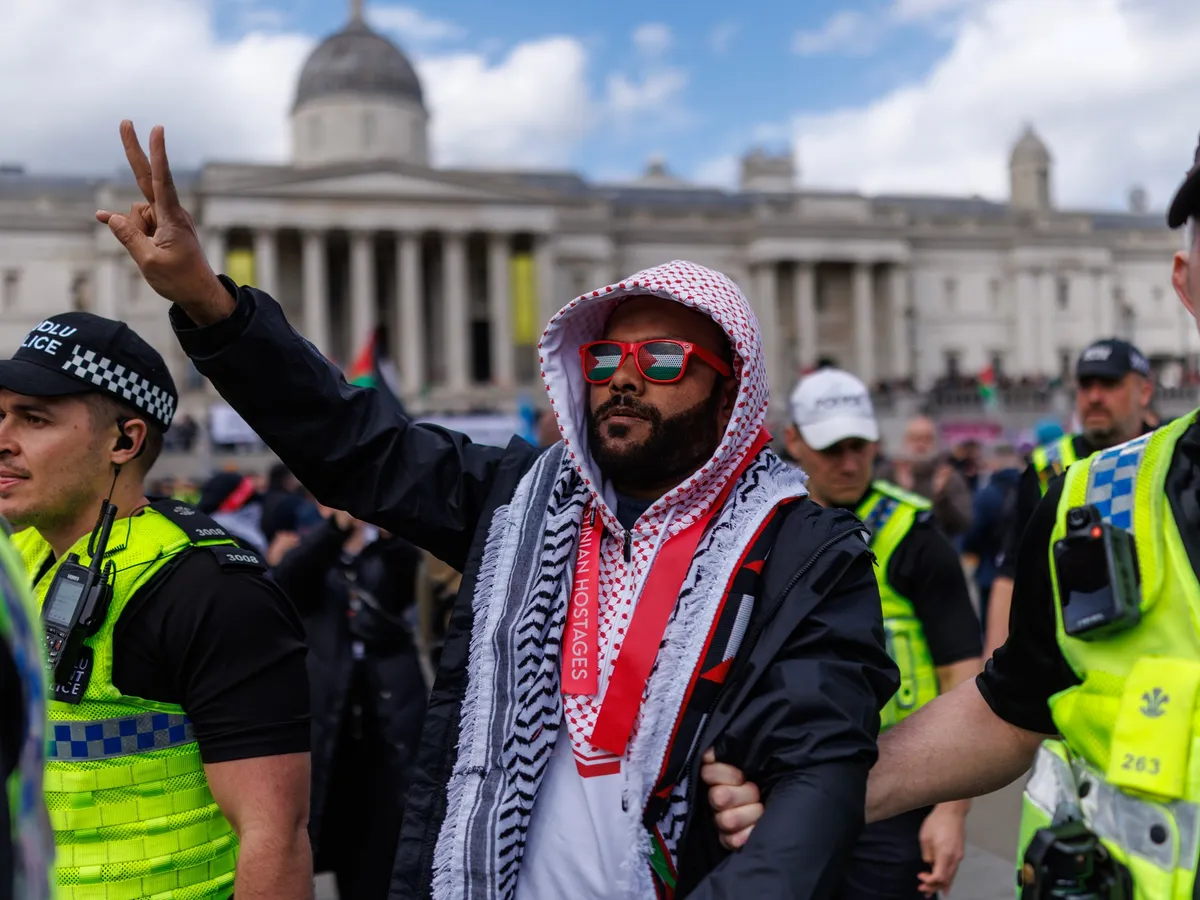
EXPLAINERCourt of Appeals to decide whether government’s proscription of action group was unlawful.Police make arrests at the 'Everyone Day' protest in London against the government's proscription of Palestine Action, April 11, 2026 [Dan Kitwood/Getty Images]Published On 14 Jun 2026The United Kingdom’s Court of Appeal is expected to rule on Monday whether the British government was right to proscribe the Palestine Action activist group as a “terrorist” organisation.Palestine Action was formally proscribed by the UK last July. A court in London ruled earlier this month that four activists convicted of criminal damage at a British facility owned by an Israeli weapons group would be sentenced on the basis that their actions had a “terrorist connection”.Recommended Stories list of 4 itemslist 1 of 4‘Torture isn’t new to Palestinians’: How Israel learned from colonialismlist 2 of 4UK court jails Palestine Action activists on ‘terrorism’ chargeslist 3 of 4UK court jails Palestine Action activists on ‘terrorism’ chargeslist 4 of 4‘Right to protest genocide’ denied: Scotland’s Palestine Action supportersend of listThe proscription of Palestine Action as a “terrorist” organisation has been challenged in the High Court, which ruled in February that the ban was unlawful. The government then appealed that decision.What is Palestine Action and why was it proscribed?Palestine Action is a British protest group which was founded six years ago and describes itself as a movement “committed to ending global participation in Israel’s genocidal and apartheid regime”.It says it uses “disruptive tactics” to target “corporate enablers” and companies involved in the manufacture of weapons for Israel, such as Israeli group Elbit Systems, Italian aerospace company Leonardo, French multinational Thales and Teledyne from the United States. The group has targeted British facilities linked to those companies.In all, British police have said action by the group has resulted in millions of pounds of criminal damage.Palestine Action’s protests include: In 2021, members protested for six days on the roof of Elbit Systems’ subsidiary, UAV Tactical Systems in Leicester, until some were arrested by police. In 2022, the group broke into a Thales equipment factory in Glasgow, causing damage to weapons worth more than a million pounds ($1.3m). In 2024, 10 months into Israel’s genocidal war on Gaza, Palestine Action activists broke into an Elbit Systems UK facility near Bristol in southwest England, causing another million pounds of damage. On June 20, 2025, Palestine Action activists broke into the Royal Air Force base at Brize Norton in Oxfordshire and sprayed two military aircraft with red paint. Days after the Brize Norton attack, members of parliament voted in favour of proscribing the group. That classified Palestine Action as a “terrorist” organisation, bringing it into the same category as armed groups such as al-Qaeda and ISIL (ISIS).Critics decried the vote, arguing that while members of the group have caused damage to property, they have not committed violent acts that amount to terrorism.More than 130 high-profile public figures have spoken out against the proscription.At least 1,600 arrests linked to support for Palestine Action were made in the three months following the ban.What is Monday’s Court of Appeal judgment about?Last August, Palestine Action’s co-founder, Huda Ammori, challenged the government’s proscription in the High Court. In November, the High Court heard a three‑day judicial review.In February, the High Court ruled that the government’s “terror group” ban was unlawful and disproportionate.The government immediately said it would appeal. “I am disappointed by the court’s decision and disagree with the notion that banning this terrorist organisation is disproportionate,” Home Secretary Shabana Mahmood said.“I intend to fight this judgment in the Court of Appeal.”Although the High Court found the ban unlawful, the proscription remains in force, pending the outcome of the government’s appeal at the Court of Appeal on Monday.Palestine Action protesters at the Royal Court of Justice in London, April 28, 2026 [Kin Cheung/AP]What is the broader context?Four activists from the Palestine Action group were sentenced as “terrorists” on Friday, despite most of them only being convicted of criminal damage by a jury in May.Dozens of protesters were arrested outside Woolwich Crown Court in London ahead of the sentencing of the four members of the group – Charlotte Head, 30, Samuel Corner, 23, Leona Kamio, 30, and Fatema Zainab Rajwani, 21 – for causing criminal damage at the Elbit Systems facility in Filton, near Bristol in west England.Corner was also found guilty of striking a police officer with a sledgehammer and convicted of inflicting grievous bodily harm.While the convictions are for criminal damage, the court had leeway to decide whether their actions were related to “terrorism”, which carries heavier penalties.Judge Jeremy Johnson handed down sentences of about five to eight years to the four defendants after branding their August 2024 raid on the Elbit Systems site in Bristol a “terrorist act”.Having their convictions linked to “terrorism” means the activists will have to serve their entire sentences in prison, unless they have already completed at least two‑thirds of their sentences and a parole board decides they can be released.Samuel was jailed for seven years and eight months, Charlotte was sentenced to five years, along with Leona, while Fatema was ordered to serve four years and eight months in prison.They will be recorded as “terrorists” for the rest of their lives, will be required to register new mobile devices, email addresses and bank accounts with the police for their lifetime, and face being returned to prison if they breach their licence conditions or reoffend.Amnesty International said the sentencing was “completely disproportionate”.The organisation’s UK chief executive, Kerry Moscogiuri, said: “Today’s sentencing hearing risks marking a new low in the ongoing crackdown against protest across the UK. Criminal damage has never been treated as terrorism within the UK justice system before, and it is completely disproportionate to do so because the offence occurred at a protest.”“The use of terrorism laws to suppress direct action protesters sets a dangerous precedent for our fundamental rights in this country and must come to an end.”On Wednesday, ahead of the sentencing, a group of more than 50 lawyers and law professors published an open letter denouncing potential plans to sentence the four Palestine Action members as terrorists.The letter highlights that damage to property has been a recurring feature of protest campaigns from the Suffragettes who fought for women to have the right to vote a century ago, to the modern environmental protest group Extinction Rebellion.“It has never previously even been suggested that those taking such action should be treated as terrorists. Blurring the distinction between principled direct action and terrorism is the hallmark of authoritarian regimes,” the open letter stated.The letter has been signed by law professors from universities in the UK, the Netherlands, Norway and Canada as well as by dozens of practising barristers and solicitors.
SRCAl Jazeera
LANGEN
LEANCenter
WORDS1 113
ENT12
SUN · 2026-06-14 · 08:34 GMTBRIEF NSR-2026-0614-84280
NSR-2026-0614-84280News Report·EN·Legal & Judicial
UK court to rule on Palestine Action ‘terrorist’ label: What we know
The UK's Court of Appeal is set to rule on whether the government's decision to proscribe Palestine Action as a "terrorist" organization was unlawful. The activist group, founded six years ago, targets companies involved in supplying weapons to Israel, causing millions of pounds in criminal damage to British facilities.
Sarah ShamimAl JazeeraFiled 2026-06-14 · 08:34 GMTLean · CenterRead · 5 min
Al JazeeraFIG 01
Reading time
5min
Word count
1 113words
Sources cited
0cited
Entities identified
12entities
Quality score
100%
§ 01
Briefing Summary
AI-generatedNEWSAR · AI
The UK's Court of Appeal is set to rule on whether the government's decision to proscribe Palestine Action as a "terrorist" organization was unlawful. The activist group, founded six years ago, targets companies involved in supplying weapons to Israel, causing millions of pounds in criminal damage to British facilities. In February, the High Court ruled the ban unlawful and disproportionate, a decision the government appealed. This ruling comes as four Palestine Action activists were sentenced with a "terrorist connection" for criminal damage, despite convictions primarily for property offenses. The proscription, which classifies the group alongside organizations like al-Qaeda, remains in effect pending the Court of Appeal's judgment.
Confidence 0.90Claims 5Entities 12
§ 02
Article analysis
Model · rule-basedFraming
Legal & Judicial
Social Justice
Tone
Measured
AI-assessed
CalmNeutralAlarmist
Factuality
0.70 / 1.00
Factual
LowHigh
Sources cited
0
No named sources
FewMany
§ 03
Key claims
5 extracted01
The High Court previously ruled the ban on Palestine Action was unlawful, a decision the government appealed.
factual
Confidence
1.00
02
Palestine Action describes itself as a movement committed to ending global participation in Israel’s genocidal and apartheid regime.
quotePalestine Action
Confidence
1.00
03
The UK's Court of Appeal will rule on whether the government's proscription of Palestine Action as a 'terrorist' organisation was lawful.
factual
Confidence
1.00
04
Palestine Action activists caused over a million pounds of damage to weapons at a Thales factory in Glasgow in 2022.
factual
Confidence
0.90
05
British police state action by Palestine Action has resulted in millions of pounds of criminal damage.
statisticBritish police
Confidence
0.90
§ 04
Full report
5 min read · 1 113 words§ 05
Entities
12 identifiedKey playerOppositionContextPositiveNeutralNegative
Organizations7
Locations4
§ 06
Keywords & salience
9 termspalestine action
1.00
terrorist label
0.90
court of appeal
0.80
proscription
0.70
activist group
0.60
israeli weapons
0.50
criminal damage
0.50
protest
0.40
disruptive tactics
0.40
§ 07
Topic connections
Interactive graph Network visualization showing 42 related topics
View Full Graph Person Organization Location Event|Click node to navigate|Edge numbers = shared articles