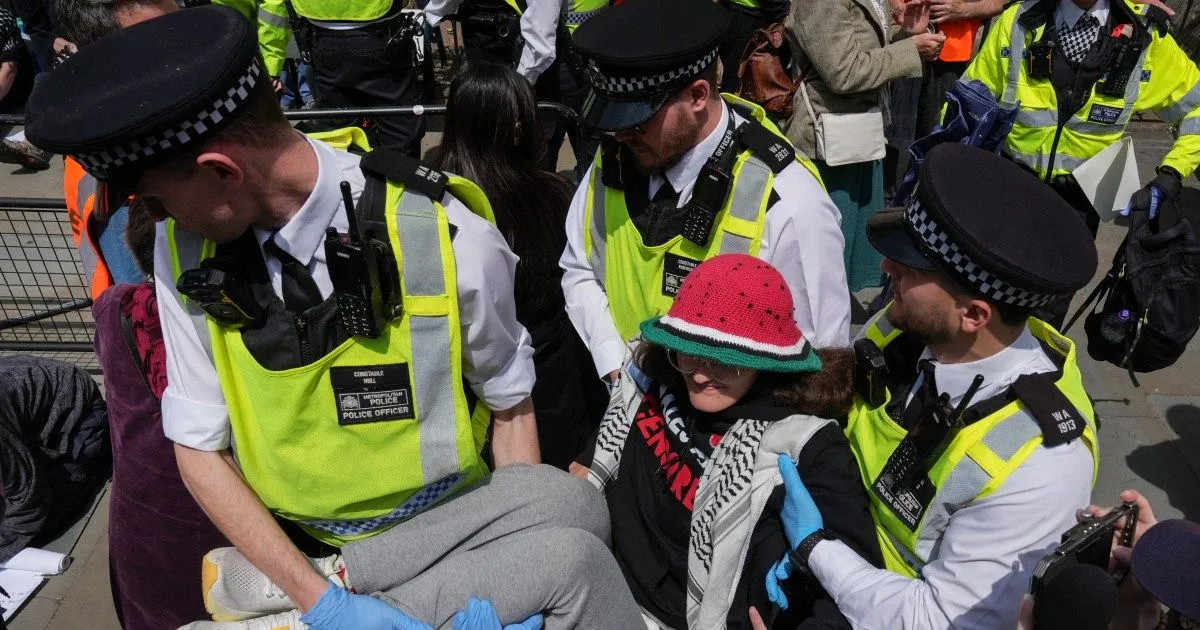
EXPLAINERThe UK Court of Appeals ruled that Britain was right to proscribe Palestine Action – what happens next?Published On 15 Jun 2026The United Kingdom’s Court of Appeal has ruled that the British government was right to proscribe the Palestine Action activist group as a “terrorist” organisation last year.Palestine Action is a British protest group which was founded six years ago and describes itself as a movement “committed to ending global participation in Israel’s genocidal and apartheid regime”.On Monday, police made more arrests of protesters demonstrating in support of Palestine Action outside the Court of Appeal in London.Since the group’s proscription, which also bans support for proscribed groups, about 3,000 people have been arrested.The Metropolitan Police welcomed the ruling and said it would continue to arrest those who protest in support of the group.Here is what we know about the ruling:What has the Court of Appeal ruled?The judgement released on Monday states: “The proscription of an organisation like Palestine Action is highly controversial. But it is a fundamental mistake to overlook the fact that Palestine Action overtly promotes unlawful violence amounting to terrorism”.The ruling was made by a five-strong panel, including the two most senior judges in England and Wales.Palestine Action, which was formally proscribed by the UK last July, is a British protest group founded six years ago. It says it uses “disruptive tactics” to target “corporate enablers” and companies involved in the manufacture of weapons for Israel, such as Israeli group Elbit Systems, Italian aerospace company Leonardo, French multinational Thales and Teledyne from the United States. The group has targeted British facilities linked to those companies.In all, British police say action by the group has resulted in millions of pounds of criminal damage.A court in London ruled on June 12 that four Palestine Action members convicted of criminal damage at a British facility owned by Israeli weapons group Elbit Systems near Bristol, west England, would be sentenced on the basis that their actions had a “terrorist connection”.Why was this case brought?Following the proscription of Palestine Action last year, the group’s co-founder, Huda Ammori, challenged the decision in the High Court. In February, the High Court ruled that the government’s “terror group” ban was unlawful and disproportionate.The government immediately said it would appeal. “I am disappointed by the court’s decision and disagree with the notion that banning this terrorist organisation is disproportionate,” Home Secretary Shabana Mahmood said.The judgement on Monday agreed with her. Its ruling states: “The Home Secretary had the institutional competence and the democratic accountability to make the decision. The Proscription Decision was consistent with the Home Secretary’s Proscription Policy and was proportionate. It was not unlawful.”Why did the UK proscribe Palestine Action?On June 20, 2025, Palestine Action activists broke into the Royal Air Force base at Brize Norton in Oxfordshire and sprayed two military aircraft with red paint.Days after the Brize Norton attack, members of parliament voted in favour of proscribing the group. That classified Palestine Action as a “terrorist” organisation, bringing it into the same category as armed groups such as al-Qaeda and ISIL (ISIS).Critics decried the vote, arguing that while members of the group have caused damage to property, they have not committed violent acts that amount to terrorism. More than 130 high-profile public figures have spoken out against the proscription.Other previous actions the group has taken include: In 2021, members protested for six days on the roof of Elbit Systems’ subsidiary, UAV Tactical Systems in Leicester, until some were arrested by police. In 2022, the group broke into a Thales equipment factory in Glasgow, causing damage to weapons worth more than a million pounds ($1.3m). In 2024, 10 months into Israel’s genocidal war on Gaza, Palestine Action activists broke into an Elbit Systems UK facility near Bristol in southwest England, causing another million pounds of damage. How has Palestine Action responded to the ruling?In a statement read by a representative following the ruling, Palestine Action’s Ammori said the group will challenge the judgement in the UK’s Supreme Court.“We will fight this all the way. We will seek permission to appeal to the Supreme Court and, if need be, take this to the European Court of Human Rights,” Ammori said.The European Court of Human Rights (ECHR), established by the Council of Europe, allows individuals to hold member states accountable for rights violations through a dedicated court. When the ECHR finds a violation, its judgements are legally binding on the state concerned under the European Convention on Human Rights.“We will not stop fighting to overturn one of the most extreme attacks on free speech and the right to protest in modern British history,” Ammori added.“This unprecedented abuse of power has devastated the lives of thousands of people while silencing dissent over Israel’s slaughter of the Palestinian people during the genocide, when that dissent could not be more urgent.”How have others reacted to the ruling?Anas Mustapha, Head of Public Advocacy at CAGE International, said: “This ruling tells us exactly what these powers are for. They are not safeguards against violence, they are authoritarian tools for crushing dissent.”Mustapha added: “No ruling from any court is going to convince people that their conscience is wrong, and no amount of legislation will make support for Palestine disappear. The only sustainable outcome is the abolition of these laws in their entirety.”Thomas Bell, acting UK Director of Human Rights Watch, said: “This disastrous decision further cements the UK’s place among countries that are backsliding on human rights by classifying acts of protest as terrorism.”“When Palestine Action members have committed criminal damage, that should be dealt with under normal criminal laws, not by misusing overbroad and poorly defined terrorism powers. Defining a protest group as terrorists has created an absurd situation where thousands of people peacefully holding up signs have been arrested,” Bell added.
SRCAl Jazeera
LANGEN
LEANCenter
WORDS961
ENT12
MON · 2026-06-15 · 13:46 GMTBRIEF NSR-2026-0615-84591
NSR-2026-0615-84591News Report·EN·Legal & Judicial
What a UK court’s backing of the Palestine Action ‘terror’ ban means
The UK Court of Appeal has upheld the government's decision to proscribe Palestine Action as a terrorist organization. The ruling, made on June 15, 2026, found that the group overtly promotes unlawful violence amounting to terrorism.
Sarah ShamimAl JazeeraFiled 2026-06-15 · 13:46 GMTLean · CenterRead · 4 min
Al JazeeraFIG 01
Reading time
4min
Word count
961words
Sources cited
3cited
Entities identified
12entities
Quality score
100%
§ 01
Briefing Summary
AI-generatedNEWSAR · AI
The UK Court of Appeal has upheld the government's decision to proscribe Palestine Action as a terrorist organization. The ruling, made on June 15, 2026, found that the group overtly promotes unlawful violence amounting to terrorism. Palestine Action, founded six years ago, targets companies involved in manufacturing weapons for Israel, leading to millions of pounds in criminal damage, according to British police. The group's co-founder had challenged the proscription, arguing it was unlawful and disproportionate, but the Court of Appeal disagreed, stating the Home Secretary had the competence and accountability to make the decision. Palestine Action intends to challenge the judgment in the UK's Supreme Court and potentially the European Court of Human Rights.
Confidence 0.90Sources 3Claims 5Entities 12
§ 02
Article analysis
Model · rule-basedFraming
Legal & Judicial
Political Strategy
Tone
Measured
AI-assessed
CalmNeutralAlarmist
Factuality
0.80 / 1.00
Factual
LowHigh
Sources cited
3
Well sourced
FewMany
§ 03
Key claims
5 extracted01
The Court of Appeal stated Palestine Action 'overtly promotes unlawful violence amounting to terrorism'.
quoteUK Court of Appeal
Confidence
1.00
02
The High Court had previously ruled the government's 'terror group' ban unlawful and disproportionate.
factualHigh Court
Confidence
1.00
03
Palestine Action describes itself as a movement 'committed to ending global participation in Israel’s genocidal and apartheid regime'.
quotePalestine Action
Confidence
1.00
04
UK Court of Appeal ruled the British government was right to proscribe Palestine Action as a 'terrorist' organisation.
factualUK Court of Appeal
Confidence
1.00
05
British police state action by the group has resulted in millions of pounds of criminal damage.
statisticMetropolitan Police
Confidence
0.90
§ 04
Full report
4 min read · 961 words§ 05
Entities
12 identifiedKey playerOppositionContextPositiveNeutralNegative
Organizations8
§ 06
Keywords & salience
9 termspalestine action
1.00
terrorist organization
0.90
uk court of appeal
0.80
proscription
0.70
activist group
0.60
criminal damage
0.50
unlawful violence
0.50
israel
0.40
elbit systems
0.40
§ 07
Topic connections
Interactive graph Network visualization showing 42 related topics
View Full Graph Person Organization Location Event|Click node to navigate|Edge numbers = shared articles