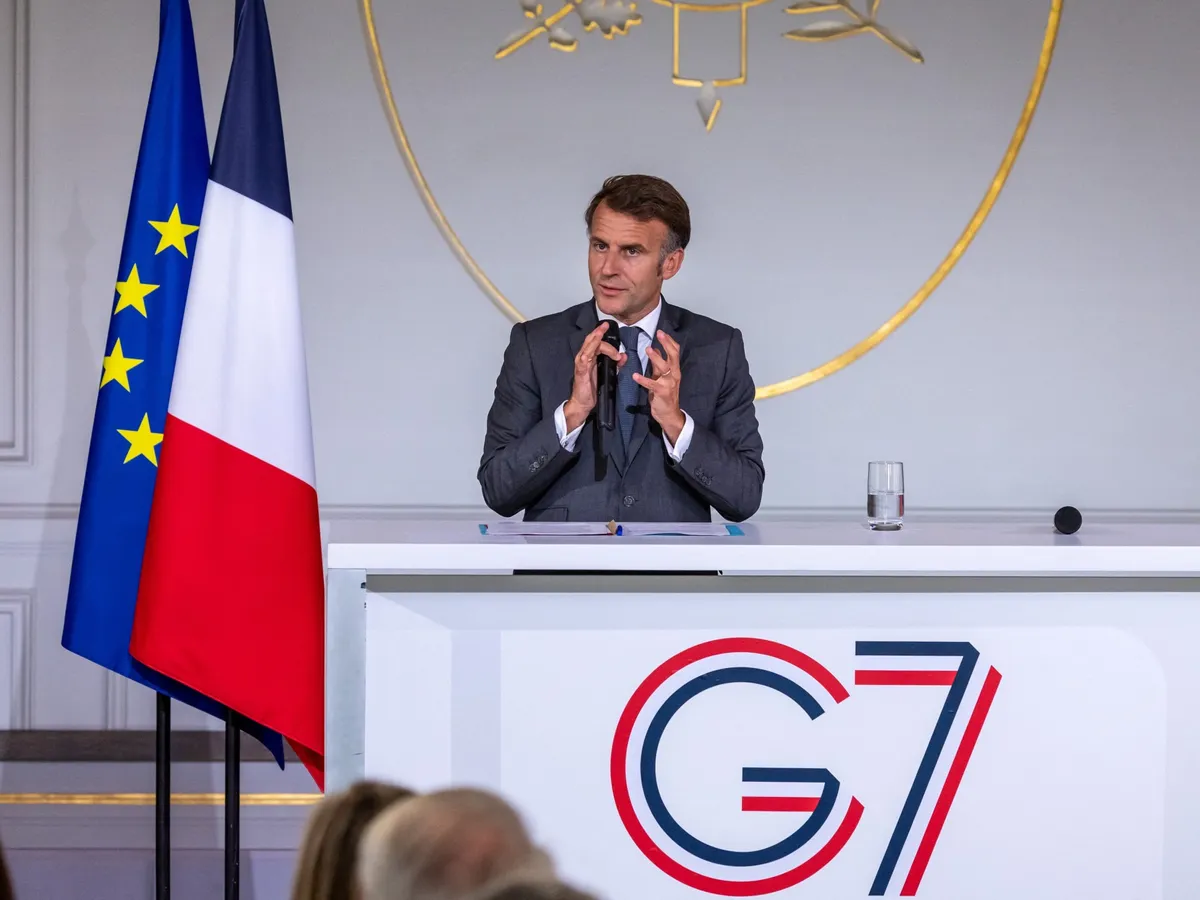
EXPLAINERThe war in Iran, Ukraine and economic challenges are expected to be a key part of the agenda.French President Emmanuel Macron speaks during a meeting with leaders of the Engagement Groups involved in the G7 on social and economic issues at the Elysee Palace in Paris [Christophe Petit Tesson/Pool/Reuters]Published On 15 Jun 2026The Ukraine war, trade tensions and the Iran-US conflict will be on the agenda as leaders of the Group of Seven (G7) countries are set to meet on Monday in the French town of Evian-les-Bains.United States President Donald Trump will join fellow world leaders at the summit after announcing a tentative deal with Iran to end the war.Recommended Stories list of 3 itemslist 1 of 3Are Iran, US really close to a breakthrough ‘deal’?list 2 of 3Ukraine to keep targeting Russian energy after hitting sea terminallist 3 of 3‘A global rupture’: Carney calls for Canada-EU unity before G7 summitend of listFrance holds the rotating presidency of the G7 nations, comprising Canada, France, Germany, Italy, Japan, the United Kingdom and the US. The summit this year comes amid Russia’s ongoing war in Ukraine and the Middle East conflict.Who is attending the summit and what is on the agenda? Here’s what we know:Who is attending the summit this year?Besides leaders of the G7 countries and the European Union, which is also represented at the summit, French President Emmanuel Macron has invited several heads of state from non-G7 countries as guests.These include Indian Prime Minister Narendra Modi, Ukraine’s President Volodymyr Zelenskyy, Egyptian President Abdel Fattah el-Sisi, Saudi Crown Prince Mohammed bin Salman and Qatari Emir Sheikh Tamim bin Hamad Al Thani. While the leaders of India, Ukraine, Egypt and Qatar have confirmed their attendance, it is unclear if the Saudi crown prince will be attending this year’s summit.Leaders of Australia, Brazil, Kenya and South Korea are also attending.Meanwhile, in March, South Africa announced that it had been disinvited from this year’s summit after initially being invited. South Africa’s ties with the US, one of its biggest trading partners, have deteriorated over its stand on the Israeli genocide in Gaza and the treatment of the white minority in the country – an issue Trump has raised multiple times, including during his meeting with South African President Cyril Ramaphosa at the White House last May.The Trump administration has heaped pressure on South Africa, claiming it tacitly supports the persecution of white Afrikaner farmers in the country. But the US claims have not been backed by facts. Ramaphosa has rejected these claims. White Africans, who are less than 10 percent of the country’s population, own more than 70 percent of the land.Besides world leaders, AI executives from Anthropic, OpenAI, Google and Mistral AI are expected to attend, officials from France – who are crafting an agenda aimed at discussing the world’s crises and broad economic challenges – told the Reuters news agency.(Al Jazeera)What is on the agenda?During the two-day summit in the French town, leaders are expected to discuss the situation in Ukraine and Iran, as well as world economic challenges.UkraineAs Russia’s war on Ukraine continues to rage, Trump, who has been trying to bring Moscow and Kyiv to the negotiating table, is expected to meet Ukraine’s President Volodymyr Zelenskyy and G7 leaders for discussions.One senior US official told reporters the US wants “the war to end as quickly as possible”.Meanwhile, European diplomats see the summit as an opportunity to convince Trump that US proposals for a deal have been too favourable to Moscow. European nations also want to signal that they are willing to engage Moscow, while tightening sanctions and boosting military support for Ukraine.“What we are increasingly seeing is Europeans beginning to think about a life with less America,” Victor Cha, head of geopolitics and foreign policy at Washington’s Center for Strategic and International Studies, told Reuters.IranBesides Ukraine, leaders are also expected to discuss the next steps on Iran and other pressing issues facing the world.Many G7 leaders have been directly impacted by Trump’s tariff wars and his decision to join Israel in attacking Iran, which sent oil prices soaring and caused a geopolitical headache for the world. His unilateral actions have led to larger questions about the US commitment to a rules-based world order.Trump will be greeted on Monday by Macron and is expected to meet separately with the leaders of Egypt, Qatar, the United Arab Emirates and India.TradeTrade and economic growth are also expected to be part of the agenda. Last year, Trump imposed broad tariffs on every member of the G7, as well as on most other countries around the world, prompting a global trade war. While the US Supreme Court struck down the tariffs in February this year, in June, the Trump administration has threatened tariffs of between 10 percent and 12.5 percent on 60 trading partners, including India, the UK, the EU and Australia, over alleged forced labour failures.Trade and tariffs will be a key part of the discussion when Trump meets India’s Prime Minister Modi.China, the world’s second-largest economy, will not be in attendance at the gathering. But leaders will discuss issues, including Beijing’s dominance and control in the market for rare earth minerals used in everyday electronic appliances.According to Reuters, France has framed the issue of macro-economic imbalances as a shared responsibility in that China overproduces, the US over-consumes, and Europe underinvests.Brazil, India, Kenya and South Korea will join this discussion, while Macron has urged China to boost its consumption.
SRCAl Jazeera
LANGEN
LEANCenter
WORDS905
ENT12
MON · 2026-06-15 · 08:40 GMTBRIEF NSR-2026-0615-84548
NSR-2026-0615-84548News Report·EN·Diplomatic
G7 meeting in France: What’s on agenda, who is attending?
The G7 summit, hosted by France in Evian-les-Bains, will convene leaders from Canada, France, Germany, Italy, Japan, the United Kingdom, and the United States. Key agenda items include the ongoing war in Ukraine, economic challenges, and the conflict with Iran.
Al Jazeera StaffAl JazeeraFiled 2026-06-15 · 08:40 GMTLean · CenterRead · 4 min
Al JazeeraFIG 01
Reading time
4min
Word count
905words
Sources cited
3cited
Entities identified
12entities
Quality score
100%
§ 01
Briefing Summary
AI-generatedNEWSAR · AI
The G7 summit, hosted by France in Evian-les-Bains, will convene leaders from Canada, France, Germany, Italy, Japan, the United Kingdom, and the United States. Key agenda items include the ongoing war in Ukraine, economic challenges, and the conflict with Iran. US President Donald Trump, who has announced a tentative deal to end the war in Iran, will attend. Several non-G7 leaders, including the Prime Ministers of India and Ukraine, and the Presidents of Egypt and the EU, have been invited as guests. Discussions will focus on finding resolutions to these global crises and addressing broad economic issues, with European nations aiming to influence US proposals regarding Russia and Ukraine. The summit will also touch upon trade tensions, with the US having previously imposed tariffs on G7 members.
Confidence 0.90Sources 3Claims 5Entities 12
§ 02
Article analysis
Model · rule-basedFraming
Diplomatic
Conflict
Tone
Measured
AI-assessed
CalmNeutralAlarmist
Factuality
0.70 / 1.00
Factual
LowHigh
Sources cited
3
Well sourced
FewMany
§ 03
Key claims
5 extracted01
South Africa was disinvited from this year’s summit after initially being invited.
factual
Confidence
0.90
02
Leaders of India, Ukraine, Egypt and Qatar have confirmed their attendance at the G7 summit.
factual
Confidence
0.90
03
The war in Iran, Ukraine and economic challenges are expected to be a key part of the G7 agenda.
factual
Confidence
0.90
04
The US claims that South Africa tacitly supports the persecution of white Afrikaner farmers have not been backed by facts.
factual
Confidence
0.80
05
United States President Donald Trump will join fellow world leaders at the summit after announcing a tentative deal with Iran to end the war.
factual
Confidence
0.80
§ 04
Full report
4 min read · 905 words§ 05
Entities
12 identifiedKey playerOppositionContextPositiveNeutralNegative
People6
Organizations2
§ 06
Keywords & salience
9 termsg7 meeting
1.00
ukraine war
0.90
iran-us conflict
0.80
economic challenges
0.70
trade tensions
0.60
world leaders
0.50
french president
0.40
united states president
0.40
middle east conflict
0.40
§ 07
Topic connections
Interactive graph Network visualization showing 4 related topics
View Full Graph Person Organization Location Event|Click node to navigate|Edge numbers = shared articles