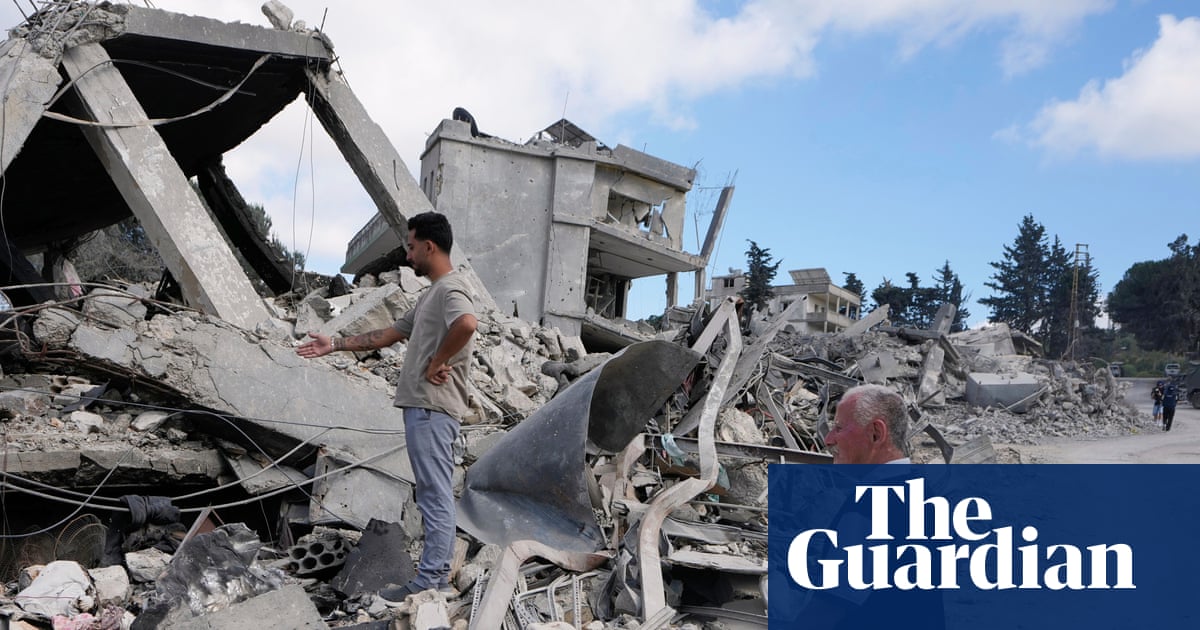
Hours after the US-Iran ceasefire was announced, residents of south Lebanon began to race back to their villages. One man filmed as he drove into the entrance of Harees, his arrival interrupted as the car in front of him suddenly veered off the road. An Israeli armoured vehicle was parked in the middle of the road less than 100 metres ahead; he scrambled to turn around.“It was packed with explosives. I guess they still want to blow things up,” said Abdullah al-Ali, a municipal official in Harees. Ali added that the entrance to the town was blocked off after two other explosive-laden vehicles left by the Israelis were discovered in the area.The Lebanese army and civil defence told people not to return to their villages, warning that the war, which had so far claimed almost 3,800 lives in Lebanon, was not yet over. Their point was punctuated by the Israeli shelling that met people attempting to return to their homes south of the city of Nabatieh, still occupied by Israeli soldiers.It was the third ceasefire declared in Lebanon in less than two months; the fourth in two years. This time, war-weary Lebanese did not greet the apparent truce as they had before, with fingers held up in a V for victory sign, but with a question. Would it last?“How many times has this happened before? I have mixed feelings, there’s joy, I’m excited. But there’s a fear in the back of my head that won’t go away,” said Ghia Hajo, a 25-year-old woman who had been displaced from the town of Abbasieh, just outside of the southern Lebanese city of Tyre, during the war.Hajo watched on her phone as videos came in from friends and social media of the long-awaited return to their villages in south Lebanon. She itched to see her own home, which, due to sheer luck, was still standing. But she did not want to return only to be displaced once again – or worse, be met with bombs.“We want to go and not have to leave our bags unpacked. Because we always had our clothes in our bag, ready to evacuate at any moment. We want to be 100% sure,” said Hajo, who was mulling a return once she was assured the situation was safe in Abbasieh.Lebanon’s officials welcomed the ceasefire, which came about on the heels of a greater US-Iran truce they had been informed of via news reports. How it would apply in Lebanon remained unclear.In the hours after the ceasefire was announced, Hezbollah’s attacks entirely stopped; Israeli strikes mostly stopped, with the exception of shelling and two drone strikes on residents who neared villages close to its troops. Israel’s defence minister, Israel Katz, said that Israeli troops would not withdraw from the “security zone” in south Lebanon, an area that was declared by its military to include at least 600 sq km (231 sq miles) along the border and in recent weeks had crept up farther north to include the outskirts of Nabatieh.Israel further said that it reserved the right to respond to any Hezbollah attacks, while other officials suggested it retained freedom of movement in Lebanon. Under previous ceasefires in Lebanon, Israel continued to carry out airstrikes in the south of the country at will. Hezbollah said in a statement on Monday that it would not allow this scenario to repeat. Its warnings were backed by Tehran, which had shown that it would not hesitate to strike Israel if it felt red lines in Lebanon were crossed.The fundamental issues which drew Israel and Hezbollah into war remained unsolved. The current round of conflict started when Hezbollah launched rockets at Israel on 2 March in retaliation for the killing of the then Iranian supreme leader, Ayatollah Ali Khamenei. Israel invaded, stating at first that its aim was to destroy Hezbollah, then just to disarm it. It achieved neither.As the day continued, the trickle of cars heading south on Lebanon’s highways grew to a flood. Residents wanted to return to check on their homes, even if only for one day. For some, the act of return was enough; the call to prayer echoed from a minaret and filled the town of al-Sultaniyeh, which for weeks had only heard the sound of explosions.For others, return confirmed their worst fears. One man found his family home flattened by a bomb in the town of Seddiqine. “My house is gone,” was all he managed to choke out. Why or when it was destroyed he did not know – his family’s prolonged displacement had robbed him of an explanation.The war, which lasted just over 100 days, left thousands of homes and shops destroyed, dozens of villages occupied and flattened, more than a million displaced and thousands dead. The question of reconstruction, both material and spiritual, was not yet on the table as it was unclear if the war was really over.To those residents whose homes lay in villages still occupied, many of which were demolished by the Israelis, the war would not end until their land was free.“We miss our villages, but our dear villages became a sorry sight, bulldozed, destroyed systematically,” said Ahmad Abu Taan, a 56-year-old construction supply shop owner from Taybeh, a village destroyed by the Israelis. “But we will return, hopefully, under a deal, under a truce. And when we do, then I’ll tell you how I feel,” he said over the phone, the buzz of an Israeli drone overhead punctuating his speech.
SRCThe Guardian - World News
LANGEN
LEANCenter-Left
WORDS909
ENT12
MON · 2026-06-15 · 15:16 GMTBRIEF NSR-2026-0615-84632
NSR-2026-0615-84632News Report·EN·Human Interest
‘We want to be 100% sure’: war-weary Lebanese greet truce with caution
Following a US-Iran ceasefire announcement, residents of south Lebanon cautiously returned to their villages, many finding homes destroyed by Israeli forces. Despite officials welcoming the truce, many Lebanese expressed uncertainty about its duration, fearing further displacement or harm.
William Christou in BeirutThe Guardian - World NewsFiled 2026-06-15 · 15:16 GMTLean · Center-LeftRead · 4 min
The Guardian - World NewsFIG 01
Reading time
4min
Word count
909words
Sources cited
3cited
Entities identified
12entities
Quality score
100%
§ 01
Briefing Summary
AI-generatedNEWSAR · AI
Following a US-Iran ceasefire announcement, residents of south Lebanon cautiously returned to their villages, many finding homes destroyed by Israeli forces. Despite officials welcoming the truce, many Lebanese expressed uncertainty about its duration, fearing further displacement or harm. The Lebanese army and civil defense warned against immediate returns due to ongoing risks, including the discovery of explosive-laden vehicles left by Israeli forces. Israel stated its troops would not withdraw from the "security zone" and reserved the right to respond to Hezbollah attacks, while Hezbollah and Iran warned against repeated Israeli actions. The fundamental issues that initiated the conflict, which lasted over 100 days and caused widespread destruction and displacement, remained unresolved.
Confidence 0.90Sources 3Claims 5Entities 12
§ 02
Article analysis
Model · rule-basedFraming
Human Interest
Conflict
Tone
Mixed Tone
AI-assessed
CalmNeutralAlarmist
Factuality
0.70 / 1.00
Factual
LowHigh
Sources cited
3
Well sourced
FewMany
§ 03
Key claims
5 extracted01
Residents expressed caution and fear about the ceasefire's longevity, wanting to be '100% sure' it was safe.
quoteGhia Hajo
Confidence
1.00
02
Israeli troops will not withdraw from the 'security zone' in south Lebanon.
factualIsrael Katz
Confidence
0.90
03
The Lebanese army and civil defense warned people not to return due to ongoing conflict.
factualLebanese army and civil defence
Confidence
0.90
04
Explosive-laden vehicles were discovered at the entrance of Harees, blocking the road.
factualAbdullah al-Ali
Confidence
0.90
05
Residents of south Lebanon returned to their villages after a US-Iran ceasefire was announced.
factual
Confidence
0.90
§ 04
Full report
4 min read · 909 words§ 05
Entities
12 identifiedKey playerOppositionContextPositiveNeutralNegative
§ 06
Keywords & salience
8 termslebanese caution
1.00
us-iran ceasefire
0.90
return to villages
0.80
explosive devices
0.70
israeli shelling
0.70
war-weary residents
0.60
displaced persons
0.50
hezbollah attacks
0.40
§ 07
Topic connections
Interactive graph Network visualization showing 51 related topics
View Full Graph Person Organization Location Event|Click node to navigate|Edge numbers = shared articles