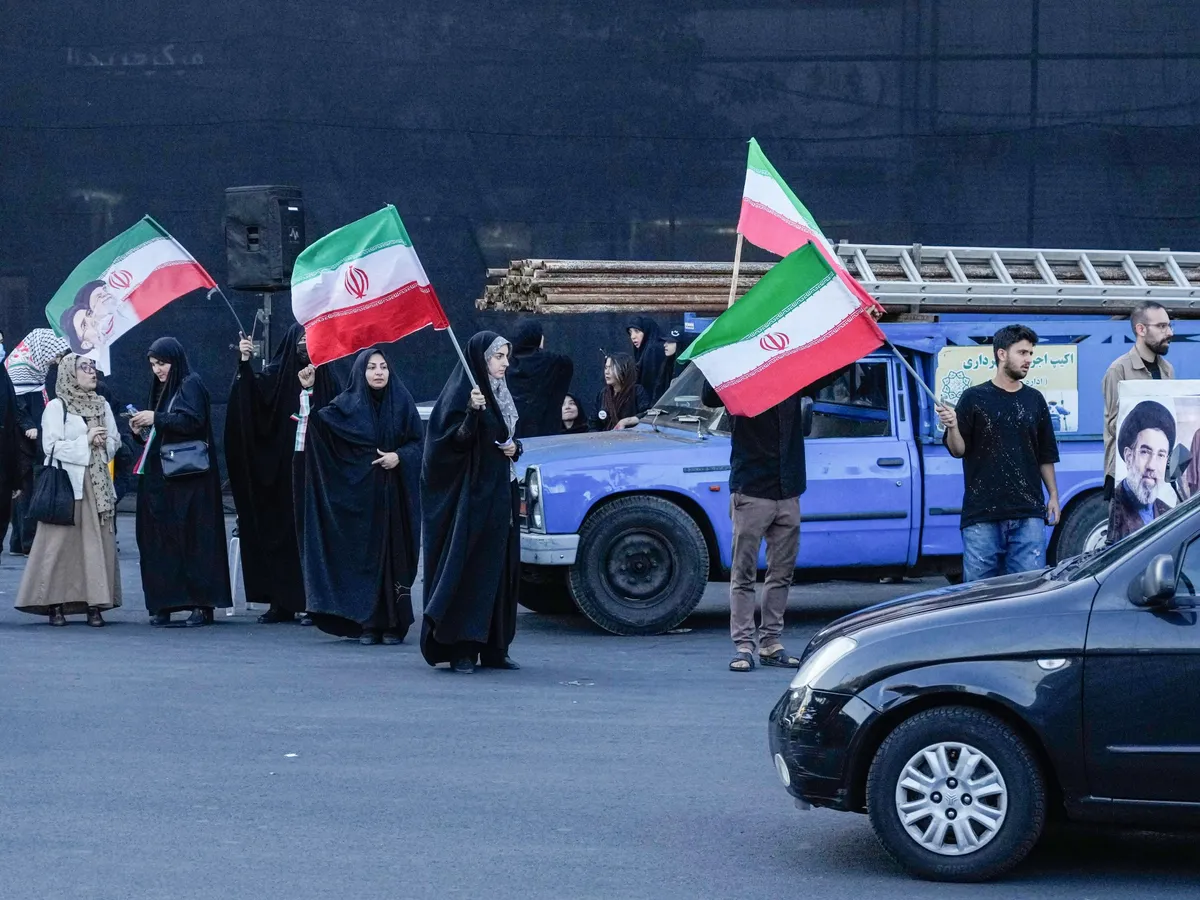
The US-Iran deal offers a potential path to a longer-term resolution that appears far off to many at present.Demonstrators wave Iranian flags in a small group gathering at the Revolution Square in Tehran, Iran, Sunday, June 14, 2026 [Vahid Salemi/AP Photo]Published On 15 Jun 2026Tehran, Iran – The world let out a collective sigh of relief when the United States and Iran announced that a memorandum of understanding had been agreed to end nearly four months of hostilities on Sunday. But on the streets of Tehran – exhausted by years of sanctions and tensions – the ceasefire announcement has done little to instill confidence that the crisis is over.An agreement between the two sides, to be signed on Friday, looks set to reopen the Strait of Hormuz, largely controlled by Iran since the war began on February 28, something it is hoped will stabilise rattled energy markets. In return, the US will lift a naval blockade on Iran’s southern ports, which has squeezed Iran’s already embattled economy.Many important and delicate issues still remain to be addressed, such as the future of Iran’s nuclear programme, US sanctions, and Tehran’s frozen assets. These will likely be deferred until a later date, leading to pessimism among many in Iran that a long-term resolution will ever be finalised.“I think the agreement doesn’t have huge benefits for the people because it won’t be really enforced in full to bring any stability to our lives,” said Parisa, a university student based in Tehran, who used just her first name for security reasons. “It might work for now, but both sides will jeopardise it based on their own interests.”Mehdi, another resident of the capital, said he is not optimistic that a ceasefire will hold long term due to the number of contested issues that still remain unresolved.“I don’t think that the US is willing to accept even the least of Iran’s demands,” he said.Iranians say that before a potential long-term deal is realised, harsh US and United Nations sanctions – which have made Iran poorer and isolated its businesses from global markets – will need to be lifted. There is the issue of the billions of dollars of frozen overseas Iranian assets and Tehran’s demand for a fee for ships to cross the Strait of Hormuz. The US and much of the world insist on toll-free passage through the waterway.A memorandum of understanding was reached despite recent exchanges of fire between Iran and the US, and Israeli opposition to the deal. Israel’s bombing of the Beirut suburbs on Sunday, which has been a red line for Tehran, threatened to disrupt work on the agreement and return the region to conflict.Preliminary details of the deal have also been frustrated by the stance of Iranian hardliners, who wanted the government to take a tougher stance during negotiations and will likely pick apart any perceived concessions.Iran held off on announcing the deal until after midnight local time into Monday, in an apparent attempt to ensure the news did not fall on US President Donald Trump’s birthday on Sunday. The time difference with the US still allowed Washington to announce the agreement on Sunday, as promised by Trump.On Monday in Tehran’s downtown Valiasr Square, authorities unveiled a giant black mural depicting slain Supreme Leader Ayatollah Ali Khamenei, who is slated to be buried in July and who regularly advocated distrust toward the US.During nightly gatherings of pro-state forces in city squares and streets across the country, many have lamented Iran’s failure to avenge the US for Khamenei’s February 28 killing and opposed any concessions to Washington. Some have heavily criticised the negotiating team and security officials.Others believe that the coming months will see a resumption of war, so Tehran must maintain the leverage it gained after more than 100 days of conflict with the US and Israel.“In my opinion, this agreement will not hold up; the US will violate it again. It’s better that we remain firm in our stance, for example, keep closing the Strait of Hormuz and not allow it to open,” a pro-government woman called Mohadese told Al Jazeera.Vessels sail at Suru Beach in Bandar Abbas, Iran on the Strait of Hormuz [Amirhossein Khorgooei/ISNA via AFP]The deal also includes halting military operations on all fronts, including in Lebanon, which Tehran has insisted should be covered by the agreement.Mohammad Bagher Zolghadr, secretary of Iran’s Supreme National Security Council, promised on Sunday night that “the response of the fighters of Islam is at hand” after Israel’s targeting of Beirut. But hours later, the top decision-making body confirmed that the agreement with the US, and no retaliation happened.Iranian media said Trump agreed to immediately lift the naval blockade, instead of over 30 days previously negotiated, in exchange for Iran halting any planned retaliatory attacks against Israel.Israel’s Prime Minister Benjamin Netanyahu is under fire from the opposition, who consider the deal a failure for the country. Defence Minister Israel Katz said the country has no plans to withdraw occupying troops from Lebanon, Syria or the Gaza Strip, and will forcefully retaliate if Iran attacks.The official text of the Iran-US agreement has not been published, but both sides are already attempting to frame the deal as a victory.Iranian state television, when announcing the agreement, said, “the US was forced to sign the understanding to end the war with the Islamic Republic and the axis of resistance”.In the meantime, Iranian markets have welcomed the prospect of an end of direct hostilities and the potential benefits that lifting the US blockade will have on the availability and price of imported goods.The national currency also strengthened on Monday for a third day since the start of the working week in Iran, changing hands for about 1.61 million rials per US dollar. It had hit an all-time low rate of about 1.9 million last month.The price of gold coins also continued to slide in Tehran on Monday, while the capital market also extended its run, with the index of the Tehran Stock Exchange reaching a new high of almost five million points by the end of trading on Monday. It is hoped that the end of the siege on Iranian ports, lifting of sanctions, and unfreezing of assets will reinvigorate the country’s economy, but this will depend on myriad factors, many beyond Tehran’s control.
SRCAl Jazeera
LANGEN
LEANCenter
WORDS1 047
ENT12
MON · 2026-06-15 · 18:00 GMTBRIEF NSR-2026-0615-84686
NSR-2026-0615-84686News Report·EN·Diplomatic
As deal is agreed with US, not all in Iran are convinced that peace is here
An agreement has been reached between the United States and Iran to end nearly four months of hostilities, with a memorandum of understanding set to be signed. The deal aims to reopen the Strait of Hormuz and lift the US naval blockade on Iran's southern ports, potentially stabilizing energy markets and easing Iran's economic struggles.
Maziar MotamediAl JazeeraFiled 2026-06-15 · 18:00 GMTLean · CenterRead · 5 min
Al JazeeraFIG 01
Reading time
5min
Word count
1 047words
Sources cited
2cited
Entities identified
12entities
Quality score
100%
§ 01
Briefing Summary
AI-generatedNEWSAR · AI
An agreement has been reached between the United States and Iran to end nearly four months of hostilities, with a memorandum of understanding set to be signed. The deal aims to reopen the Strait of Hormuz and lift the US naval blockade on Iran's southern ports, potentially stabilizing energy markets and easing Iran's economic struggles. However, many Iranians remain skeptical that this agreement will bring lasting peace or significantly improve their lives, citing unresolved issues like Iran's nuclear program, sanctions, and frozen assets. Hardliners within Iran and Israel have also expressed opposition, raising concerns about the long-term viability of the ceasefire. The agreement was announced on Sunday, June 14, 2026, following recent exchanges of fire and despite Israeli actions.
Confidence 0.90Sources 2Claims 5Entities 12
§ 02
Article analysis
Model · rule-basedFraming
Diplomatic
Economic Impact
Tone
Measured
AI-assessed
CalmNeutralAlarmist
Factuality
0.40 / 1.00
Mixed
LowHigh
Sources cited
2
Limited
FewMany
§ 03
Key claims
5 extracted01
In return for reopening the Strait of Hormuz, the US will lift a naval blockade on Iran’s southern ports.
factual
Confidence
1.00
02
The agreement is set to reopen the Strait of Hormuz, which Iran has largely controlled since the war began.
factual
Confidence
1.00
03
A memorandum of understanding has been agreed to end nearly four months of hostilities between the United States and Iran.
factual
Confidence
1.00
04
Israel's bombing of Beirut suburbs threatened to disrupt the agreement and return the region to conflict.
factual
Confidence
0.90
05
Many in Iran are pessimistic about the deal's long-term effectiveness due to unresolved issues like Iran's nuclear program and US sanctions.
quote
Confidence
0.90
§ 04
Full report
5 min read · 1 047 words§ 05
Entities
12 identifiedKey playerOppositionContextPositiveNeutralNegative
Organizations1
Locations6
§ 06
Keywords & salience
10 termsus-iran deal
1.00
sanctions
0.90
hostilities
0.90
strait of hormuz
0.80
energy markets
0.70
frozen assets
0.60
nuclear programme
0.60
naval blockade
0.50
ceasefire
0.50
long-term resolution
0.40
§ 07
Topic connections
Interactive graph Network visualization showing 51 related topics
View Full Graph Person Organization Location Event|Click node to navigate|Edge numbers = shared articles