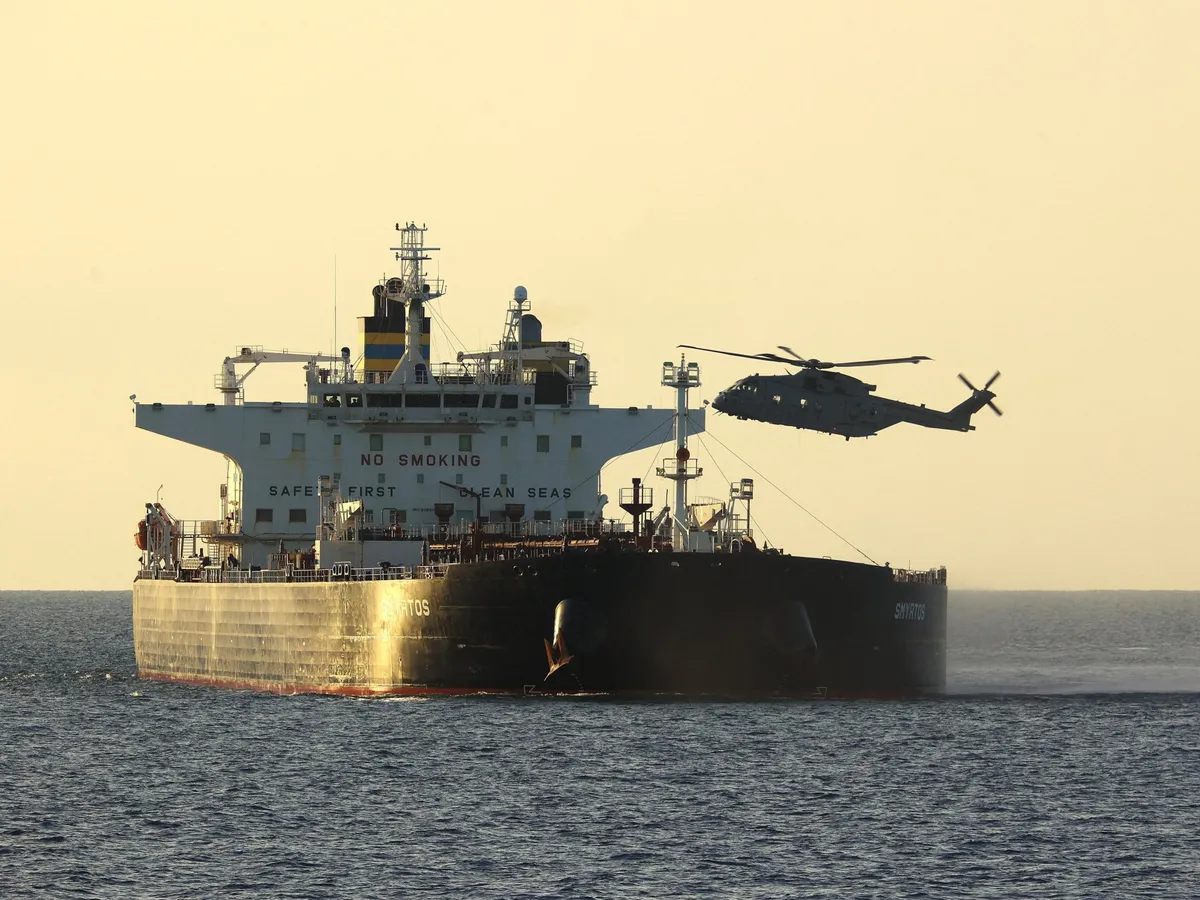
EXPLAINERUK’s Royal Marines conduct first-of-its-kind operation in the English Channel, causing other tankers to turn around.United Kingdom Royal Marines commandos take part in a maritime interdiction operation on the vessel Smyrtos off the south coast of England on June 14, 2026 [Reuters]Published On 16 Jun 2026British forces have seized a Russian-linked oil tanker suspected of breaching sanctions while transiting the English Channel on Sunday, in what Prime Minister Keir Starmer described as a significant setback for Moscow’s efforts to fund its war in Ukraine.“This successful operation delivers yet another blow to Russia and reminds those fuelling [Russian President Vladimir] Putin’s war in Ukraine that we will not let them hide,” Starmer wrote in a post on X on Sunday.Recommended Stories list of 4 itemslist 1 of 4Iran, US agree tentative deal to ‘end war’: Your questions answeredlist 2 of 4‘Netanyahu’s life project failed with US-Iran deal’list 3 of 4Ebola risk for World Cup is ‘extremely low’, but US is ready, experts saylist 4 of 4Record increase in DRC Ebola cases raises death toll to 181end of listFollowing the raid, officers from the National Crime Agency (NCA) arrested an Indian national on suspicion of sanctions offences, while the United Kingdom Ministry of Defence (MoD) confirmed the seizure of the tanker Smyrtos.The operation marks the first UK-led operation in which its forces have boarded and detained a vessel from Russia’s so-called “shadow fleet” – a network of hundreds of tankers used to transport Russian oil and circumvent Western sanctions imposed following Moscow’s full-scale invasion of Ukraine in 2022.Here’s what this means.What happened?According to the vessel-tracking website MarineTraffic, an oil tanker named Smyrtos, carrying 700,000 barrels of Russian oil and sailing under a Cameroonian flag, departed the Russian Baltic port of Ust-Luga on June 5 and was bound for Port Said in Egypt.The Smyrtos is recorded as being owned by a Hong Kong-registered company, Zhao Yao Shipping Ltd, which owns several other sanctioned tankers as well. Its management company is listed as being in Tamil Nadu state, India.The MoD said Royal Marines commandos and NCA officers boarded the tanker in a predawn raid on Sunday, descending onto the vessel with ropes from Chinook helicopters, and supported by other military aircraft, a Royal Navy frigate and a minehunter.The NCA said 24 Georgian and Indian crew members remained aboard the vessel, which is now anchored off the Dorset coast.The operation lasted six hours. The tanker will be moved to England’s south coast and monitored for any environmental or safety concerns, the ministry said.The operation was carried out successfully despite a Russian warship, the Admiral Grigorovich, being close by. The frigate has been stationed close to the UK since April and has escorted many Russian tankers through the English Channel. It is not clear how close to the Smyrtos it was at the time of the raid.Following the raid, at least six other tankers immediately changed course away from the English Channel.Ukraine’s President Volodymyr Zelenskyy thanked the UK in a post on X for “taking this important step against Russia’s oil fleet”.Russia has not publicly commented on the incident.Why does Russia use ‘shadow-fleet’ tankers?Along with other Western nations, Britain has barred vessels linked to Russia’s so-called “shadow fleet” from entering its ports and prohibits British companies from providing insurance, brokerage or financial services to ships transporting Russian oil, which remains a crucial source of revenue for Russia amid its war effort in Ukraine.Alexander Lord, a defence analyst at London intelligence firm Sibylline, told Al Jazeera that sanctions have increased costs and complications for Moscow but have not completely prevented Russia from continuing to export large volumes of oil.“Russia has a significant customer base and continues to trade its oil at a heavy discount, particularly to countries such as India and China,” Lord said.“The sanctions are undoubtedly causing problems for the Russian economy. But we are now well into the fifth year of the full-scale invasion [of Ukraine], and Russia is still exporting large quantities of oil.“Russia is constantly trying to find loopholes to protect its fleet, using shadow-fleet vessels, changing names and ownership structures to circumvent sanctions and investigations.”Why has the UK acted now?Many observers say the real question is why the UK hasn’t acted before now.The move follows a March announcement by Starmer that UK authorities would be empowered to stop, board and detain sanctioned vessels transiting British waters.According to the MoD, the UK has imposed sanctions on more than 500 vessels linked to Russia’s shadow fleet, and the measures contributed to a 24 percent decline in Russian oil and gas revenues in 2025 compared with the previous year.Defence analyst and historian Peter Caddick-Adams told Al Jazeera: “The authority for this operation has existed since March. That month, Starmer agreed that British armed forces and law enforcement could stop, board and detain sanctioned shadow-fleet vessels in accordance with international law.“That legal framework has sat in place for 11 weeks. In those 11 weeks, more than 200 sanctioned tankers sailed through Britain’s exclusive economic zone. Unchecked. Unchallenged.”UK media reported that the start of such operations was delayed by legal issues and the potentially high cost of storing seized vessels.The operation follows a broader Western effort to target Russia’s shadow fleet.Lord added that the United States, with assistance from the Royal Navy, seized a Russia-linked tanker off Scotland in January. “That operation marked the beginning of a new phase of shadow-fleet interdictions,” he said.“It created a clear precedent for subsequent boarding actions. Shortly afterwards, there was a flurry of activity around the legal justification for the UK to act unilaterally.”France has also detained several vessels suspected of transporting sanctioned Russian oil. In January, French authorities impounded the tanker Grinch, and in March they detained the Deyna, which had sailed from Murmansk under a Mozambican flag.Finland, Sweden and Estonia have similarly stepped up inspections and enforcement actions against vessels suspected of helping Russia evade sanctions.“Russia contests the French and British legal basis for such actions, arguing they contravene the UN Convention on the Law of the Sea,” Lord said. “The British and French argue that existing provisions within their legislation justify interdictions. These legal disputes could continue for years.”What impact could this operation have on Russia’s oil exports?Ukraine welcomed the seizure, with President Zelenskyy thanking Starmer and the British people for their “principled resolve”.“It was Russia’s hubris, fuelled by high oil and gas revenues, that paved the way for this war, and every decision by partners that deprives Russia of money also limits the war itself,” Zelenskyy wrote in his X post.Analysts say the seizure is unlikely to significantly disrupt Russia’s overall oil exports but could increase costs and force some vessels to take longer routes to avoid scrutiny.Avoiding the English Channel adds about 926km (500 nautical miles) to the journey of a tanker from Russia heading for the Suez Canal. Tankers will also have to traverse the North Atlantic instead – a much rougher passage with higher cost and risk.“I don’t think this changes the broader picture,” Lord said. “Ust-Luga on the Baltic Sea, near St Petersburg, will remain a major destination and vessels will continue transiting that route.
SRCAl Jazeera
LANGEN
LEANCenter
WORDS1 182
ENT12
TUE · 2026-06-16 · 04:54 GMTBRIEF NSR-2026-0616-84775
NSR-2026-0616-84775News Report·EN·Political Strategy
UK seizes Russian ‘shadow fleet’ tanker – what that means
British Royal Marines, supported by the National Crime Agency, seized the Russian-linked oil tanker Smyrtos in the English Channel on Sunday. The tanker, carrying 700,000 barrels of Russian oil and sailing under a Cameroonian flag, is suspected of breaching sanctions.
Caolán MageeAl JazeeraFiled 2026-06-16 · 04:54 GMTLean · CenterRead · 5 min
Al JazeeraFIG 01
Reading time
5min
Word count
1 182words
Sources cited
3cited
Entities identified
12entities
Quality score
100%
§ 01
Briefing Summary
AI-generatedNEWSAR · AI
British Royal Marines, supported by the National Crime Agency, seized the Russian-linked oil tanker Smyrtos in the English Channel on Sunday. The tanker, carrying 700,000 barrels of Russian oil and sailing under a Cameroonian flag, is suspected of breaching sanctions. This marks the first UK-led operation to board and detain a vessel from Russia's "shadow fleet," a network used to circumvent Western sanctions. Prime Minister Keir Starmer stated the operation is a setback for Moscow's war funding efforts. An Indian national was arrested on suspicion of sanctions offenses. The seizure follows new UK powers to detain sanctioned vessels in British waters and is intended to disrupt Russia's oil revenue streams.
Confidence 0.90Sources 3Claims 5Entities 12
§ 02
Article analysis
Model · rule-basedFraming
Political Strategy
Legal & Judicial
Tone
Measured
AI-assessed
CalmNeutralAlarmist
Factuality
0.80 / 1.00
Factual
LowHigh
Sources cited
3
Well sourced
FewMany
§ 03
Key claims
5 extracted01
This operation marks the first UK-led operation to board and detain a vessel from Russia’s ‘shadow fleet’.
factualUnited Kingdom Ministry of Defence
Confidence
1.00
02
An Indian national was arrested on suspicion of sanctions offences following the raid.
factualNational Crime Agency
Confidence
1.00
03
The tanker Smyrtos was carrying 700,000 barrels of Russian oil and sailed under a Cameroonian flag.
factualMarineTraffic
Confidence
1.00
04
Prime Minister Keir Starmer described the seizure as a significant setback for Moscow’s efforts to fund its war in Ukraine.
quoteKeir Starmer
Confidence
1.00
05
British forces seized a Russian-linked oil tanker suspected of breaching sanctions in the English Channel.
factualUnited Kingdom Ministry of Defence
Confidence
1.00
§ 04
Full report
5 min read · 1 182 words§ 05
Entities
12 identifiedKey playerOppositionContextPositiveNeutralNegative
Organizations4
§ 06
Keywords & salience
9 termsshadow fleet
1.00
sanctions
1.00
russian oil tanker
0.90
maritime interdiction
0.80
war in ukraine
0.70
english channel
0.70
royal marines
0.60
national crime agency
0.50
keir starmer
0.40
§ 07
Topic connections
Interactive graph Network visualization showing 51 related topics
View Full Graph Person Organization Location Event|Click node to navigate|Edge numbers = shared articles