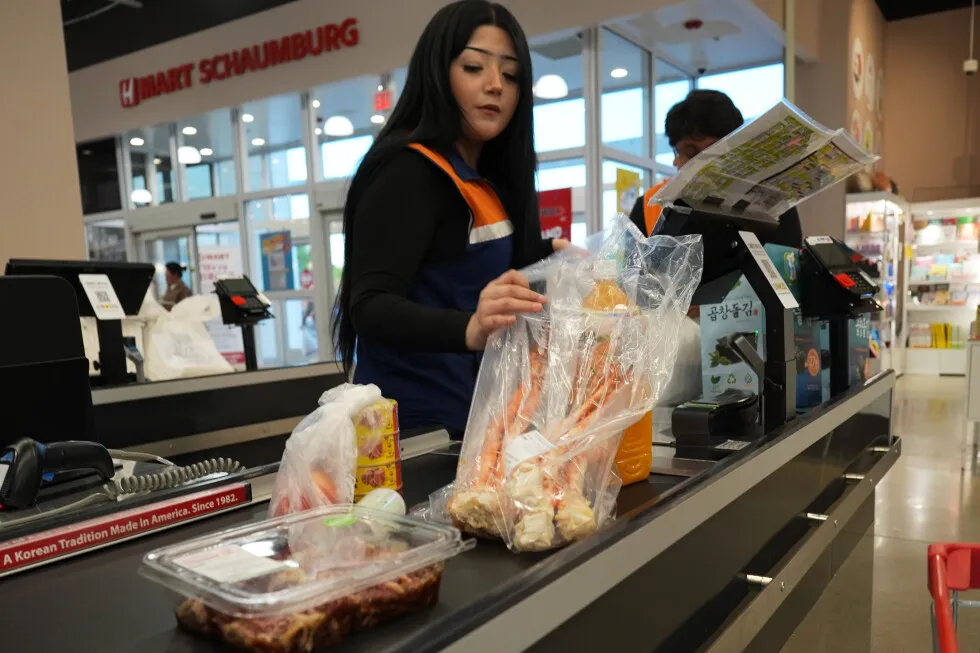
Higher prices for gas, groceries and flights will outlast the Iran-war" class="entity-link entity-event" data-entity-id="38748" data-entity-type="event">Iran war, experts say 1 of 5 | A employee works at a cash register in a grocery store in Schaumburg, Ill., Thursday, May 14, 2026. (AP Photo/Nam Y. Huh, File) 2 of 5 | The American Flag flies next to a One9 Fuel Stop sign displaying gas prices for diesel and unleaded gas in Wilmington, Ohio, Wednesday, June 10, 2026. (AP Photo/Carolyn Kaster) 3 of 5 | People paddle along the shoreline as cargo ships are anchored in the Strait of Hormuz off Bandar Abbas, Iran, Monday, June 1, 2026. (Amirhosein Khorgooi/ISNA via AP) 4 of 5 | Customer checks gas price before she fills up her vehicle’s tank at a gas station in Lincolnshire, Ill., Monday, June 8, 2026. (AP Photo/Nam Y. Huh) 5 of 5 | Congress party supporters hold placards during a protest against the rising prices of essential commodities, in Jammu, India, Wednesday, June 3, 2026. (AP Photo/Channi Anand) By MAE ANDERSON Updated 6:07 AM MESZ, June 16, 2026 Leer en español Add AP News on Google Add AP News as your preferred source to see more of our stories on Google. Share Share Facebook Copy Link copied Print Email X LinkedIn Bluesky Flipboard Pinterest Reddit NEW YORK (AP) — A tentative deal to end the Iran-war" class="entity-link entity-event" data-entity-id="38748" data-entity-type="event">Iran war makes it reasonable to ask how soon prices will drop for gasoline, groceries, airline tickets and other items that got more expensive during the conflict. Even after oil starts flowing again from the Middle East, it could take a while for consumers to see a difference at local fuel pumps, supermarkets and other places they shop, according to economists and industry analysts. Fighting over the Strait of Hormuz disrupted not only supplies of crude and refined fuel but also the supply chains for fertilizer, food and even footwear. Businesses expect higher costs to linger, which means their customers might need to prepare for that too. “It is not clear, despite three months of war, that anything has been achieved that makes the American consumer better off,” Brett House, an economist who teaches at Columbia Business School, said. “In fact, by almost any measure, not just the American consumer, but the world, is worse off as a result of this attack.” If the deal between the U.S. and Iran holds, here’s how experts see the war’s effects receding — or not — in the weeks ahead: Following news of the tentative agreement, oil prices fell Monday to about $80 for a barrel of U.S. benchmark crude. That compares to $67-per-barrel before the war and the price of over $120 a barrel reached earlier in the conflict. Refineries typically pay for crude oil a month or more in advance, so even after oil prices drop, they won’t immediately be processing cheaper products. “The tendency of gasoline prices to fall slowly is partly because the raw material takes weeks to work through the system until it’s delivered to consumers,” said Michael Lynch, a distinguished fellow at the nonpartisan Energy Policy Research Foundation. Iranian official says end of war includes end of Israel’s occupation of Lebanon, state TV reports 1 MIN READ Iran-war" class="entity-link entity-event" data-entity-id="38748" data-entity-type="event">Iran war is a ‘wake-up call’ for Southeast Asia’s energy sector, report says 2 MIN READ Elijah Just’s 2-goal World Cup breakthrough lifts New Zealand to a gritty 2-2 draw 2 MIN READ In places without enough refining capacity to meet their needs, such as the West Coast of the U.S., gas prices will take longer to drop, said Mark Barteau, a professor of chemical engineering and chemistry at Texas A&M University. In some Asian and African countries that rely more on oil from the Middle East, the supply shock led to school and government office closures and instructions to work from home, according to the International Energy Agency. “The bottom line is that getting back to ‘normal’ will be a lengthy process involving many parties and countries,” Barteau said. “Getting an agreement between the U.S. and Iran to open the strait is just the beginning.” Industry experts have spent months warning that even if the war ended, travelers should not expect airfares to go down immediately. Airlines typically buy fuel in advance, adjust their schedules gradually and price tickets based heavily on demand, meaning lower oil and jet fuel prices can take weeks or months to get factored into the cost of commercial flights. “I think it’s unlikely that we’re going to see a retreat or reduction in the cost of flying at any point this summer,” Columbia’s House said. Fuel surcharges that some airlines outside the U.S. added are one of the first areas where passengers might get a reprieve, said Gordon Ho, a professor at the University of Southern California’s business school. “Consumers are going to say, ‘Wait a minute, why are you still charging me a fuel surcharge?’” Ho said. Reopening the strait is unlikely to deliver instant relief at the grocery store, according to David Ortega, a professor of food economics and policy at Michigan State University. Fuel accounts for roughly 15% to 30% of the total cost of food, according to the Independent Grocers Alliance, a grouping of 7,500 global supermarkets. But it can take months for an energy shock like the one caused by the Iran-war" class="entity-link entity-event" data-entity-id="38748" data-entity-type="event">Iran war to wind through the food supply chain and raise grocery prices. And once prices go up, it takes them a long time to come back down, especially when the future is unpredictable, Ortega said. “We’re likely still looking at inflationary pressure on food in the coming months,” Ortega said. “There’s still a good deal of uncertainty about how the reopening will unfold, and it will take time for fuel, diesel and retail fertilizer prices to come back down.” Rabobank, which is based in the Netherlands, said it expected war-related food price inflation to peak sometime next year in Europe. In the U.S., grocery prices are expected to rise 3.2% this year, which compares to a historical average of 2.6%, according to the U.S. Department of Agriculture. Reopening the Strait of Hormuz would also be a welcome change for farmers and the production of food globally. Roughly 30% of the world’s fertilizer passed through the waterway before the war began. Prices soared as the supply was effectively cut off, and shipments probably will take a long time to return to pre-war levels. The consequences of the shortage facing farmers now may only intensify down the road, regardless. Many farmers around the world are going through planting seasons without the fertilizer they need or paying sky-high prices for both fertilizer and fuel needed to produce and transport their products. The World Food Program of the United Nations expects this to have a “devastating impact” on crop yields — and consequently, food prices and the availability of food — for months to come. U.S. retailers that sell shoes were encouraged to see falling gasoline prices, hoping they would mean Americans have more money to spend on back-to-school shopping, said Andy Polk, senior vice president of the Footwear Distributors and Retailers of America trade group. However, shoe companies anticipate their own costs staying higher for the foreseeable future, Polk said. The group’s members keep a two- to three-month inventory of finished products, but their next orders may include suppliers charging more for materials, he said. Most of the footwear sold in the U.S. is imported, and Polk said he expects shipping costs to remain higher for the rest of 2026 and 2027. U.S. tariffs imposed last year have made it more difficult for shoe sellers to absorb higher costs or pass them on customers, he said. In May, footwear prices were 5.2% higher than the same month a year earlier, according to government figures. Shipping industry costs ers expect a slow recovery Judah Levine, head of research at the freight booking platform Freightos, said the Straight of Hormuz closure has affected about 2% to 3 % of the total volume of container ships that are used for global shipping, but higher oil prices and disruption have impacted the shipping industry more broadly. Josh Steinitz, chief strategy officer of the business logistics platform ShipStation Global, said consumers might notice higher shipping costs and more out-of-stock items online until the end of the year. “I think fuel surcharges, which then flow into shipping costs, which then get passed along to consumers, are still going to be with us for quite sometime from many of the major carriers,” Steinitz said. Associated Press writers Cathy Bussewitz, Anne D’Innocenzio, and Wyatte Grantham-Philips in New York, Dee-Ann Durbin in Detroit and Rio Yamat in Las Vegas contributed to this report. MAE ANDERSON Anderson reports for The Associated Press on a wide range of issues that small businesses face. She is based in New York. twitter mailto
SRCAssociated Press (AP)
LANGEN
LEANCenter
WORDS1 471
ENT12
TUE · 2026-06-16 · 06:23 GMTBRIEF NSR-2026-0616-84813
NSR-2026-0616-84813News Report·EN·Economic Impact
Higher prices for gas, groceries and flights will outlast the Iran war, experts say
Experts predict that higher prices for gas, groceries, and flights will persist even after a tentative deal to end the Iran war. The conflict disrupted not only oil supplies but also supply chains for fertilizer, food, and footwear, leading to increased costs for businesses and consumers.
Associated Press (AP)Filed 2026-06-16 · 06:23 GMTLean · CenterRead · 6 min
Associated Press (AP)FIG 01
Reading time
6min
Word count
1 471words
Sources cited
2cited
Entities identified
12entities
Quality score
100%
§ 01
Briefing Summary
AI-generatedNEWSAR · AI
Experts predict that higher prices for gas, groceries, and flights will persist even after a tentative deal to end the Iran war. The conflict disrupted not only oil supplies but also supply chains for fertilizer, food, and footwear, leading to increased costs for businesses and consumers. While oil prices have fallen, it will take weeks or months for these lower prices to be reflected at the pump due to refinery processes. Airfare is unlikely to decrease immediately as airlines adjust schedules and pricing over time. Grocery prices are expected to remain elevated due to the lingering effects on fertilizer and fuel costs throughout the supply chain. Retailers and the shipping industry also anticipate higher costs and potential stockouts for the remainder of the year.
Confidence 0.90Sources 2Claims 5Entities 12
§ 02
Article analysis
Model · rule-basedFraming
Economic Impact
Conflict
Tone
Measured
AI-assessed
CalmNeutralAlarmist
Factuality
0.60 / 1.00
Mixed
LowHigh
Sources cited
2
Limited
FewMany
§ 03
Key claims
5 extracted01
Oil prices fell to about $80 per barrel after the tentative agreement to end the Iran war.
statisticarticle
Confidence
0.95
02
The American consumer and the world are worse off as a result of the attack on the Strait of Hormuz.
quoteBrett House
Confidence
0.90
03
Fighting over the Strait of Hormuz disrupted supplies of crude, refined fuel, fertilizer, food, and footwear.
factualarticle
Confidence
0.90
04
It could take a while for consumers to see a price difference after oil starts flowing again.
predictioneconomists and industry analysts
Confidence
0.80
05
Higher prices for gas, groceries, and flights will outlast the Iran war.
predictionexperts
Confidence
0.70
§ 04
Full report
6 min read · 1 471 words§ 05
Entities
12 identifiedKey playerOppositionContextPositiveNeutralNegative
People1
Organizations3
Locations4
§ 06
Keywords & salience
10 termsprice increases
1.00
iran war
0.90
strait of hormuz
0.80
supply chains
0.70
flight prices
0.60
gas prices
0.60
grocery prices
0.60
oil prices
0.50
economists
0.40
consumer impact
0.40
§ 07
Topic connections
Interactive graph Network visualization showing 51 related topics
View Full Graph Person Organization Location Event|Click node to navigate|Edge numbers = shared articles