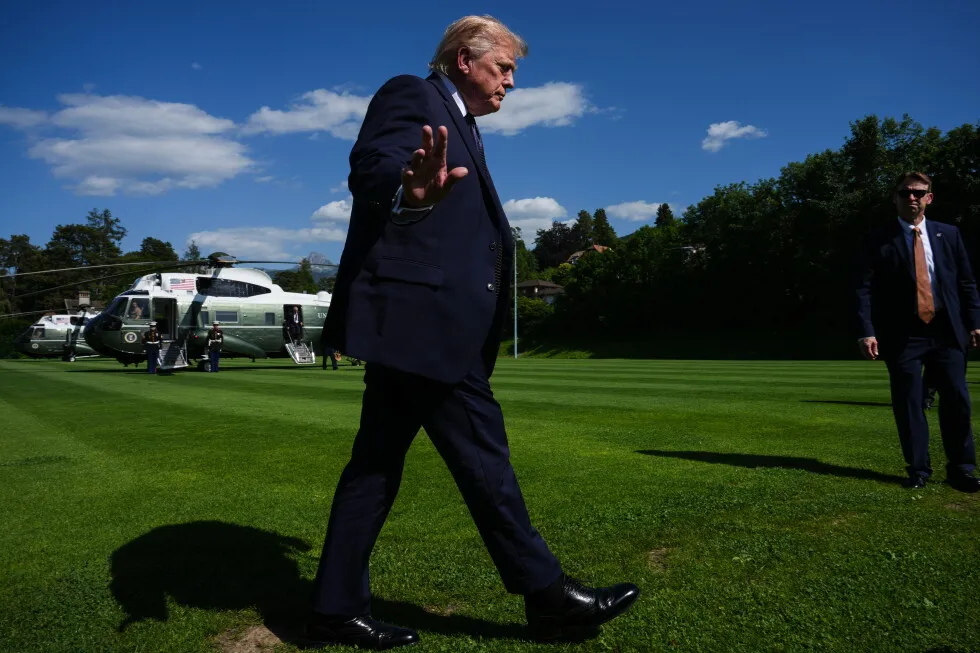
Trump’s Iran deal greeted with skepticism and scrutiny on Capitol Hill 1 of 4 | President Donald Trump waves to reporters as he arrives for the G7 summit, Monday, June 15, 2026, in Evian-les-Bains, France. (AP Photo/Julia Demaree Nikhinson) 2 of 4 | Poland’s President Karol Nawrocki, center, shakes hand with Sen. Majority Leader John Thune, R-S.D., as Sen. Jim Risch, R-Idaho, left, Sen. Roger Wicker, R-Miss., right, stand for a group photo before a meeting on Capitol Hill, Monday, June 15, 2026, in Washington. (AP Photo/Mariam Zuhaib) 3 of 4 | Vice President JD Vance attends UFC Freedom 250 on the South Lawn of the White House, Monday, June 15, 2026, in Washington. (AP Photo/Mark Schiefelbein) 4 of 4 | The U.S. Capitol is visible as the motorcade with President Donald Trump heads from the White House to Joint Base Andrews, Md., Monday, June 15, 2026. (AP Photo/Julia Demaree Nikhinson) 1 of 4 | President Donald Trump waves to reporters as he arrives for the G7 summit, Monday, June 15, 2026, in Evian-les-Bains, France. (AP Photo/Julia Demaree Nikhinson) 1 of 4 President Donald Trump waves to reporters as he arrives for the G7 summit, Monday, June 15, 2026, in Evian-les-Bains, France. (AP Photo/Julia Demaree Nikhinson) Add AP News on Google Add AP News as your preferred source to see more of our stories on Google. Share 2 of 4 | Poland’s President Karol Nawrocki, center, shakes hand with Sen. Majority Leader John Thune, R-S.D., as Sen. Jim Risch, R-Idaho, left, Sen. Roger Wicker, R-Miss., right, stand for a group photo before a meeting on Capitol Hill, Monday, June 15, 2026, in Washington. (AP Photo/Mariam Zuhaib) 2 of 4 Poland’s President Karol Nawrocki, center, shakes hand with Sen. Majority Leader John Thune, R-S.D., as Sen. Jim Risch, R-Idaho, left, Sen. Roger Wicker, R-Miss., right, stand for a group photo before a meeting on Capitol Hill, Monday, June 15, 2026, in Washington. (AP Photo/Mariam Zuhaib) Add AP News on Google Add AP News as your preferred source to see more of our stories on Google. Share 3 of 4 | Vice President JD Vance attends UFC Freedom 250 on the South Lawn of the White House, Monday, June 15, 2026, in Washington. (AP Photo/Mark Schiefelbein) 3 of 4 Vice President JD Vance attends UFC Freedom 250 on the South Lawn of the White House, Monday, June 15, 2026, in Washington. (AP Photo/Mark Schiefelbein) Add AP News on Google Add AP News as your preferred source to see more of our stories on Google. Share 4 of 4 | The U.S. Capitol is visible as the motorcade with President Donald Trump heads from the White House to Joint Base Andrews, Md., Monday, June 15, 2026. (AP Photo/Julia Demaree Nikhinson) 4 of 4 The U.S. Capitol is visible as the motorcade with President Donald Trump heads from the White House to Joint Base Andrews, Md., Monday, June 15, 2026. (AP Photo/Julia Demaree Nikhinson) Add AP News on Google Add AP News as your preferred source to see more of our stories on Google. Share Updated [hour]:[minute] [AMPM] [timezone], [monthFull] [day], [year] Washington (AP) — Republicans on Capitol Hill said Monday they need more information about the agreement between the United States and Iran announced by President Donald Trump, and some are expressing skepticism as they ask the White House for details. The agreement announced Sunday to end the war in Iran, set for a ceremonial signing Friday in Geneva, is centered around reopening the Strait of Hormuz and lifting the United States’ naval blockade in the region, along with financial incentives for Iran if it meets certain benchmarks. But Senate Republicans and Democrats who returned to Washington on Monday said there were still many unanswered questions about the deal and they need thorough briefings before it is finalized. “I just don’t know enough about it,” Senate Majority Leader John Thune, R-S.D., told reporters in the Capitol. “Even the people who follow this stuff closely up here don’t know that much about it.” Congressional leaders and intelligence committees generally receive higher-level intelligence briefings before rank-and-file members, and they are notified of major developments before they are announced. But Thune said he had not been personally briefed on the deal. 5 MIN READ 5 MIN READ 5 MIN READ “I think that my understanding of what it entails — and, again, not having seen anything — it would require, I think the issues are going to be compliance, and how are you going to enforce that,” Thune said. Thune’s concerns were echoed by several other GOP senators. “If it’s a secret deal then how can I take it seriously?” asked Republican Sen. Thom Tillis of North Carolina. Vice President JD Vance told ABC News on Monday that the White House would release the text this week, “and what everybody will see is that Iran doesn’t get a dime of money unless they perform their obligations.” Senators have questions about detailsTrump has not yet explained how his agreement will address Iran’s nuclear program, including who will be in charge of verifying that Iran is in compliance and who will destroy or remove highly enriched uranium believed to be buried under nuclear sites that were badly damaged by U.S. strikes last summer.A memorandum of understanding also includes the possibility of releasing Iran’s frozen funds, sanctions relief and a $300 billion fund to help rebuild Iran if Tehran meets certain benchmarks, senior U.S. officials told reporters Monday. But the document has not been released. Thune said he wants to know more about the conditions on the financial incentives for Iran. He said the deal would be a “good one” if the incentives are conditioned upon Iran winding down its nuclear program and getting rid of the enriched uranium, “preventing them from having a nuclear capability in the future.”Sen. John Kennedy, R-La., said he is hopeful but “until you see the final document, it’s hard to make an assessment.” “I go into it very skeptical of the government of Iran,” Kennedy said. “They learn to lie before they learn to talk. So any agreement we make with them has to have guardrails. It has to have a way to judge through independent inspection if they’re doing what they say they’re doing.” Senate could have a vote Under the Iran nuclear agreement review act passed by Congress during the Obama era, any deal the U.S. reaches concerning Iran’s nuclear material must be submitted within a certain amount of time to Congress for review. But it is up to Congress whether that happens — it is not required. President Barack Obama’s 2015 nuclear agreement with Iran, known as the JCPOA, was submitted for what’s called a vote of disapproval in the Senate. The outcome did not roll back the agreement, but put the senators on record with their support or opposition. Sen. Lindsey Graham, a close ally of Trump and a longtime hawk on Iran, has appeared skeptical over the emerging agreement. He said he is “pulling for a deal” but Congress will need to review and vote on it, and he wants to see the memorandum that the two countries have agreed on. “The way Iran describes it, it’s awful. The way we describe it, it makes sense to me,” Graham, R-S.C., said. “Let’s look at it and see what it actually is.” Graham has said he wants Vance, whom he called “the architect of the deal,” to present it to lawmakers. Vance responded to Graham on Monday, saying in the interview with ABC that he would “caution Lindsey Graham and anybody else not to believe the hard-liner propaganda in Iran, but to believe what’s actually in the agreement.”Even though Iran’s new supreme leader, Mojtaba Khamenei, is the son of the last supreme leader, and Iran’s paramilitary Revolutionary Guard still has significant authority in Iran, Vance told CNN in a separate interview that “fundamentally, it is a much different group of people.” He insisted that the conflict had unlocked much more direct communication with high-level Iranian officials and that the relationship was “fundamentally transformed.” Next steps in Congress unclear Most Senate Republicans said they want to review the deal, but it was still unclear whether they would have a vote, or if Congress could pass it. Republican Sen. Eric Schmitt of Missouri said he doesn’t think an up-or-down vote is necessary. “You have the camp that wants us to lose and then you have a camp that wants a forever war,” Schmitt said. “President Trump’s not in either one of those camps, and neither am I.”Sen. Ted Cruz, R-Texas, said he expects the Senate will get the final say. But he praised Trump for making “the single most consequential decision of his presidency” by attacking Iran.“I think he made America safer,” Cruz said. “The president as commander in chief acted decisively to stop that ayatollah from getting nuclear weapons.”Sen. James Lankford, an Oklahoma Republican who serves on the Intelligence Committee, said he expects there are still many more steps to the process before any package would come to Congress for review.“Seems like early reports are showing that this is kind of the first step,” he said. “Once we have a final agreement, we need to take it up and pass it. … If you want a long-term agreement it’s got to be law.”Democrats ask what has changed Democrats questioned how the deal will improve upon the U.S. position before the war — and how it differs from Obama’s 2015 nuclear deal.“For all his critique of JCPOA, we had international observers, we actually had an alliance there that included the Europeans, and Russia and China were all signatories,” Virginia Sen. Mark Warner, the top Democrat on the Intelligence Committee, told CBS’ “Face the Nation” on Sunday.Sen. Elizabeth Warren, D-Mass., said there are more questions than answers, including what happens to the Iranian nuclear program and sanctions on Iranian oil. Trump has spent “tens of billions of dollars” and service members and Iranians have died, “and he still cannot explain how one family in Massachusetts is better off,” Warren said. Democratic Sen. Tim Kaine of Virginia said an end to what has been a costly and unpopular war would be a good resolution, but he wants to hear more details. “An off ramp is good because it was a war that should have never been started,” he said. ___Associated Press writers Michelle Price in Washington and Bill Barrow in Alpharetta, Georgia, contributed to this report. Cappelletti covers Congress for The Associated Press. He previously reported on Michigan politics for AP.
SRCAssociated Press (AP)
LANGEN
LEANCenter
WORDS1 758
ENT12
TUE · 2026-06-16 · 06:23 GMTBRIEF NSR-2026-0616-84818
NSR-2026-0616-84818News Report·EN·Political Strategy
Trump’s Iran deal greeted with skepticism and scrutiny on Capitol Hill
Republicans on Capitol Hill are expressing skepticism and demanding more information regarding the Iran deal announced by President Donald Trump. The agreement, set for a ceremonial signing, aims to end the war in Iran by reopening the Strait of Hormuz, lifting the U.S.
By
MARY CLARE JALONICK, LISA MASCARO and JOEY CAPPELLETTIAssociated Press (AP)Filed 2026-06-16 · 06:23 GMTLean · CenterRead · 8 min
Associated Press (AP)FIG 01
Reading time
8min
Word count
1 758words
Sources cited
0cited
Entities identified
12entities
Quality score
100%
§ 01
Briefing Summary
AI-generatedNEWSAR · AI
Republicans on Capitol Hill are expressing skepticism and demanding more information regarding the Iran deal announced by President Donald Trump. The agreement, set for a ceremonial signing, aims to end the war in Iran by reopening the Strait of Hormuz, lifting the U.S. naval blockade, and offering financial incentives to Iran contingent on meeting benchmarks. However, congressional leaders, including Senate Majority Leader John Thune, stated they have not been personally briefed and have numerous unanswered questions about the deal's compliance and enforcement mechanisms, particularly concerning Iran's nuclear program. Vice President JD Vance assured that Iran will only receive funds if it fulfills its obligations, and the White House plans to release the agreement's text this week. Democrats are also seeking details, questioning how the new deal improves upon previous agreements and what has changed regarding Iran's nuclear program and sanctions.
Confidence 0.90Claims 5Entities 12
§ 02
Article analysis
Model · rule-basedFraming
Political Strategy
Diplomatic
Tone
Measured
AI-assessed
CalmNeutralAlarmist
Factuality
0.30 / 1.00
Opinion-Heavy
LowHigh
Sources cited
0
No named sources
FewMany
§ 03
Key claims
5 extracted01
President Donald Trump traveled from the White House to Joint Base Andrews.
factualAP Photo/Julia Demaree Nikhinson
Confidence
1.00
02
Vice President JD Vance attended UFC Freedom 250 at the White House.
factualAP Photo/Mark Schiefelbein
Confidence
1.00
03
Polish President Karol Nawrocki met with U.S. Senators John Thune, Jim Risch, and Roger Wicker.
factualAP Photo/Mariam Zuhaib
Confidence
1.00
04
President Donald Trump attended the G7 summit in Evian-les-Bains, France.
factualAP Photo/Julia Demaree Nikhinson
Confidence
1.00
05
Trump's Iran deal is being met with skepticism and scrutiny on Capitol Hill.
factual
Confidence
0.90
§ 04
Full report
8 min read · 1 758 words§ 05
Entities
12 identifiedKey playerOppositionContextPositiveNeutralNegative
People6
Locations5
§ 06
Keywords & salience
9 termsiran deal
1.00
capitol hill
0.90
skepticism
0.80
scrutiny
0.80
donald trump
0.70
g7 summit
0.60
us foreign policy
0.50
international relations
0.50
political scrutiny
0.40
§ 07
Topic connections
Interactive graph Network visualization showing 51 related topics
View Full Graph Person Organization Location Event|Click node to navigate|Edge numbers = shared articles