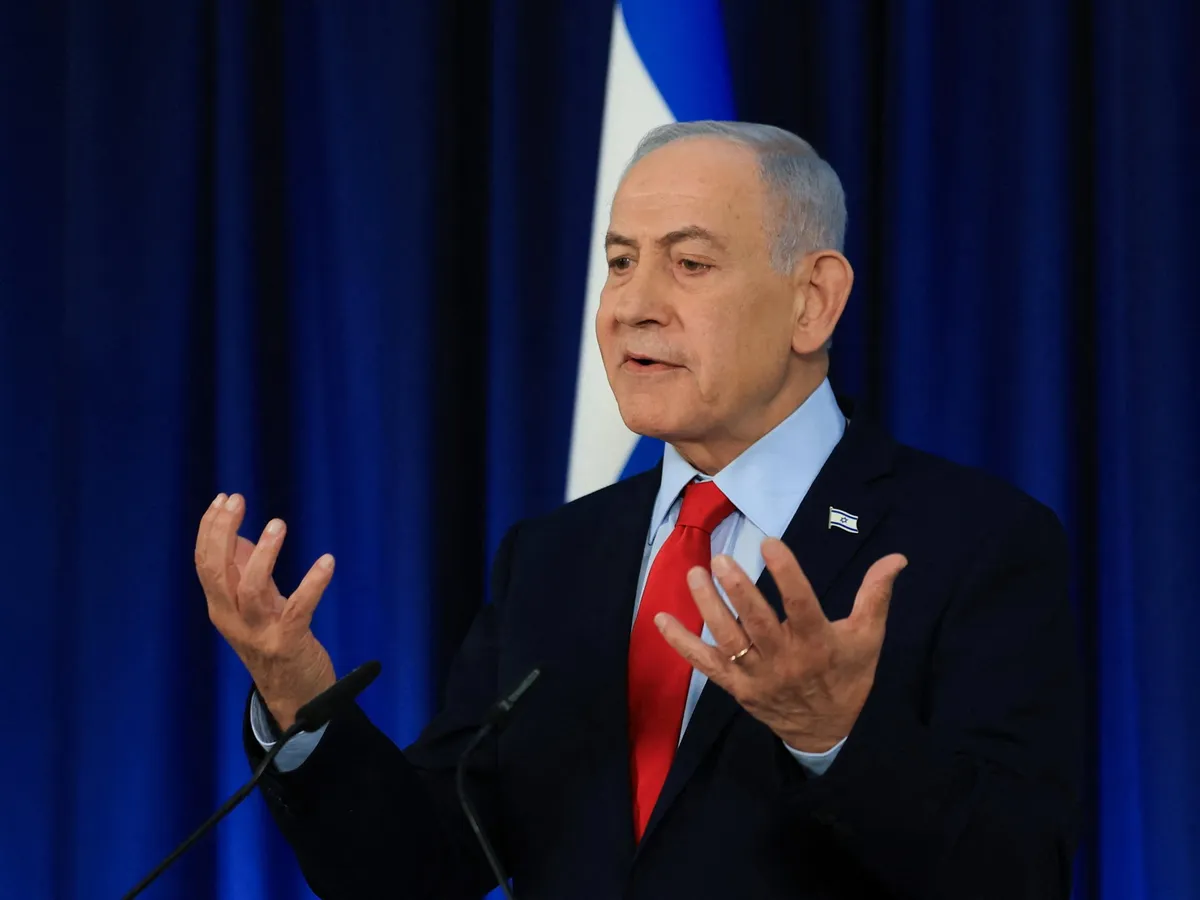
Critics say Netanyahu’s Iran war strengthened Tehran, strained US ties, and left Israel weaker.Israeli Prime Minister Benjamin Netanyahu speaks during a press conference, amid the US-Israel conflict with Iran, in West Jerusalem [File: Ronen Zvulun/Pool/Reuters]Published On 16 Jun 2026The headline strapped across the front page of the Israeli news site Haaretz on Tuesday summed up the feelings of many: “The Iran Fiasco Is Netanyahu’s Biggest Failure Since October 7”.After three and a half months of a stuttering war with Iran, Israel’s foremost ally, the United States, has brokered an interim agreement without, it appears, any input from Israel.Recommended Stories list of 4 itemslist 1 of 4Trump tells Netanyahu to be ‘more responsible with respect to Lebanon’list 2 of 4Families return to shattered towns as fragile ceasefire holds in Lebanonlist 3 of 4Geneva to host Iran-US deal event: What other pacts have been signed there?list 4 of 4‘There’s divergence between US and Israeli objectives in the region’end of listInstead, the Iranian state, which Israel’s politicians have for decades cast as an existential threat, is still standing, and, through its control over the Strait of Hormuz, arguably more powerful than before.Closer to home, Israel’s ability to continue its military operations in Lebanon, which it claimed was necessary to protect against rocket fire from the Iran-allied Lebanese group Hezbollah, must now be weighed against its potential to cause problems between the US and Iran ahead of the agreement’s signing, expected later this week.Mass oppositionOpposition to the deal in Israel has come from both the centre and the far right.Gadi Eisenkot, a centrist who is one of the favourites to oust Israeli Prime Minister Benjamin Netanyahu in elections later this year, was unsparing in his criticism of the Israeli leader and the US-Iran deal.Eisenkot blasted what he described as “the dismal outcome of a failed government”, pointing to what he characterised as the “vast gulf” between Netanyahu’s “empty promises of total victory” and the outline of what the agreement between the US and Iran will stipulate.Far-right members of Netanyahu’s coalition government – namely, National Security Minister Itamar Ben-Gvir and Finance Minister Bezalel Smotrich – have been typically uncompromising, with a possible eye on the elections. “We must not act according to the agreements between Trump and [Mojtaba] Khamenei,” Ben-Gvir said in reference to the US and Israeli leaders, while Smotrich called it a “bad deal”.Netanyahu, having spent years pushing for a war with Iran and popularising it in Israel, knows that ending the conflict is unpopular domestically. The prime minister has gone to considerable pains to put as much distance between himself and what he called “Trump’s decision” to end the war while simultaneously claiming to have been an equal partner with the US in waging it.Shrugging off what critics claimed was Israel’s calamitous position ahead of the agreement’s signing later this week, Netanyahu instead claimed success, telling a press conference on Monday: “We removed, for years to come, this danger hanging over us of the elimination of Israel’s population,” he said.“That is what we did. We saved the State of Israel from annihilation,” he continued, offering an uncannily accurate echo of his claims after the June 2025 12-day war with Iran, when he said that he had secured Israel a “historic victory” over Iran that would “abide for generations”.US President Donald Trump points his finger towards Israeli Prime Minister Benjamin Netanyahu as they shake hands during a press conference after meeting at Trump’s Mar-a-Lago club in Palm Beach, Florida in the US [File: Jonathan Ernst/Reuters]“It is not playing well, and the claims are not credible,” former Israeli government adviser Daniel Levy told Al Jazeera. “The assumption was that if you pull America into a war, then it is a given that Iran will be crushed and that things Israel cannot achieve in terms of regime destruction and Iranian capitulation can be achieved by America,” he said, noting that this has not been the case.Levy continued, pointing to how Israeli expectations of how the war might play out were shaped by the country’s own view of itself within the region. “The assumption itself is infused with colonial racism and Israeli hubris,” he said. “The notion that Iran could possibly outsmart, out-strategise, and gain leverage was not on the agenda.”Iran on top?Much of the conversation within Israel has been centred on Iran’s status as a regional power, but also as a potential nuclear power, after the conclusion of the war.US President Donald Trump has insisted that Iran will never gain nuclear weapons. However, it remains unclear how the US intends to persuade Iran to surrender its stockpiles of enriched uranium after a war that many Iranians believe they won, particularly given the economic fallout from the effective closure of the Strait of Hormuz.“Netanyahu inflicted on Israel a strategic catastrophe,” said Ahron Bregman, a senior teaching fellow in the Department for War Studies at King’s College London. “He initiated a war with Iran which aimed to topple its regime, but the regime is still standing and it is [more] radical than before. Iran will rebuild its missile arsenal.”Also uncertain is how long Israel can rely on US support for its continuing invasion of Lebanon. Iran has long made a cessation of Israeli attacks on Lebanon a condition of any agreement to end the war. But Netanyahu has claimed that the agreement between the US and Iran does not extend to Israel’s own freedom of movement in Lebanon, creating what analysts say could be an obstacle to any ceasefire, as well as a growing source of fiction between Israel and its sponsors in Washington.On Tuesday, Trump sought to emphasise those differences, saying that he was “not happy” with Israel’s conduct in Lebanon, adding that Netanyahu had to be “more responsible” when it came to Israel’s neighbour to the north.An Iranian flag flutters in the wind as ships remain anchored on May 16, 2026 in the Strait of Hormuz near Larak Island, Iran [File: Majid Saeedi/Getty Images].“Lebanon will be the spark, the trigger to forthcoming rounds of blows between Israel and Iran,” Bregman suggested. “Will the US join Israel to fight Iran again? I doubt any US president with a shred of common sense will attempt any war with Iran.”“Geography is on Iran’s side, and it is an economic nuclear bomb which the Iranians will use again without hesitation,” he concluded, referring to the Strait of Hormuz and Iran’s ability to stop oil from passing through it.Netanyahu remains Israel’s longest-serving prime minister, and few are willing to count him out ahead of this year’s elections. But history’s verdicts on his latest regional adventures are beginning to coalesce, Alon Pinkas, a former Israeli ambassador and consul general in New York, told Al Jazeera.“He now finds himself coming into an election carrying the disaster of October 7 [2023 Hamas-led attack on Israel], failure in Lebanon, and a catastrophic war against Iran behind him,” he said.“Ultimately, Netanyahu is being seen as a man who was given the opportunity of a lifetime and squandered it. He finally had everything in his favour: a US president, Iran alone and without allies, and a military and technological advantage, and he blew it,” Pinkas said. “For 30 years, he’s been talking about this and, when it came to it, he blew it.“He’s right that he’s changed the political landscape of the Middle East. He’s done so in Iran’s favour.”
SRCAl Jazeera
LANGEN
LEANCenter
WORDS1 224
ENT12
TUE · 2026-06-16 · 15:57 GMTBRIEF NSR-2026-0616-84972
NSR-2026-0616-84972Analysis·EN·Political Strategy
Israel went to war with Iran, but Netanyahu may be the loser
Critics argue that Israeli Prime Minister Benjamin Netanyahu's war with Iran has inadvertently strengthened Tehran, strained relations with the United States, and weakened Israel. Following a three-and-a-half-month conflict, the US has brokered an interim agreement with Iran, reportedly without Israeli input.
Simon Speakman CordallAl JazeeraFiled 2026-06-16 · 15:57 GMTLean · CenterRead · 5 min
Al JazeeraFIG 01
Reading time
5min
Word count
1 224words
Sources cited
3cited
Entities identified
12entities
Quality score
100%
§ 01
Briefing Summary
AI-generatedNEWSAR · AI
Critics argue that Israeli Prime Minister Benjamin Netanyahu's war with Iran has inadvertently strengthened Tehran, strained relations with the United States, and weakened Israel. Following a three-and-a-half-month conflict, the US has brokered an interim agreement with Iran, reportedly without Israeli input. This outcome has drawn criticism from both centrist and far-right figures in Israel, who point to a significant gap between Netanyahu's promises of total victory and the current situation. Despite claims of success from Netanyahu, who stated the war removed an existential threat, critics contend that Iran remains a powerful regional actor, potentially more so due to its control over the Strait of Hormuz. The war's conclusion also raises questions about Israel's operations in Lebanon and potential future US-Iran relations.
Confidence 0.90Sources 3Claims 5Entities 12
§ 02
Article analysis
Model · rule-basedFraming
Political Strategy
Conflict
Tone
Mixed Tone
AI-assessed
CalmNeutralAlarmist
Factuality
0.40 / 1.00
Mixed
LowHigh
Sources cited
3
Well sourced
FewMany
§ 03
Key claims
5 extracted01
Gadi Eisenkot described the outcome as 'the dismal outcome of a failed government'.
quoteGadi Eisenkot
Confidence
1.00
02
The US has brokered an interim agreement with Iran without Israeli input.
factual
Confidence
0.80
03
Netanyahu knows that ending the conflict is unpopular domestically.
factual
Confidence
0.70
04
Netanyahu's Iran war has strengthened Tehran and strained US ties, leaving Israel weaker.
factualCritics
Confidence
0.70
05
Iran is arguably more powerful than before due to its control over the Strait of Hormuz.
factual
Confidence
0.60
§ 04
Full report
5 min read · 1 224 words§ 05
Entities
12 identifiedKey playerOppositionContextPositiveNeutralNegative
People6
Organizations1
Locations4
Events1
§ 06
Keywords & salience
9 termsiran war
1.00
benjamin netanyahu
0.90
us-iran relations
0.80
israeli politics
0.70
hezbollah
0.60
lebanon conflict
0.50
strait of hormuz
0.50
elections
0.40
total victory
0.40
§ 07
Topic connections
Interactive graph No topic relationship data available yet. This graph will appear once topic relationships have been computed.