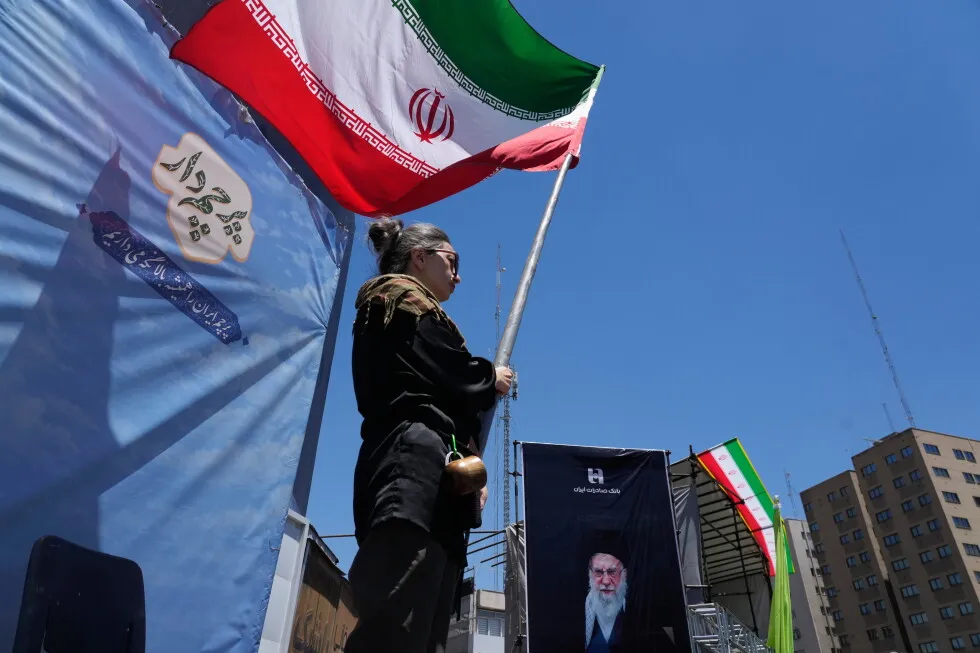
Iran will reopen Strait of Hormuz and can sell oil freely under deal with US, according to leaks 1 of 4 | A woman waves an Iranian flag during a pro-government campaign as a portrait of the slain Supreme Leader Ayatollah Ali Khamenei, who was killed in U.S. and Israeli strikes on Feb. 28, is displayed at right, in downtown Tehran, Iran, Monday, June 15, 2026. (AP Photo/Vahid Salemi) 2 of 4 | People walk along Tajrish square in northern Tehran, Monday, June 15, 2026. (AP Photo/Vahid Salemi) 3 of 4 | A man who returns to his village following the announcement of an initial ceasefire agreement between the United States and Iran, flashes victory sign as he stands on the rubble of his destroyed house in Nabatiyeh town, southern Lebanon, Tuesday, June 16, 2026. (AP Photo/Hussein Malla) 4 of 4 | Rescue workers inspect a damaged ambulance belonging to Hezbollah’s health unit that was hit in a previous Israeli airstrike in the southern village of Souaneh, Lebanon, Tuesday, June 16, 2026. (AP Photo/Mohammed Zaatari) By JON GAMBRELL, ZEKE MILLER, MICHELLE L. PRICE and SAMY MAGDY Updated 12:13 PM MESZ, June 17, 2026 Leer en español Add AP News on Google Add AP News as your preferred source to see more of our stories on Google. Share Share Facebook Copy Link copied Print Email X LinkedIn Bluesky Flipboard Pinterest Reddit DUBAI, United Arab Emirates (AP) — Iran will immediately take steps to reopen the Strait of Hormuz once a tentative deal with the U.S. to end the war is signed and will be allowed to sell its oil without restrictions, according to leaked copies of an interim agreement that officials say broadly matches the document. The accord, due to be formally signed in a ceremony in Switzerland on Friday, lays out that the U.S. would secure at least $300 billion to rebuild Iran after the war and work to end all American and United Nations sanctions imposed on Tehran if a final agreement addressing Iran’s nuclear program is reached. The U.S. agreement to immediately allow Iran to sell its oil freely and the offer to eventually lift all sanctions represent major concessions that outstrip the terms of Iran’s 2015 nuclear deal with world powers, which U.S. President Donald Trump unilaterally withdrew America from in his first term, declaring it the “worst deal ever.” This new accord likely will draw intense criticism in Washington — and appears to be a major setback for Israeli Prime Minister Benjamin Netanyahu, who launched the war with Trump on Feb. 28. The deal calls for an immediate end to all fighting in Lebanon between Israel and the Iranian-backed militia Hezbollah. That is one of the most delicate parts of the agreement because Israel has maintained it will continue to defend itself and to occupy vast swaths of Lebanon. Iran has said it must withdraw under the deal, although the leaked versions make no mention of withdrawal. A New York House primary has become an AI industry family feud with millions in corporate spending 5 MIN READ Canada’s Carney isn’t having a bilateral meeting with Trump at G7 but says it’s not a snub 2 MIN READ Trump delays Clayton’s nomination for intelligence director to try to push Congress on voter ID bill 3 MIN READ 21 The two sides are to start 60 days of negotiations over a final deal that the Trump administration insists will prevent Iran from ever developing a nuclear weapon. The U.S. offers appear aimed at enticing Iran to strike an agreement. But in the meantime, Iran appears to be getting benefits up front while making few concessions. Much of the agreement would restore the status quo before the war, including ending hostilities and reopening the strait, which is a crucial passage for the world’s oil and natural gas and whose closure created a historic energy crisis. Other concessions to Iran — some of which are extraordinary, including the money for rebuilding, the full lifting of sanctions and the release of frozen assets — appear dependent on the progress of further negotiations on Iran’s nuclear program. A person who was briefed on the memorandum of understanding after it was signed and another who viewed a copy beforehand said it largely matched the text of what was published by the Saudi-owned broadcaster Al Arabiya, which reported details of the deal Tuesday. The two people spoke on condition of anonymity because of the sensitivity of the discussions. Another two officials in the Mideast, who spoke on condition of anonymity for the same reason, also said the versions published by Al Arabiya and Bloomberg broadly matched the final agreement. The White House and other American officials have not published the terms and did not immediately respond to questions. Iran also has not published an official version of the deal. Iran’s semiofficial Tasnim news agency, close to its paramilitary Revolutionary Guard, claimed Wednesday that Bloomberg’s version had missing portions, without offering a full accounting. The deal would provide relief to the global economy The deal provides a major win for the global economy — the reopening of the Strait of Hormuz, the narrow mouth of the Persian Gulf through which a fifth of all oil and natural gas traded once passed before the war began. Since then, Iranian attacks on shipping and the threat to vessels effectively shut the strait. The strait’s closure drove up energy prices around the world and made many basics, including food, more expensive. Iran let out some vessels that paid tolls, something never done before in the strait, which sits in the territorial waters of Iran and Oman and long has been considered an international waterway. The U.S. later provided military support to get other tankers out, but traffic through the strait was nowhere near levels before the war. The deal calls for the U.S. to lift a blockade imposed on Iranian ports and for the strait to return to its prewar traffic levels in 30 days, while acknowledging Iranian mines may still be in its waters that need to be destroyed. While the deal says that the eventual lifting of sanctions on Iran will depend on future negotiations, the U.S. will immediately issue waivers on Iranian oil sales. Granting oil waivers directly at the start of the 60-day talks strips the U.S. of a major point of leverage over Iran. In the years before the 2015 nuclear deal, Iranian oil faced international sanctions limiting their sales. Only at the conclusion of the overall deal in 2015 were those sanctions lifted. The interim deal also opens the door to ending all sanctions Iran faces from the U.S. and at the U.N. — though it says the schedule for that will be worked out later. Still, that is far beyond the 2015 deal, which only lifted some sanctions in exchange for Iran drastically reducing its enrichment and stockpile of uranium. The accord would also provide Iran with at least $300 billion to rebuild after an intense U.S. and Israeli bombing campaign — an extraordinary figure and another major benefit for Iran. U.S. Vice President JD Vance has said Gulf Arab nations would provide that amount as investments in Iran. The deal leaves much more to be resolved in future negotiations The interim deal sets a 60-day window, which can be extended, to negotiate over limiting Iran’s nuclear program, which has been discussed at multiple rounds of talks during Trump’s second administration without success. Iran maintains its nuclear program is peaceful, though it has enough highly enriched uranium to build multiple atomic bombs, should it choose to do so, according to the International Atomic Energy Agency. In the interim deal, Iran reiterates that it will never produce nuclear weapons — a promise that it also made in the 2015 nuclear accord. Iranian diplomats have long pointed to statements from the late Ayatollah Ali Khamenei that Iran wouldn’t build an atomic bomb. It remains unclear whether Khamenei’s son, Iran’s new Supreme Leader Ayatollah Mojtaba Khamenei, will follow that or not. Trump has cited shifting goals for the war, including at times vowing it would end Iran’s nuclear and missile programs and its support for Hezbollah and other proxy groups in the region. He also suggested it could lead to toppling the Iranian government. The interim deal falls short of all of these goals. The negotiations also exposed a rift between Netanyahu and Trump, the Israeli leader’s closest and most important ally, just as Netanyahu is seeking reelection. Netanyahu has come under heavy domestic criticism over the emerging deal but will be hard pressed to go against Trump, given Israel’s heavy reliance on the U.S. for diplomatic and military support. Miller and Price reported from Washington, and Magdy from Cairo. JON GAMBRELL Gambrell is the news director for the Gulf and Iran for The Associated Press. He has reported from each of the Gulf Cooperation Council countries, Iran and other locations across the world since joining the AP in 2006. twitter instagram mailto ZEKE MILLER Miller manages coverage of the White House, Congress, national security and politics in the AP’s Washington bureau. twitter mailto MICHELLE L. PRICE Price covers the White House. She previously covered the 2024 presidential campaign and politics, government and other news in New York, Nevada, Utah and Arizona. She is based in Washington. twitter mailto SAMY MAGDY Magdy is a Middle East reporter for The Associated Press, based in Cairo. He focuses on conflict, migration and human rights abuses. twitter facebook mailto
SRCAssociated Press (AP)
LANGEN
LEANCenter
WORDS1 582
ENT12
WED · 2026-06-17 · 10:23 GMTBRIEF NSR-2026-0617-85193
NSR-2026-0617-85193News Report·EN·National Security
Iran will reopen Strait of Hormuz and can sell oil freely under deal with US, according to leaks
According to leaked documents, Iran and the U.S. have reached a tentative interim agreement to end a war, with Iran set to immediately reopen the Strait of Hormuz and sell oil freely.
Associated Press (AP)Filed 2026-06-17 · 10:23 GMTLean · CenterRead · 7 min
Associated Press (AP)FIG 01
Reading time
7min
Word count
1 582words
Sources cited
4cited
Entities identified
12entities
Quality score
100%
§ 01
Briefing Summary
AI-generatedNEWSAR · AI
According to leaked documents, Iran and the U.S. have reached a tentative interim agreement to end a war, with Iran set to immediately reopen the Strait of Hormuz and sell oil freely. The deal, expected to be signed soon, also includes U.S. efforts to secure $300 billion for Iran's reconstruction and work towards lifting sanctions, contingent on a final agreement on Iran's nuclear program. This accord represents significant concessions from the U.S. and includes an immediate end to fighting between Israel and Hezbollah in Lebanon. The agreement initiates 60 days of negotiations for a final deal, with the U.S. aiming to prevent Iran from developing nuclear weapons. The reopening of the Strait of Hormuz is seen as a major economic benefit, restoring pre-war traffic levels.
Confidence 0.90Sources 4Claims 4Entities 12
§ 02
Article analysis
Model · rule-basedFraming
National Security
Tone
Measured
AI-assessed
CalmNeutralAlarmist
Factuality
0.80 / 1.00
Factual
LowHigh
Sources cited
4
Well sourced
FewMany
§ 03
Key claims
4 extracted01
The deal calls for an immediate end to all fighting in Lebanon between Israel and the Iranian-backed militia Hezbollah.
factualaccording to leaked copies of an interim agreement that officials say broadly matches the document
Confidence
0.90
02
Iran will immediately take steps to reopen the Strait of Hormuz once a tentative deal with the U.S. to end the war is signed and will be allowed to sell its oil without restrictions.
factualaccording to leaked copies of an interim agreement that officials say broadly matches the document
Confidence
0.90
03
The U.S. would secure at least $300 billion to rebuild Iran after the war and work to end all American and United Nations sanctions imposed on Tehran if a final agreement addressing Iran’s nuclear program is reached.
factualleaked copies of an interim agreement that officials say broadly matches the document
Confidence
0.90
04
This new accord likely will draw intense criticism in Washington — and appears to be a major setback for Israeli Prime Minister Benjamin Netanyahu, who launched the war with Trump on Feb. 28.
factual
Confidence
0.70
§ 04
Full report
7 min read · 1 582 words§ 05
Entities
12 identifiedKey playerOppositionContextPositiveNeutralNegative
People3
§ 06
Keywords & salience
9 termsiran oil sales
1.00
us-iran deal
1.00
strait of hormuz
1.00
sanctions relief
0.90
nuclear program
0.80
war end
0.70
rebuilding iran
0.60
2015 nuclear deal
0.50
israeli airstrike
0.40
§ 07
Topic connections
Interactive graph Network visualization showing 51 related topics
View Full Graph Person Organization Location Event|Click node to navigate|Edge numbers = shared articles