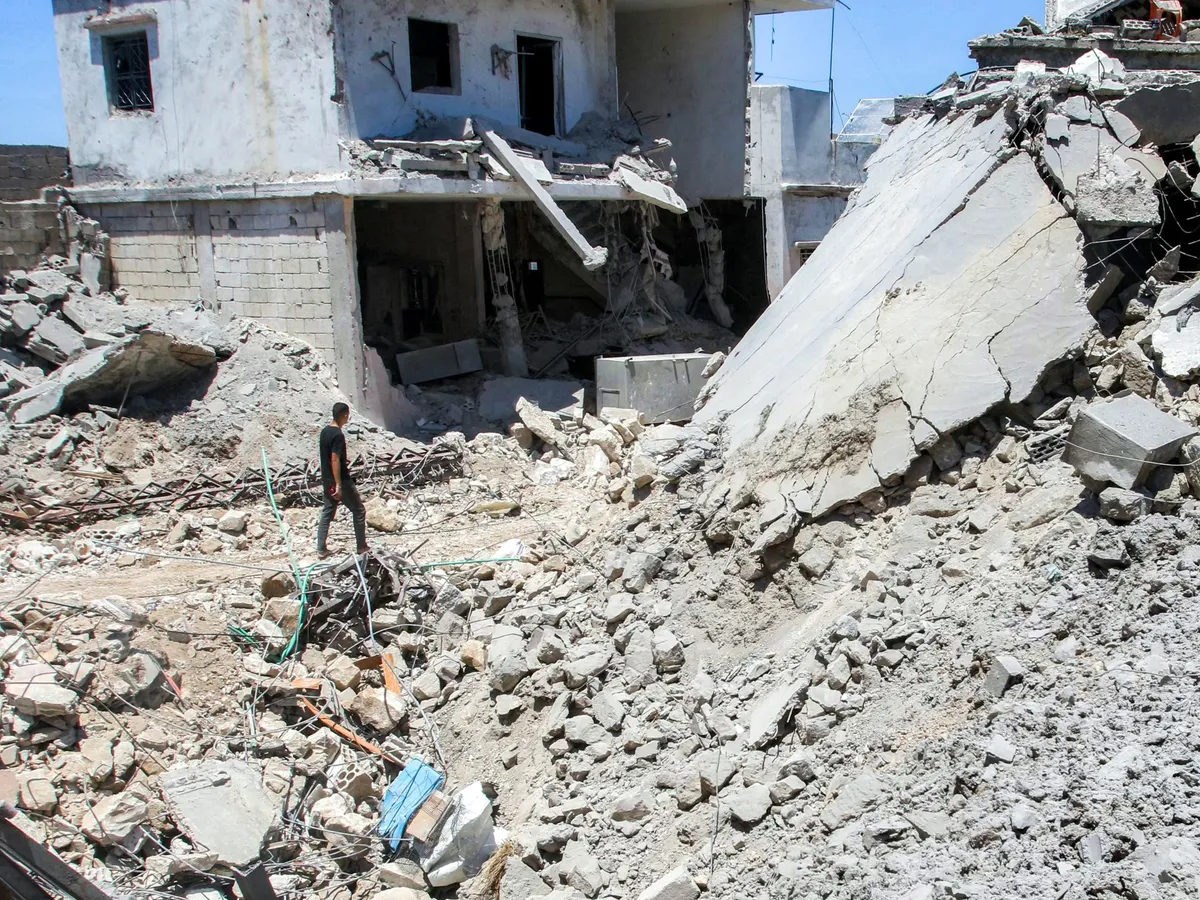
There has been a reduction in violence since the US-Iran agreement was announced, but attacks on Lebanese territory have not stopped.A man walks past the rubble of a destroyed building in the village of Deir Qanoun en-Nahr in southern Lebanon [File: AFP]Published On 17 Jun 2026Israeli air strikes have continued to target towns in southern Lebanon despite an agreement between the United States and Iran set to be formally signed on Friday to end the war on all fronts.Israeli drones carried out three attacks in Tyre that resulted in injuries while a drone also targeted the Bint Jbeil district in Nabatieh, Lebanon’s state-run National News Agency said on Wednesday.Recommended Stories list of 4 itemslist 1 of 4Israeli strikes kill four in southern Lebanon amid ceasefire talkslist 2 of 4Returning to destruction in south Lebanonlist 3 of 4UN reports decline in cross-border fire in southern Lebanonlist 4 of 4Iran war day 110: Tehran says Israeli attacks on Lebanon threaten US dealend of listThe fighting in Lebanon is considered one of the biggest threats to the framework agreement in the US-Israel war on Iran with Tehran warning that new Israeli strikes on Lebanon and continued occupation of its territory would be regarded as a violation of the deal.Earlier on Wednesday, Al Jazeera Arabic correspondents on the ground reported that Israeli forces carried out an air strike on the outskirts of Kfar Tebnit, also in the Nabatieh district. They also launched raids on the town of Nabatieh-al-fawqa" class="entity-link entity-location" data-entity-id="148021" data-entity-type="location">Nabatieh al-Fawqa and shelled the Ali al-Taher heights and the outskirts of the town.Hezbollah fighters, meanwhile, launched at least 10 rockets towards Israeli forces near Kfar Tebnit.A day earlier, Israeli attacks killed at least four people in Nabatieh, including in drone strikes on several vehicles.There has been a reduction in violence since the US-Iran agreement was announced, but attacks have not stopped, Al Jazeera’s Zeina Khodr said, reporting from Beirut.“Security sources believe that the Israeli army is trying to occupy more ground, especially strategic high ground around Nabatieh,” she said.“Yes, families have started to return to their villages, but people are worried. They say they don’t trust that Israel will abide by the ceasefire.”United Nations spokesperson Stephane Dujarric said the number of projectiles fired between Israeli forces and Lebanon fell to 174 on Sunday, compared with 705 the previous Sunday.Of these, 169 were attributed to Israel and five to Hezbollah, he said.Lebanon ‘most sensitive issue between the sides’The situation in Lebanon is one of the main pillars of the US-Iran agreement, Al Jazeera’s Almigdad Alruhaid said, reporting from Tehran.“As we approach the signing of the deal, it is becoming the most sensitive issue between the sides,” Alruhaid said.Iran said the Israeli military has violated the ceasefire in Lebanon 84 times in the past two days and warned that Israel should expect “a harsh response” if it does not stop its attacks, he reported.This came after Iranian Foreign Minister Abbas Araghchi said the withdrawal of the Israeli military from Lebanese territory is one of the core demands right now to move forward with the framework agreement Iran has with the US, Alruhaid said: “So the Iranians say the situation in Lebanon, in particular southern Lebanon, is an integral part of the memorandum of understanding.”Lebanon was among the top priorities for the Iranians when they started negotiations with US President Donald Trump’s administration, according to Mohammad Eslami from Tehran University.“Once the Iranians not only retaliated against the Israeli attacks on Dahiyeh and Beirut but also pre-emptively attacked Israeli territory, they showed right from the outset they are determined and very serious about supporting Lebanon, the Lebanese people, the Lebanese government and the resistance factions in Lebanon,” Eslami told Al Jazeera.Israel’s invasion akin to ‘war crimes’Meanwhile, the human rights group Amnesty International said on Wednesday that the Israeli army’s mass forced displacement orders in Lebanon amount to war crimes under international law.“In parts of southern Lebanon, the Israeli military’s forced displacement of civilians and prevention of their return amounts to unlawful transfer – which is a war crime,” Amnesty said in a statement.The Israeli army has “radically expanded” its use of such orders, displacing hundreds of thousands of people across Lebanon, it said.“Instead of forcibly uprooting communities and designating entire swathes of Lebanese land as ‘no-go zones’ for civilians, Israeli forces must immediately withdraw from Lebanese territory,” said Kristine Beckerle, Amnesty International’s deputy regional director for the Middle East and North Africa.The Israeli military declared about 4.6 percent of Lebanon as a “no-go zone” on November 28, 2024, a day after a previous ceasefire took effect, Amnesty noted.This year, just three days after an April 17 ceasefire announcement, the restricted area was expanded to about 6 percent of the country, and residents were ordered not to return to villages previously home to tens of thousands of civilians.Lebanese officials said Israel, which has been carrying out a large-scale offensive in the country since March 2, has killed more than 3,800 people, wounded 11,850 and displaced more than one million.
SRCAl Jazeera
LANGEN
LEANCenter
WORDS828
ENT12
WED · 2026-06-17 · 13:15 GMTBRIEF NSR-2026-0617-85195
NSR-2026-0617-85195News Report·EN·Conflict
Israeli air strikes on Lebanon continue despite US-Iran deal
Despite a US-Iran agreement aimed at ending conflict, Israeli air strikes continue to target southern Lebanon. On Wednesday, Israeli drones attacked Tyre and the Bint Jbeil district, causing injuries.
Al Jazeera StaffAl JazeeraFiled 2026-06-17 · 13:15 GMTLean · CenterRead · 4 min
Al JazeeraFIG 01
Reading time
4min
Word count
828words
Sources cited
4cited
Entities identified
12entities
Quality score
100%
§ 01
Briefing Summary
AI-generatedNEWSAR · AI
Despite a US-Iran agreement aimed at ending conflict, Israeli air strikes continue to target southern Lebanon. On Wednesday, Israeli drones attacked Tyre and the Bint Jbeil district, causing injuries. Hezbollah also launched rockets towards Israeli forces. Iran has warned that continued Israeli strikes and occupation of Lebanese territory would violate the deal, viewing the situation in Lebanon as a sensitive and integral part of the agreement. Amnesty International stated that Israel's forced displacement of civilians in southern Lebanon constitutes war crimes. While overall violence has reduced since the agreement's announcement, residents express concern about Israel's adherence to a ceasefire.
Confidence 0.90Sources 4Claims 5Entities 12
§ 02
Article analysis
Model · rule-basedFraming
Conflict
Diplomatic
Tone
Measured
AI-assessed
CalmNeutralAlarmist
Factuality
0.70 / 1.00
Factual
LowHigh
Sources cited
4
Well sourced
FewMany
§ 03
Key claims
5 extracted01
The number of projectiles fired between Israeli forces and Lebanon fell to 174 on Sunday, compared with 705 the previous Sunday.
statisticUnited Nations spokesperson Stephane Dujarric
Confidence
1.00
02
Israeli air strikes continued to target towns in southern Lebanon despite a US-Iran agreement to end the war on all fronts.
factual
Confidence
1.00
03
Israeli drones carried out three attacks in Tyre resulting in injuries, and a drone targeted the Bint Jbeil district.
factualLebanon’s state-run National News Agency
Confidence
0.90
04
Iran said the Israeli military has violated the ceasefire in Lebanon 84 times in the past two days.
factualIran
Confidence
0.80
05
The fighting in Lebanon is considered one of the biggest threats to the US-Iran framework agreement.
factual
Confidence
0.80
§ 04
Full report
4 min read · 828 words§ 05
Entities
12 identifiedKey playerOppositionContextPositiveNeutralNegative
Organizations1
§ 06
Keywords & salience
10 termsisraeli air strikes
1.00
lebanon
0.90
us-iran agreement
0.80
southern lebanon
0.70
violence
0.60
ceasefire
0.50
united states
0.40
iran
0.40
occupation
0.40
hezbollah
0.40
§ 07
Topic connections
Interactive graph Network visualization showing 51 related topics
View Full Graph Person Organization Location Event|Click node to navigate|Edge numbers = shared articles