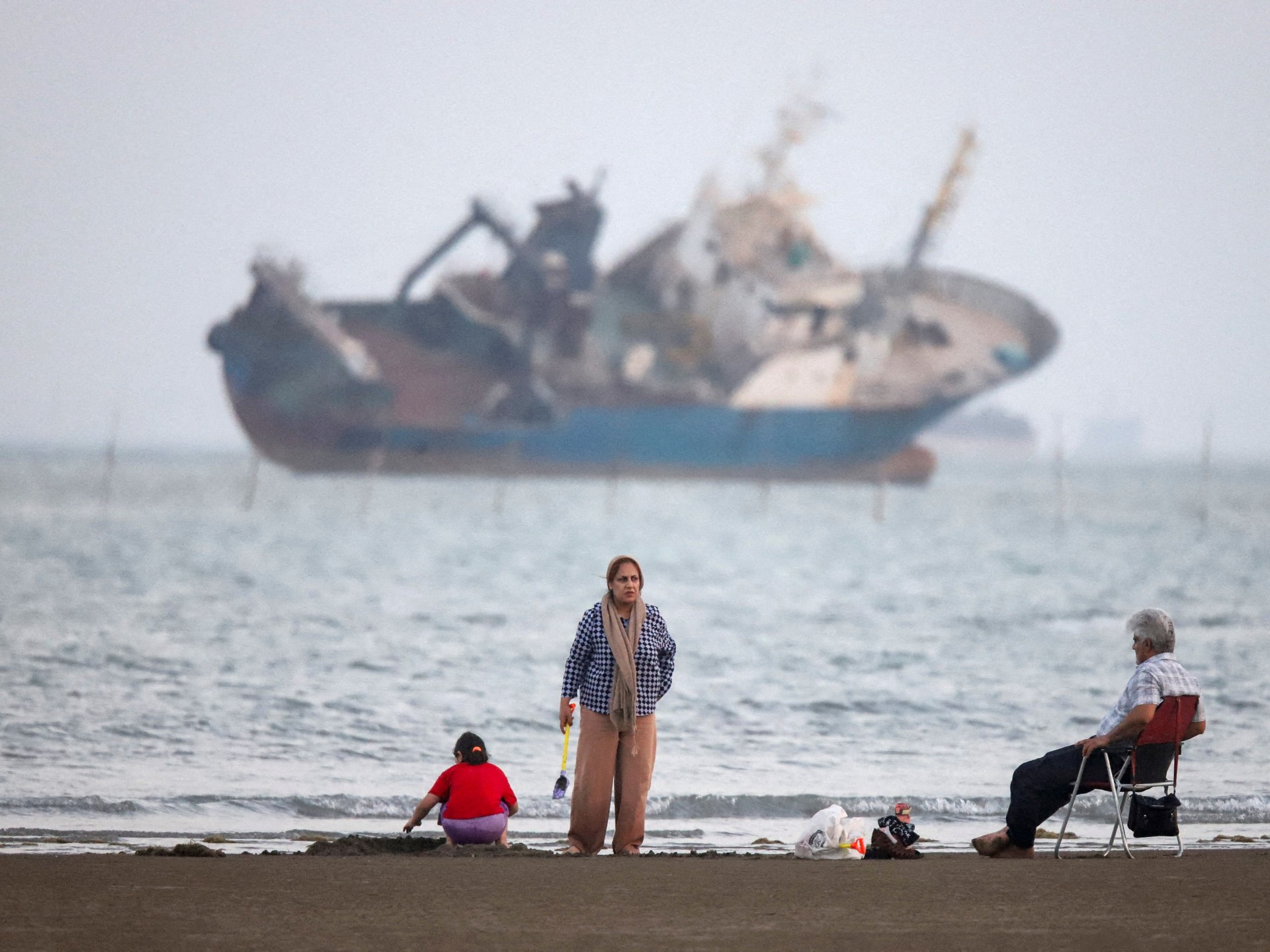
EXPLAINERShipping operators and insurers prefer to wait and watch from a distance for now.People gather on a beach, as a vessel in the Strait of Hormuz is visible, near the beach of Bandar Abbas, Iran, May 31, 2026 [Amirhosein Khorgooi/West Asia News Agency via Reuters]Published On 17 Jun 2026US President Donald Trump was jubilant when he announced a preliminary deal with Iran to end the war that has brought about the worst energy crisis of modern history – and which has closed the Strait of Hormuz to world shipping.“Ships of the World, start your engines. Let the oil flow!” Trump wrote in his Truth Social post on Sunday.Oil prices tumbled. But three days after the agreement was announced by both Iran and the US, marine traffic has not picked up in the narrow yet vital waterway, ship tracking data shows.Shipping companies and insurance underwriters appear to be taking a wait-and-see approach before deeming transit through the Strait of Hormuz, and the broader ceasefire, sufficiently stable.So, what are the major challenges as the Strait of Hormuz reopens?Commuters drive past a large banner depicting the closure of the Strait of Hormuz in Tehran on June 3, 2026 [Atta Kenare/AFP]What’s happening in Hormuz?Before the war began, between 120 and 140 ships travelled through the strait each day, about half of them oil tankers carrying some 20 million barrels of oil between them. Iran quickly closed the strait following the start of US-Israeli bombing at the end of February, and the US began a corresponding naval blockade of Iranian ports a few weeks later.Since the preliminary deal was announced on Sunday, only seven ships have passed through, according to shipping monitor MarineTraffic. Among these were a few tankers carrying Iranian oil which crossed the US blockade line in the Strait of Hormuz – Iran’s “first crude oil exports in two months”, the marine shipping monitor TankerTrackers reported on Wednesday.More than 550 ships remain stranded on either side of the strait, waiting to transit the Gulf waters.While Trump insists that the strait is “wide open” for traffic, Iranian officials have reiterated that any transit through it must still be coordinated with Iran’s Islamic Revolutionary Guard Corps (IRGC) and follow a route close to the Iranian coastline.(Al Jazeera)Why isn’t the traffic picking up?Besides fears of mines in the strait, which the US says will be cleared now, shipping operators are still wary that hostilities could kick off again at any time.The unprecedented exchange of missiles and armed drones across the Gulf in recent weeks has heightened security concerns in the Strait of Hormuz. Furthermore, both the US and Iran have attacked and fired upon commercial vessels in the waterway that is only 33km (20 miles) wide at its narrowest point.Last week, the US military attacked at least three commercial vessels, killing three Indian sailors in one attack.Then, just one day before the deal was announced, the US military’s Central Command (CENTCOM) said in a statement that its naval blockade had redirected 142 commercial ships that complied and disabled nine vessels that did not comply.Even though negotiations for a final peace deal are due to begin following a ceremonial signing in Switzerland on Friday, concerns remain that commercial shipping could still be caught in the crossfire.“It will take more than just a political agreement before we see a normalisation, hence the reason we haven’t seen any material changes until now in Hormuz if looking at AIS-trackers,” said Haider Anjum, a senior equity analyst at Jyske Bank, referring to the transponders ships use to transmit their locations.“Shipowners need to see actual physical security and stability over a longer period,” he told Al Jazeera. “We must see a sustained period with no incidents before shipowners and insurers will consider that the risk has de-escalated enough.”This could take around four months, he added.An Iranian woman walks on the beach as vessels in the Strait of Hormuz are visible near the beach of Bandar Abbas, Iran, May 22, 2026 [Majid Asgaripour/West Asia News Agency via Reuters]Shipping operators’ main concerns include the following:MinesThe threat of underwater mines has plagued the Strait of Hormuz traffic for some time.Earlier in the war, Iran threatened that it would mine the waterway, but it has never confirmed whether or not it did this. When the IRGC first released a map of the safe route ships it approves for passage can pass, it mentioned that this would avoid “potential” mines.The US has claimed mines are a risk and said it specifically targeted Iranian mine-laying boats during the conflict.On June 2, US Secretary of State Marco Rubio told a Senate Foreign Relations Committee hearing that Iran had “mined large segments of Hormuz – international waters”, without elaborating.However, even the possibility of mines in the waterway is enough to halt traffic, largely because no insurance company will cover ships taking such a risk.“Even with the reopening, the risk environment remains elevated. The primary risks stem from mines,” Anjum said. “Establishment of a verified and secure mine-free corridor, with mine clearance, is expected to take around two months.”Nader Habibi, an Iranian-American economist, told Al Jazeera that the crew on vessels transiting the Strait of Hormuz “would still be concerned about their safety for a few weeks as negotiations continue for the unresolved issues between the US and Iran”, adding that there will be a risk of “encountering unresolved mines”.This photo obtained by AFP from the Iranian news agency Tasnim shows an IRGC boat allegedly taking part in an operation to seize ships attempting to cross the Strait of Hormuz, on April 21, 2026 [AFP]TollsHistorically, a transit through the Strait of Hormuz, which flows through the territorial waters of Iran and Oman, has been free of charge. Since the war began, however, Tehran has stated that this will not continue.Under international law, tolls may not be charged through natural straits such as Hormuz, even if they are not in international waters. However, it is permissible for adjacent states to charge fees for “services” rendered to shipping passing through, such as insurance or docking.The US and GCC countries have opposed the imposition of any “toll-like” charges for transit, which they say essentially violate freedom of navigation in the high seas. Iran insists that it is not planning to charge tolls for passage, but fees for coordinating safe transit.It has the right to do this, Tehran says, as the strait is not in international waters. It established the Persian Gulf Strait Authority in May to oversee such operations in the Strait of Hormuz.“The US is very likely to resist and oppose unilateral tolling by Iran. However, it might be reluctant to restart the conflict over this issue,” said Habibi. “Keeping the strait open is a higher priority even if it has to look the other way on this issue.”In the longer run, however, Habibi said that it is “unlikely that the GCC countries and the US will allow Iran to demand any tolls”. He noted that the US could decide to sanction vessels paying “tolls” to Iran.Others do not believe Iran will give up some form of control of the strait, however, as it is the most powerful leverage it has against the US.InsuranceInsurance companies’ unwillingness to underwrite war-risk premiums – which were largely hiked to unaffordable levels or withdrawn altogether for Hormuz shipping following the start of the US-Iran war – is another major obstacle to restarting shipping through the strait.
SRCAl Jazeera
LANGEN
LEANCenter
WORDS1 229
ENT12
WED · 2026-06-17 · 14:07 GMTBRIEF NSR-2026-0617-85228
NSR-2026-0617-85228Analysis·EN·Conflict
Strait of Hormuz reopens: But can ships’ safety be assured?
Despite a preliminary deal between the US and Iran to end a war that closed the Strait of Hormuz, marine traffic has not significantly resumed. Shipping operators and insurers are adopting a wait-and-see approach due to lingering concerns about safety and stability.
Yashraj SharmaAl JazeeraFiled 2026-06-17 · 14:07 GMTLean · CenterRead · 5 min
Al JazeeraFIG 01
Reading time
5min
Word count
1 229words
Sources cited
3cited
Entities identified
12entities
Quality score
100%
§ 01
Briefing Summary
AI-generatedNEWSAR · AI
Despite a preliminary deal between the US and Iran to end a war that closed the Strait of Hormuz, marine traffic has not significantly resumed. Shipping operators and insurers are adopting a wait-and-see approach due to lingering concerns about safety and stability. Before the conflict, 120-140 ships transited daily, but only seven have passed since the agreement. Key challenges include the potential for mines, the risk of renewed hostilities, and the requirement for coordination with Iran's IRGC for passage. Shipping companies need to observe a sustained period of no incidents before deeming the strait safe for normal operations, a process that could take months.
Confidence 0.90Sources 3Claims 5Entities 12
§ 02
Article analysis
Model · rule-basedFraming
Conflict
Economic Impact
Tone
Mixed Tone
AI-assessed
CalmNeutralAlarmist
Factuality
0.70 / 1.00
Factual
LowHigh
Sources cited
3
Well sourced
FewMany
§ 03
Key claims
5 extracted01
US President Donald Trump announced a preliminary deal with Iran to end the war and reopen the Strait of Hormuz.
quoteDonald Trump
Confidence
1.00
02
Shipping operators and insurers are taking a wait-and-see approach due to fears of mines and potential renewed hostilities.
factualarticle
Confidence
0.90
03
Before the war, 120-140 ships, carrying about 20 million barrels of oil daily, travelled through the Strait of Hormuz.
statisticarticle
Confidence
0.90
04
Marine traffic in the Strait of Hormuz has not significantly picked up since the preliminary deal was announced.
factualarticle
Confidence
0.90
05
Iran closed the Strait of Hormuz following the start of US-Israeli bombing in late February.
factualarticle
Confidence
0.80
§ 04
Full report
5 min read · 1 229 words§ 05
Entities
12 identifiedKey playerOppositionContextPositiveNeutralNegative
Organizations5
Locations5
Events1
§ 06
Keywords & salience
10 termsstrait of hormuz
1.00
shipping safety
0.90
energy crisis
0.80
iran-us relations
0.70
oil prices
0.70
ceasefire
0.60
war
0.60
marine traffic
0.50
islamic revolutionary guard corps
0.40
mines
0.40
§ 07
Topic connections
Interactive graph Network visualization showing 50 related topics
View Full Graph Person Organization Location Event|Click node to navigate|Edge numbers = shared articles