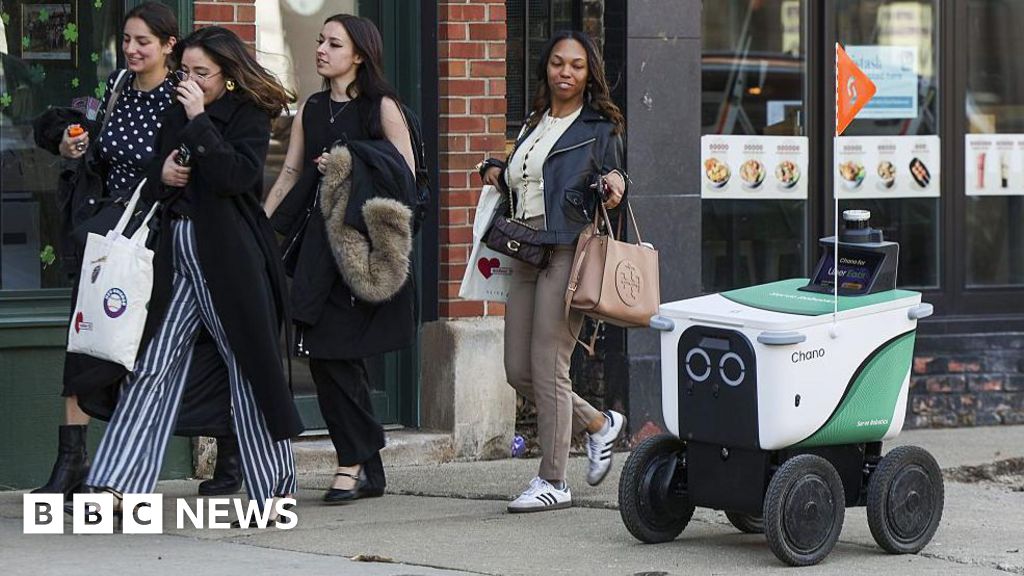
'We had to get out of the way': The backlash over delivery robots 5 hours ago Share Save Add as preferred on Google Emma WoollacottTechnology reporter AFP via Getty Images delivery robots are now a common sight in some cities around the world The first time Chicago resident John Roberts saw a delivery robot trundling down the sidewalk on his street he was impressed. "I actually thought they were kind of neat – it felt futuristic," he says. But his attitude started to change when, soon after, he was out for a walk with his family. As another robot approached, they found themselves having to dodge it. "To us it felt a little off - the fact that we were on the one strip reserved for walking, and we were having to get out of the way," says Roberts. "I started thinking about what it would be like for us to go for a walk as a family if there were dozens of robots with lights and cameras zipping around." The robots, more formally known as autonomous urban delivery vehicles, have started to appear on pavements in a number of cities across the US, plus in the UK, Japan, South Korea and Germany, transporting groceries and fast food, using cameras, sensors and GPS to navigate. John Roberts Chicagoan John Roberts has launched a campaign against delivery robots According to the companies operating them, they can reliably identify and avoid objects in the path, cross streets safely and react to their environment. The robots provide a useful service and help cut down on traffic and emissions, they claim. However, some local authorities in the US and Canada, and members of the public, are less than enthusiastic. Bans have been put in place, and protests have been launched. San Francisco has limited the access of the vehicles to less busy parts of the city, and Toronto has since 2021 prohibited the robots from using sidewalks. Meanwhile, in Chicago the machines have now been banned from two small areas of the city. Roberts wants the robots to be suspended across all of Chicago until safety tests are carried out, and clear rules are set on their usage. He has launched a petition calling for this, and so far, it has around 4,400 signatures. People frequently find themselves having to step into the street in order to get out of the machines' way, says Roberts. "There have been reports of collisions and injuries. I saw one a few days ago where somebody had been struck by one of the robots' safety flags, which is a little ironic," he says. "We've got reports of robots causing issues with traffic, blocking emergency vehicles because they're acting erratically at crosswalks." Uber Eats delivery robots vandalised in Sheffield Self-driving delivery robots rolled out Similar concerns have emerged in Glendale, California, where the local council is considering a temporary ban on the use of the vehicles. Councillors say the robots appeared without warning, and at first they didn't even know which company was supplying them. "What triggered the concern and the discussion was a number of factors," says Coun Ardy Kassakhian. "The increased visibility of the robots in the downtown, and the question about accessibility and pedestrian movement on our public sidewalks. "Plus, uncertainty regarding the regulatory authority - because no-one asked us for permission to use the sidewalks for this business enterprise - and then the broader concern was about the impact on workers and public places." Sidewalks in Glendale aren't particularly wide, adds Kassakhian, and he personally has witnessed a "stand-off" between a delivery robot and an elderly person, as well as broken-down robots causing obstructions. Kassakhian says the council is seeking a regulated approach for the longer term. "We need a regulatory framework, we need to designate operating rules, insurance requirements, accessibility standards, possibly permitting fees, operational limits in high pedestrian areas, and to have accountability for the operators." Coco Rules governing delivery robots differ around the world In the UK, where delivery robots are being piloted in a number of cities, some locals have taken matters into their own hands. There have been reports of Uber Eats vehicles being vandalised in Sheffield. The supplier of these machines, Starship Technologies, says they are perfectly safe and that perceptions need to change. "We know it's a new experience for a lot of people to share a pavement with a robot," says the company's European operations director Danny Pass. "But the robots are friendly, they're polite and they're programmed to be careful. They've slotted into everyday life in loads of communities since we started out in the UK back in 2018." Not all concerns, though, are centred around pedestrian safety. The Independent Workers Union of Great Britain (IWGB), whose members include delivery drivers, is worried about the impact on jobs. It says it is keeping a watchful eye, and it has already expressed its concerns to the government. "I think if it became more of a [permanent, countrywide] reality, we'd definitely have to be thinking about where we put on pressure - whether that's government, TfL [Transport for London], or local authorities - to ensure that these things are banned, because the human impact would be massive," says president Alex Marshall. "This would mean whole communities in London, where a lot of people are precarious workers, would really suffer. People would be fighting for their lives against these pointless robots." IWGB UK trade union boss Alex Marshall, left, is worried that delivery robots will mean job cuts While the use of autonomous delivery robots is still limited, analysts believe they're set for a major boom. A report last summer from research firm Transforma Insight, indeed, concluded that by 2034, there will be 2.1 million in operation around the world. Currently, there's a hotchpotch of regulation worldwide. Some countries, such as South Korea and Japan, have taken a liberal approach. Back in Chicago, Roberts says he is fighting for the best possible outcome for pedestrians city-wide. "There's a sense that change like this, even when it's unwanted is inevitable. But even if none of us can stop the future, we can at least choose which future we move into."
SRCBBC News - World
LANGEN
LEANCenter
WORDS1 030
ENT12
WED · 2026-06-17 · 23:02 GMTBRIEF NSR-2026-0618-85387
NSR-2026-0618-85387News Report·EN·Human Interest
'We had to get out of the way': The backlash over delivery robots
Delivery robots, or autonomous urban delivery vehicles, are increasingly appearing on sidewalks in US cities and internationally, transporting goods like groceries and food. While companies claim they are safe and reduce traffic, public backlash and regulatory actions are emerging.
BBC News - WorldFiled 2026-06-17 · 23:02 GMTLean · CenterRead · 5 min
BBC News - WorldFIG 01
Reading time
5min
Word count
1 030words
Sources cited
3cited
Entities identified
12entities
Quality score
100%
§ 01
Briefing Summary
AI-generatedNEWSAR · AI
Delivery robots, or autonomous urban delivery vehicles, are increasingly appearing on sidewalks in US cities and internationally, transporting goods like groceries and food. While companies claim they are safe and reduce traffic, public backlash and regulatory actions are emerging. Residents in cities like Chicago and Glendale report having to dodge the robots, raising concerns about pedestrian safety, accessibility, and potential obstructions. Consequently, some municipalities, such as San Francisco and Toronto, have implemented restrictions or bans on their use. Activists are calling for safety tests and clear regulations, while some locals have resorted to vandalism. Concerns also extend to the potential impact on delivery driver jobs.
Confidence 0.90Sources 3Claims 5Entities 12
§ 02
Article analysis
Model · rule-basedFraming
Human Interest
Technology
Tone
Mixed Tone
AI-assessed
CalmNeutralAlarmist
Factuality
0.60 / 1.00
Mixed
LowHigh
Sources cited
3
Well sourced
FewMany
§ 03
Key claims
5 extracted01
Delivery robots are appearing on sidewalks in cities across the US, UK, Japan, South Korea, and Germany.
factual
Confidence
1.00
02
Some local authorities in the US and Canada have implemented bans or restrictions on delivery robots using sidewalks.
factual
Confidence
0.95
03
Companies claim delivery robots help cut down on traffic and emissions.
quoteCompanies operating robots
Confidence
0.90
04
Residents are sometimes forced to step into the street to avoid delivery robots on sidewalks.
quoteJohn Roberts
Confidence
0.90
05
There have been reports of collisions and injuries involving delivery robots.
quoteJohn Roberts
Confidence
0.80
§ 04
Full report
5 min read · 1 030 words§ 05
Entities
12 identifiedKey playerOppositionContextPositiveNeutralNegative
Locations9
§ 06
Keywords & salience
10 termsdelivery robots
1.00
sidewalk access
0.90
public backlash
0.80
autonomous vehicles
0.70
urban navigation
0.60
safety concerns
0.60
pedestrian conflict
0.50
regulatory bans
0.50
technology adoption
0.40
chicago
0.40
§ 07
Topic connections
Interactive graph Network visualization showing 16 related topics
View Full Graph Person Organization Location Event|Click node to navigate|Edge numbers = shared articles