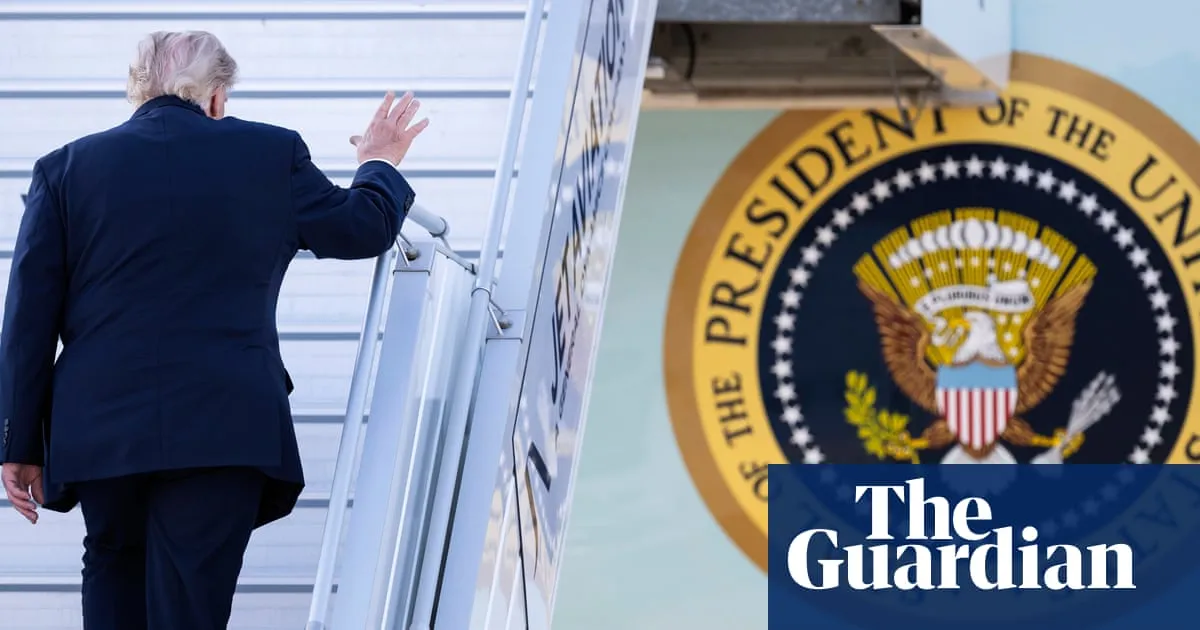
Only a man with an unparalleled ignorance of history such as Donald Trump would have signed America’s peace treaty with Iran at Versailles, the byword for national humiliation. And only a man with an impish sense of humour such as Emmanuel Macron would have suggested it.It is easy to cast Trump in the role of the humiliated and hurt German Count Ulrich von Brockdorff-Rantzau. The treaty of Versailles after all was based on 14 points, just as the memorandum of understanding has 14 clauses.But the memorandum is not a full-scale surrender document; it is an admission that America could not achieve what it sought through war.If the memorandum, taken with Trump’s remarks at his hour-long press conference at the G7, is compared with the final document the Americans tabled in 2025, it is possible to see how far the US has been forced to retreat. Red line after red line has been erased.The 2025 document was tabled by the US immediately before Israel – with US support – began the 12-day war culminating in the bombing of Iran’s nuclear sites. Under its terms, Iran would have had no domestic enrichment capabilities beyond the limited enrichment for medical and agricultural needs; all nuclear supply would be imported from outside Iran; all enriched uranium stockpiles would be shipped out of Iran immediately upon signing the agreement; all enriched stockpile material would be down-blended to 3.67%; Iran would not build any new enrichment facilities; and Iran would dismantle all programmes capable of uranium conversion. Instead, a consortium including Iran, the US and the Gulf states would undertake enrichment outside Iran.Donald Trump signed the deal at Versailles, the site of Germany’s humiliation after the first world war. Photograph: Anadolu/Getty ImagesAt Évian for the G7 meeting, however, Trump conceded Iran had a right to continue enrich uranium, saying it could not be excluded because other countries in the region had nuclear programmes.He added there was no great rush to dismantle or dilute the stockpile of highly enriched uranium, and US officials acknowledged that this stockpile could be diluted under IAEA watch inside Iran, so long as it was diluted to 3.67%.In practice, for the immediate waiver on oil exports to work, waivers will need to be issued on associated services including banking transactions, insurance and transportation.Miad Maleki, a former US Treasury official and a senior fellow at the Foundation for Defense of Democracies thinktank, said broadening authorisation to financial transactions would crack the core architecture of US oil and financial sanctions against Iran, arguably the most powerful economic leverage the US holds over the regime outside the naval blockade.Wider sanctions relief, which will not be offered until the nuclear negotiations are completed to mutual satisfaction, would cover primary and secondary sanctions as well as UN sanctions. If this happened, it would represent the biggest recasting of US-Iran relations since the Iranian revolution in 1979.What is worse from the US perspective is that all these concessions have been made to try to secure the reopening of the strait of Hormuz, which was open before the war, but even that may not be achieved.The memorandum shows the strait of Hormuz may not remain open beyond 60 days, when Iran will discuss maritime services in the strait with other Gulf states. Photograph: ReutersThe memorandum text shows that free navigation of the strait could end after 60 days, at which point Iran will conduct dialogue with Oman to define the future administration and maritime services in the strait in discussion with other Gulf states.Finally, there is a proposed $350bn Iran reconstruction fund that the US has said it will create but will not contribute to.For that amount of money – the equivalent of the financial losses Iran has suffered – to be raised, the Gulf states would have to be deeply forgiving to a country that has just bombed their hotels and airbases and frozen their economies.Nothing, even the unfreezing of the $24bn Iranian assets abroad, is likely to do much to ease Iran’s acute economies woes.Satellite image of damage to the Isfahan nuclear enrichment facility in central Iran after US strikes in June 2025. Photograph: Satellite image ©2025 Maxar Technologies/AFP/Getty ImagesAs to whether the deal is better or worse than Barack Obama’s 2015 nuclear deal, many of those involved in the talks say it is like comparing apples and oranges. The context is different, partly because Iran’s nuclear sites have been so damaged.More importantly, the 2015 deal was a fully fledged arms control document. The memorandum is at best a document that sets the stage for another negotiation that could end up in a stalemate or an agreement closely resembling the 2015 deal.Apart from the Iranian reiteration that it does not seek a nuclear weapon, the scope of the nuclear talks is left entirely open. The memorandum’s language is not even as strong as the 2015 agreement where Iran reaffirmed “that under no circumstances will Iran ever seek, develop or acquire nuclear weapons”.A denial of intent is irrelevant. It is the method of verification that matters, and on that the US is no further than before.So why has he struck the deal? Trump was very frank on Wednesday: the riskof a worldwide recession and oil reserves running out in a matter of weeks. He said: “The one president I did not want to be was the late, great Herbert Hoover,” referring to the president blamed for the Great Depression that wiped out savings and pitched millions into poverty. “I didn’t want to see economic catastrophe. If you kept this going, that could have happened.”
SRCThe Guardian - World News
LANGEN
LEANCenter-Left
WORDS926
ENT12
THU · 2026-06-18 · 15:41 GMTBRIEF NSR-2026-0618-85531
NSR-2026-0618-85531Analysis·EN·Diplomatic
Iran peace deal makes clear how far US has been forced to retreat since 2025
A recent memorandum of understanding between the US and Iran, signed at Versailles, signifies a significant retreat for US policy since 2025. The agreement, described as an admission of the US's inability to achieve its goals through war, contrasts sharply with a previous US proposal from 2025.
Patrick Wintour Diplomatic editorThe Guardian - World NewsFiled 2026-06-18 · 15:41 GMTLean · Center-LeftRead · 4 min
The Guardian - World NewsFIG 01
Reading time
4min
Word count
926words
Sources cited
1cited
Entities identified
12entities
Quality score
100%
§ 01
Briefing Summary
AI-generatedNEWSAR · AI
A recent memorandum of understanding between the US and Iran, signed at Versailles, signifies a significant retreat for US policy since 2025. The agreement, described as an admission of the US's inability to achieve its goals through war, contrasts sharply with a previous US proposal from 2025. Under the 2025 terms, Iran would have had no domestic enrichment capabilities and would have shipped all enriched uranium abroad. However, the new memorandum allows Iran to continue uranium enrichment and dilute its stockpile domestically under IAEA watch. The deal also includes potential waivers on oil exports and associated financial transactions, which could undermine US sanctions. Furthermore, the memorandum suggests free navigation of the Strait of Hormuz may be limited after 60 days, with Iran to discuss maritime services with other Gulf states. The US has also proposed a $350 billion Iran reconstruction fund to which it will not contribute.
Confidence 0.90Sources 1Claims 5Entities 12
§ 02
Article analysis
Model · rule-basedFraming
Diplomatic
Political Strategy
Tone
Sensational
AI-assessed
CalmNeutralAlarmist
Factuality
0.40 / 1.00
Mixed
LowHigh
Sources cited
1
Limited
FewMany
§ 03
Key claims
5 extracted01
Broadening authorization to financial transactions would crack the core architecture of US oil and financial sanctions against Iran.
factualMiad Maleki
Confidence
0.90
02
Trump conceded Iran has a right to continue uranium enrichment, stating it cannot be excluded due to regional nuclear programs.
factual
Confidence
0.90
03
The US tabled a document in 2025 requiring Iran to have no domestic enrichment capabilities and ship enriched uranium out of the country.
factual
Confidence
0.90
04
Donald Trump signed a peace treaty with Iran at Versailles, a site associated with national humiliation.
factual
Confidence
0.90
05
The memorandum of understanding represents an admission that America could not achieve its goals through war.
factual
Confidence
0.80
§ 04
Full report
4 min read · 926 words§ 05
Entities
12 identifiedKey playerOppositionContextPositiveNeutralNegative
People3
Organizations3
Locations5
§ 06
Keywords & salience
10 termsiran peace deal
1.00
us retreat
0.90
nuclear enrichment
0.80
donald trump
0.70
versailles treaty
0.60
us policy shift
0.60
iran nuclear program
0.50
g7 meeting
0.50
oil export waivers
0.40
iaea
0.40
§ 07
Topic connections
Interactive graph Network visualization showing 51 related topics
View Full Graph Person Organization Location Event|Click node to navigate|Edge numbers = shared articles