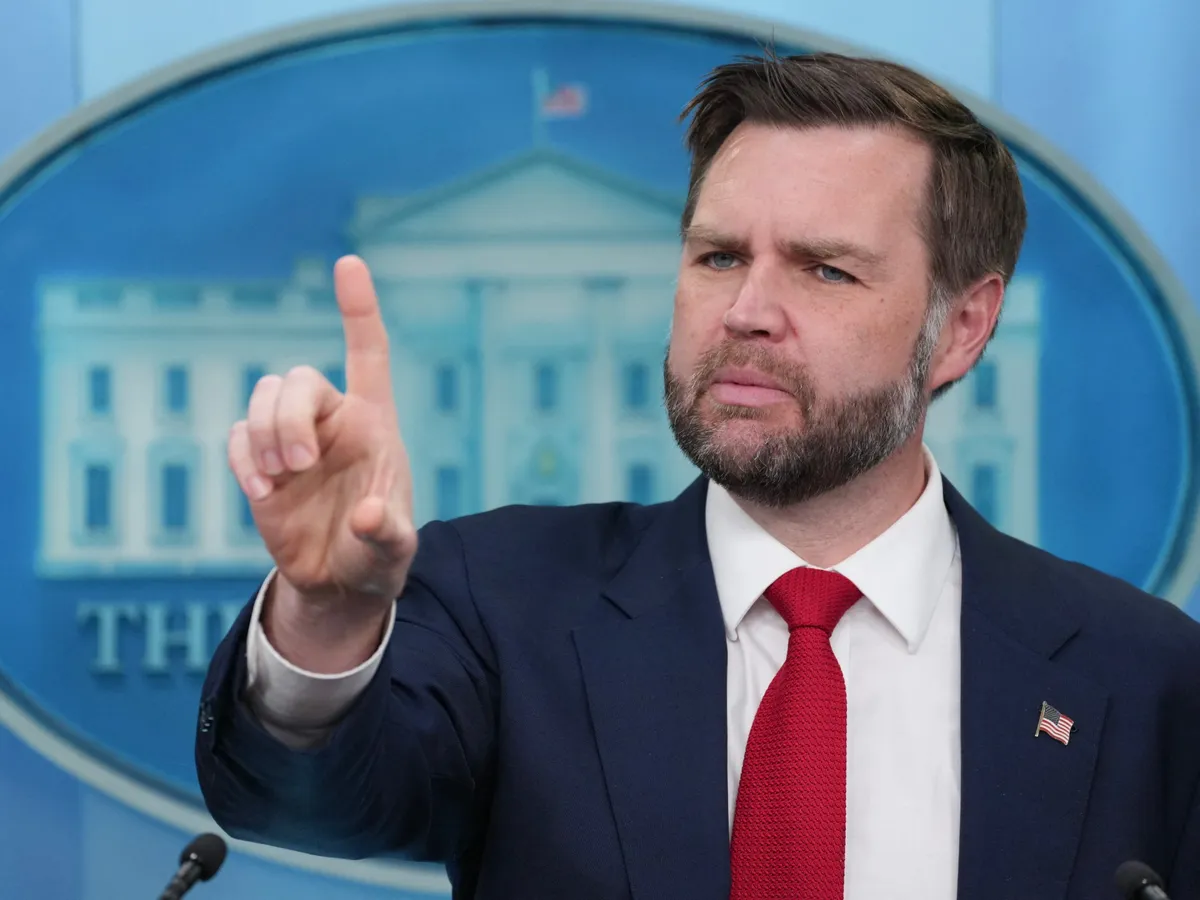
US Vice President JD Vance speaks during a press briefing in the Brady Briefing Room of the White House in Washington, DC, on June 18, 2026. [AFP]Published On 18 Jun 2026United States Vice President JD Vance has been defending the memorandum of understanding to end the Iran" class="entity-link entity-event" data-entity-id="39146" data-entity-type="event">US-Israeli war with Iran, responding to criticism of the deal from members of the opposing Democratic Party and Republicans alike.But speaking during an interview with The New York Times published on Thursday, the day after US President Donald Trump and Iranian President Pezeshkian inked the MoU, Vance reserved some of his harshest criticism for Israel, whose leaders have continually pushed Washington to continue the war.Recommended Stories list of 3 itemslist 1 of 3What the Trump-Iran agreement says about Lebanon, Hormuz and uraniumlist 2 of 3Iran says it will charge a ‘payment for services’ in the Strait of Hormuzlist 3 of 3Rial rebounds and stocks soar, but Iranians still grapple with high pricesend of listVance pointed to criticism of the deal from Israeli officials, including far-right ministers Bezalel Smotrich and Itamar Ben-Gvir.“And I guess my response to them would be: What is your exact proposal? You’re a country of nine million people. You can’t just kill your way out of solving every single national security problem that you have,” he said.He called on Israel to let negotiations play out, and to “give a little bit of credit to the United States of America, which I think has been an incredible partner for the Israeli government for a long time”.His statement was the latest instance of the Trump administration taking an atypically harsh approach – at least rhetorically – towards Israel, whose ongoing occupation of and military operations in southern Lebanon have repeatedly threatened to derail a more lasting agreement to end the war with Iran.In recent days, Trump has criticised Israel’s rules of engagement, which war monitors have long said lead to high civilian casualties, while calling for restraint in its war with Hezbollah.“Too many people have been killed,” Trump said from the G7 Summit in France.“You don’t have to knock down an apartment house every time you’re looking for somebody, because there are a lot of people in those apartment houses, and they’re not all Hezbollah,” he said.Vance claims victorySpeaking at a subsequent news conference on Thursday, Vance continued the administration’s defence of the MoU with Iran, which opens the Strait of Hormuz, lifts the US naval blockade of Iranian ports and pledges to end fighting on all fronts, including in Lebanon.Several top Democrats – and a handful of Republicans – have said the initial agreement appears to favour Tehran, saying the war has yielded no meaningful concessions that could not have been achieved in previous rounds of diplomacy.Vance maintained that, while several issues remain unresolved, the Trump administration’s war had created more favourable circumstances for the US. That included degrading Iran’s nuclear capacity, setting back Iran’s conventional military and weakening Iran’s economy, he said.The vice president framed the war as a victory, regardless of whether the upcoming negotiations, which he said could begin as soon as the weekend, were successful.“If the Iranians don’t change their behaviour, their military and their nuclear programme is still destroyed. If they do change their behaviour, then they are going to have a transformative relationship with the Middle East, and the Middle East will have a transformative relationship with the people of Iran,” he said.“That’s a win for the American people and for the President of the United States, regardless of which option the Iranians ultimately choose.”Unanswered questionsThe agreement includes immediate sanctions waivers on Iran’s fossil fuel industry, with pledges from the US and regional partners to create a $300bn reconstruction fund, negotiate the unfreezing of Iranian assets and lift all remaining sanctions.The initial agreement also includes a commitment that Iran will dilute its stockpile of highly enriched uranium “on site”, but leaves questions related to the future of Iran’s nuclear programme unanswered, leaving the issue for 60 days of negotiations.Vance said he was confident Iran would be willing to change its long-entrenched positions on its nuclear programme, potentially agreeing to an inspection regime if Washington leveraged sanctions and frozen funds.The MoU also does not address Iran’s ballistic weapons programme or its support for proxies in the region, top issues for both Israel and Iran hawks in the US.Vance suggested that he hoped negotiations would yield an agreement preventing Iran from building the “kind of missiles that can broadly threaten the entire world”. Still, as Trump had done on Wednesday, the vice president backed away from previous administration pledges to destroy Iran’s ballistic weapons capabilities.“You can’t tell a country, whether Israel or Iran, they’re not allowed to have any self-defence,” he said.The MoU also does not include commitments related to the future administration of the Strait of Hormuz or preclude Iran from imposing tolls.Vance said any future agreement will be about “ensuring that the straits are never used as a choke point for the global economy ever again”.
SRCAl Jazeera
LANGEN
LEANCenter
WORDS830
ENT12
THU · 2026-06-18 · 17:08 GMTBRIEF NSR-2026-0618-85556
NSR-2026-0618-85556News Report·EN·Conflict
JD Vance tells Israel ‘you can’t kill your way out’ of security problems
US Vice President JD Vance defended a memorandum of understanding (MoU) to end the US-Iran war, framing it as a victory for Washington regardless of future negotiations. Speaking after the MoU was inked by Presidents Trump and Pezeshkian, Vance criticized Israeli leaders for pushing for continued conflict, stating Israel "can't just kill your way out of solving every single national security problem." He urged Israel to allow negotiations to proceed, highlighting the US's long-standing partnership.
Joseph StepanskyAl JazeeraFiled 2026-06-18 · 17:08 GMTLean · CenterRead · 4 min
Al JazeeraFIG 01
Reading time
4min
Word count
830words
Sources cited
3cited
Entities identified
12entities
Quality score
100%
§ 01
Briefing Summary
AI-generatedNEWSAR · AI
US Vice President JD Vance defended a memorandum of understanding (MoU) to end the US-Iran war, framing it as a victory for Washington regardless of future negotiations. Speaking after the MoU was inked by Presidents Trump and Pezeshkian, Vance criticized Israeli leaders for pushing for continued conflict, stating Israel "can't just kill your way out of solving every single national security problem." He urged Israel to allow negotiations to proceed, highlighting the US's long-standing partnership. Vance asserted that the US-led war had degraded Iran's nuclear capacity, military, and economy, creating favorable circumstances. The MoU includes opening the Strait of Hormuz, lifting a naval blockade, and ending fighting, though issues like Iran's ballistic missiles and nuclear program remain for future talks.
Confidence 0.90Sources 3Claims 5Entities 12
§ 02
Article analysis
Model · rule-basedFraming
Conflict
Diplomatic
Tone
Mixed Tone
AI-assessed
CalmNeutralAlarmist
Factuality
0.60 / 1.00
Mixed
LowHigh
Sources cited
3
Well sourced
FewMany
§ 03
Key claims
5 extracted01
US President Donald Trump criticized Israel's rules of engagement, stating too many civilians have been killed.
quoteDonald Trump
Confidence
1.00
02
US Vice President JD Vance stated that Israel cannot kill its way out of national security problems.
quoteJD Vance
Confidence
1.00
03
Some Democrats and Republicans believe the Trump-Iran agreement favors Tehran and offers no new concessions.
factual
Confidence
0.90
04
The memorandum of understanding to end the US-Israeli war with Iran opens the Strait of Hormuz and lifts the US naval blockade of Iranian ports.
factual
Confidence
0.90
05
Vance asserted that the Trump administration's war created more favorable circumstances for the US by degrading Iran's capabilities.
factualJD Vance
Confidence
0.80
§ 04
Full report
4 min read · 830 words§ 05
Entities
12 identifiedKey playerOppositionContextPositiveNeutralNegative
People4
Organizations3
Locations4
§ 06
Keywords & salience
10 termsus-israeli war
1.00
national security problem
0.90
memorandum of understanding
0.80
military operations
0.70
civilian casualties
0.60
rules of engagement
0.50
strait of hormuz
0.50
donald trump
0.40
hezbollah
0.40
jd vance
0.40
§ 07
Topic connections
Interactive graph Network visualization showing 51 related topics
View Full Graph Person Organization Location Event|Click node to navigate|Edge numbers = shared articles