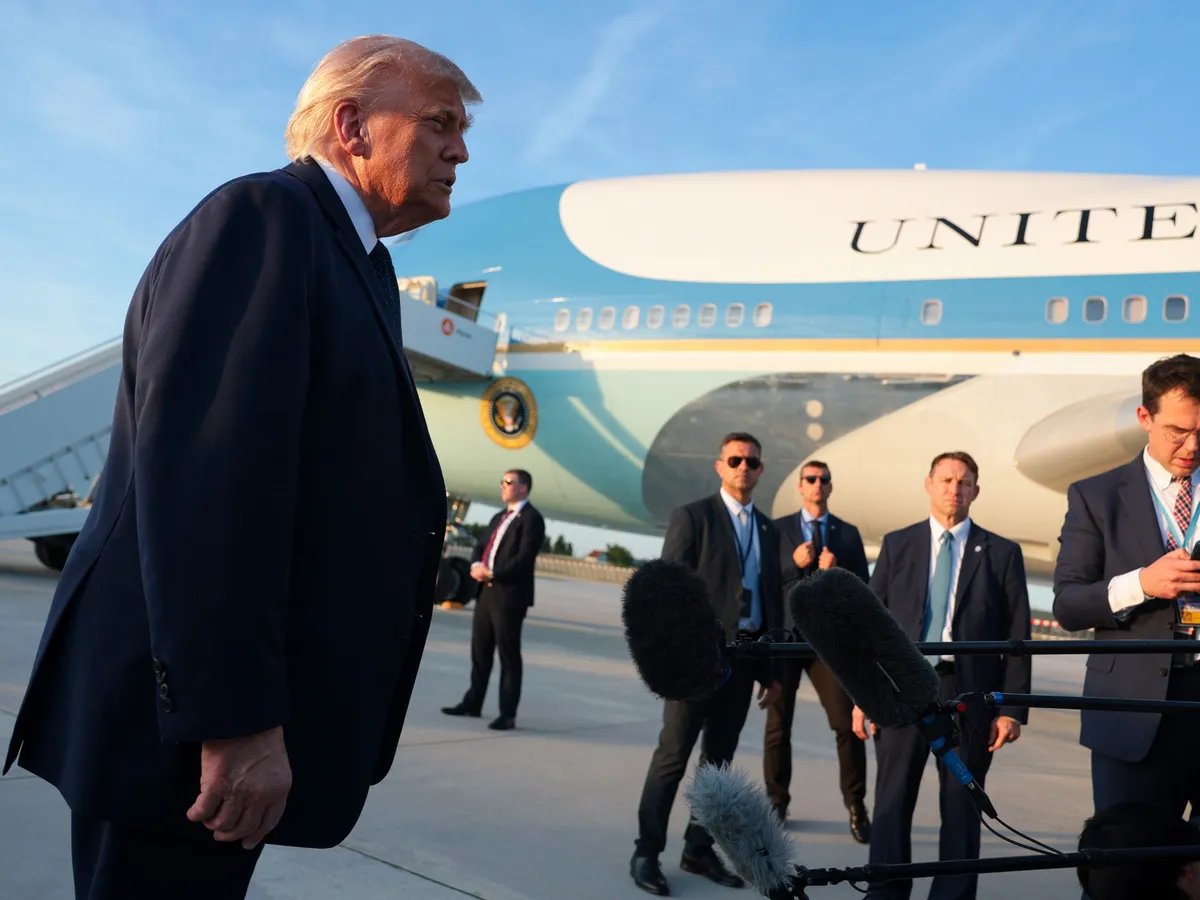
Trump says US will not pay for planned fund as part of Iran MoU, as lawmakers connect price tag to affordability issues.US President Donald Trump speaks to reporters in Orly, France, on June 17 [Anna Moneymaker/Getty]Published On 18 Jun 2026A provision in a memorandum of understanding (MoU) to end the Iran" class="entity-link entity-event" data-entity-id="38635" data-entity-type="event">US-Israel war with Iran has become the latest political flashpoint in Washington, with President Donald Trump defending the commitment to create a $300bn reconstruction plan for Iran.Trump and Vice President JD Vance both sought to reassure on Thursday that the commitment would not be funded by US taxpayers. Still, several Democrats and a handful of Republicans have seized on the planned fund at a time when affordability and economic populism have dominated the country’s electoral politics.Recommended Stories list of 3 itemslist 1 of 3Iran says it will charge a ‘payment for services’ in the Strait of Hormuzlist 2 of 3How does Trump’s MoU with Iran compare with Obama’s nuclear pact?list 3 of 3What we know so far about the US-Iran ceremony in Switzerlandend of listThe MoU, signed by Trump and Iranian President Masoud Pezeshkian on Wednesday, says only that the US “undertakes with regional partners to develop a definitive, mutually agreed plan with at least $300 billion for the reconstruction and economic development of the Islamic Republic of Iran”.It left the “mechanism for implementation” to be decided over a 60-day negotiation period, with the US committing to grant any needed licences, sanctions waivers or other permissions.While the terms remain undetermined, Trump, in a Truth Social post on Thursday, ruled out any direct US funding for the scheme.“There is no 300 Billion Dollar payment to Iran by the U.S. That’s Fake News!” he wrote.He called the issue Democrat “propaganda”.Vance, meanwhile, in an interview with The New York Times published on Thursday, said that the plan will not be “paid for by American taxpayers”.“Not a cent of American money goes to Iran,” he said.In a subsequent news conference, Vance suggested that such a fund could be paid for by regional Arab countries and by those outside the region interested in investing in Iran, creating economic integration that could help ensure lasting peace.No countries have yet confirmed financial commitments to the plan.Vance added Iran would only gain access to those resources “if they comply fully and change their behaviour”.Political cudgelSeveral top Democrats in recent days have sought to connect the $300bn fund to domestic social and economic issues, a message that is likely to grow ahead of the midterm elections in November.“With $300 billion, we could end homelessness, fund cancer research for 40 years, and give every child free pre-K for over 7 years. Instead, Trump is sending it to Iran,” Senator Amy Klobuchar said in a post on X earlier this week.US Senator Chuck Schumer, the top Democrat in the chamber, said “Democrats will not be helping Trump send $300 billion to Iran”.“Republicans won’t find the money to help Americans keep their healthcare,” Congressman Jason Crow wrote on X on Thursday. “But they will find the money to get Iran $300 billion.”A handful of Republicans have also joined in the criticism of the plan, including Iran hawk and Trump ally Senator Roger Wicker.In a statement on Thursday, Wicker said the $300bn, even if not funded by US taxpayers, would make “Iran’s payoff under President [Barack] Obama’s 2015 deal look like a pittance by comparison”.He referred to the 2015 Joint Comprehensive Plan of Action (JCPOA), which saw Washington release about $55bn in frozen Iranian assets as part of an agreement for Iran to curtail its nuclear programme and submit to regular inspections in exchange for sanctions relief. The assets were mostly held in foreign banks.Trump unilaterally withdrew from that agreement in 2018 and has repeatedly claimed that a future deal with Iran will far surpass the JCPOA’s terms. The MoU signed on Thursday does not address the future of Iran’s nuclear programme; instead, it launches 60 days of negotiations to address the issue.Beyond the reconstruction fund, the new US-Iran MoU also commits to the immediate lifting of sanctions on Iran’s fossil fuel industry. It also launches negotiations to unfreeze billions in Iranian assets and lift sanctions.US Representative Thomas Massie, a regular Trump critic who lost his re-election campaign after Trump and pro-Israel groups waded into the race, also took aim at the planned reconstruction fund.“$300 billion is 5X as much as Congress spends on our roads & bridges annually,” he wrote in a post on X.“I’m tired of winning,” he said, referring to one of Trump’s favourite refrains.
SRCAl Jazeera
LANGEN
LEANCenter
WORDS755
ENT12
THU · 2026-06-18 · 19:52 GMTBRIEF NSR-2026-0618-85612
NSR-2026-0618-85612News Report·EN·Political Strategy
MoU’s $300bn Iran reconstruction fund becomes US political flashpoint
A recently signed Memorandum of Understanding (MoU) between the US and Iran, aimed at ending a war, includes a provision for a $300 billion reconstruction fund for Iran. President Trump and Vice President Vance have stated that US taxpayers will not fund this initiative, suggesting regional partners and external investors might contribute.
Al Jazeera StaffAl JazeeraFiled 2026-06-18 · 19:52 GMTLean · CenterRead · 4 min
Al JazeeraFIG 01
Reading time
4min
Word count
755words
Sources cited
4cited
Entities identified
12entities
Quality score
100%
§ 01
Briefing Summary
AI-generatedNEWSAR · AI
A recently signed Memorandum of Understanding (MoU) between the US and Iran, aimed at ending a war, includes a provision for a $300 billion reconstruction fund for Iran. President Trump and Vice President Vance have stated that US taxpayers will not fund this initiative, suggesting regional partners and external investors might contribute. However, the plan has become a political flashpoint, with Democrats and some Republicans criticizing the large sum, linking it to domestic affordability issues. The MoU, signed on Wednesday, outlines a 60-day negotiation period to determine the implementation mechanism for the fund. While the exact funding source remains undetermined, Trump has dismissed claims of direct US payment as "Fake News."
Confidence 0.90Sources 4Claims 5Entities 12
§ 02
Article analysis
Model · rule-basedFraming
Political Strategy
Economic Impact
Tone
Mixed Tone
AI-assessed
CalmNeutralAlarmist
Factuality
0.60 / 1.00
Mixed
LowHigh
Sources cited
4
Well sourced
FewMany
§ 03
Key claims
5 extracted01
Vice President Vance stated the plan will not be 'paid for by American taxpayers' and 'Not a cent of American money goes to Iran'.
quoteJD Vance
Confidence
1.00
02
President Trump stated, 'There is no 300 Billion Dollar payment to Iran by the U.S. That’s Fake News!'
quoteDonald Trump
Confidence
1.00
03
The MoU states the US 'undertakes with regional partners to develop a definitive, mutually agreed plan with at least $300 billion for the reconstruction and economic development of the Islamic Republic of Iran'.
factual
Confidence
0.95
04
Senator Amy Klobuchar claimed that with $300 billion, 'we could end homelessness, fund cancer research for 40 years, and give every child free pre-K for over 7 years.'
quoteAmy Klobuchar
Confidence
0.90
05
A provision in a memorandum of understanding (MoU) to end the US-Israel war with Iran has become a political flashpoint in Washington.
factual
Confidence
0.90
§ 04
Full report
4 min read · 755 words§ 05
Entities
12 identifiedKey playerOppositionContextPositiveNeutralNegative
People3
Locations4
§ 06
Keywords & salience
8 termsiran reconstruction fund
1.00
us-iran relations
0.90
donald trump
0.80
political flashpoint
0.70
mou
0.60
us taxpayers
0.50
economic populism
0.40
sanctions waivers
0.40
§ 07
Topic connections
Interactive graph Network visualization showing 51 related topics
View Full Graph Person Organization Location Event|Click node to navigate|Edge numbers = shared articles