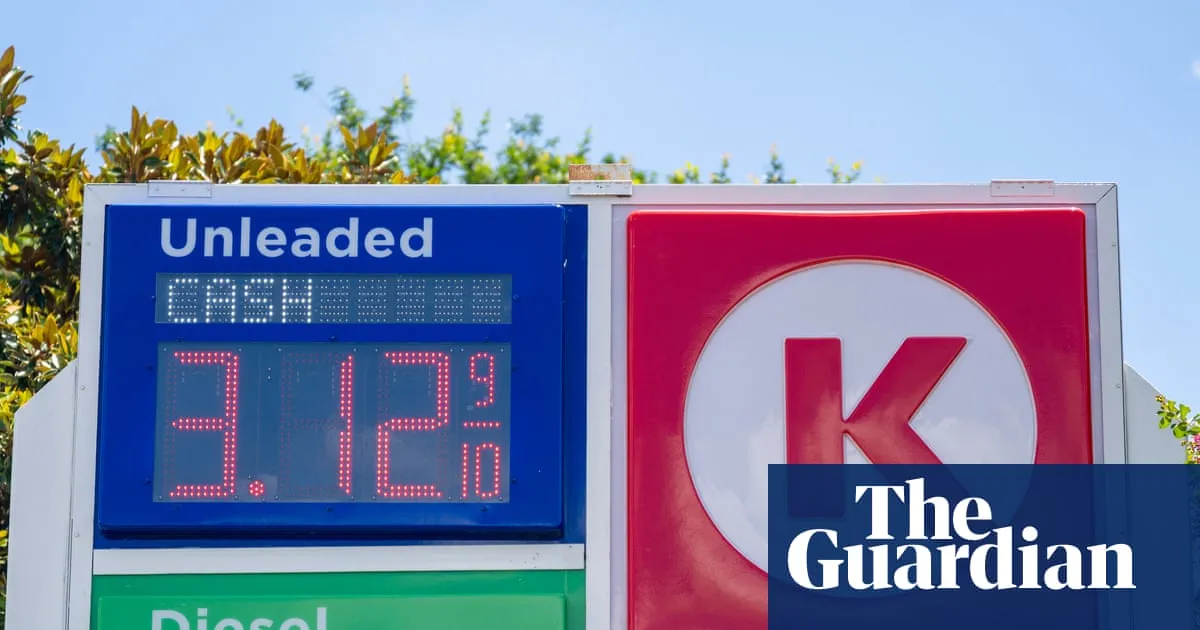
A Circle K gas station on Turesday in Austin, Texas. Photograph: Brandon Bell/Getty Images View image in fullscreen A Circle K gas station on Turesday in Austin, Texas. Photograph: Brandon Bell/Getty Images Gas Prices fall below $4 on average after Trump’s signing of Iran-deal" class="entity-link entity-topic" data-entity-id="148853" data-entity-type="topic">Iran Deal to end War Drivers feel some relief but prices still a dollar more per gallon overall since before US-Israel attack on Iran The average price of US gasoline fell to just under $4 a gallon on Thursday for the first time since March, following the announcement of a preliminary agreement between the US and Iran to end the War and reopen the Strait of Hormuz. The development has provided some relief to drivers who have seen soaring costs amid Washington’s War with Iran. But filling up still remains more expensive than it was before the conflict began. According to the motor club AAA, the current national average price for a gallon of regular gasoline stands at $3.999, marking the first time in months that prices have been that low. The decline aligns with easing crude oil costs overall, with some optimism surrounding the initial agreement between the US and Iran. Still, American drivers are collectively paying roughly $1 more per gallon than they were before the US joined Israel to attack Iran in February. Gas Prices are also about 25% higher than they were a year ago, which has put strain on many household budgets across the country. Gas isn’t the only thing that has become more expensive over the course of the War. Higher gasoline prices have also contributed to rising airline fares, while consumer goods such as groceries, and shoes have also gone up in cost amid global supply chain disruptions. Even if oil and other core necessities – such as fertilizer – begin flowing from the Middle East again, experts warn that the sticker shock is likely to outlast the fighting. “Product prices across the United States are projected to keep climbing for the rest of 2026,” Patrick Penfield, a professor of supply chain practice at Syracuse University, told the Associated Press on Thursday. Penfield pointed to depleted inventories and ongoing supply chain consequences spanning from the War. He noted that farmers, for example, already had to pay higher costs for fertilizer and other supplies in the spring, which will “ripple through to increased food prices by autumn”. And at the gas pump, he noted that limited refinery capacity in the US “remains a significant bottleneck” towards bringing down prices. The rising fuel costs have already pushed US inflation to its highest level in three years. And many consumers are still filling their tanks for much more than $4 a gallon. That price is a national average, with costs varying between states due to factors such as proximity to supply and differing tax rates. In California on Thursday, regular gasoline averaged about $5.64 a gallon, according to AAA, followed by $5.57 in Hawaii. By contrast, prices in Indiana and Texas sat at about $3.40 and $3.49 a gallon. Recent relief for fuel prices arrived with cooling costs for crude oil – the main ingredient in gasoline. Brent crude, the international standard, fell below $78 a barrel on Thursday, while US benchmark crude dropped to just over $74 a barrel. That’s still a little higher than the pre-Iran War level of roughly $70, but way below the $100-plus price seen a few weeks ago. Major shipowners have reportedly begun moving vessels through the Strait of Hormuz after Wednesday’s signing of the memorandum of understanding, according to maritime data from Lloyd’s List Intelligence – though some operators reported that only more limited side shipping routes were open. On Thursday, US Central Command said in a statement that it has lifted its blockade on all maritime traffic entering and exiting Iranian ports and coastal areas in the Strait of Hormuz. “American forces are not impeding the transit of vessels to or from Iranian ports on the Arabian Gulf and Gulf of Oman,” it said. Despite these developments, experts warn that it could take weeks or months for traffic to return to prewar levels. Explore more on these topics US news Gas US-Israel War on Iran Donald Trump Trump administration Oil Iran news Share Reuse this content
SRCThe Guardian - World News
LANGEN
LEANCenter-Left
WORDS711
ENT12
THU · 2026-06-18 · 19:51 GMTBRIEF NSR-2026-0618-85616
NSR-2026-0618-85616News Report·EN·Economic Impact
Gas prices fall below $4 on average after Trump’s signing of Iran deal to end war
The average price of US gasoline has fallen below $4 a gallon for the first time since March, following a preliminary agreement between the US and Iran to end the war and reopen the Strait of Hormuz. This development has provided some relief to drivers experiencing soaring costs due to Washington's conflict with Iran.
Anna Betts and agencyThe Guardian - World NewsFiled 2026-06-18 · 19:51 GMTLean · Center-LeftRead · 3 min
The Guardian - World NewsFIG 01
Reading time
3min
Word count
711words
Sources cited
2cited
Entities identified
12entities
Quality score
100%
§ 01
Briefing Summary
AI-generatedNEWSAR · AI
The average price of US gasoline has fallen below $4 a gallon for the first time since March, following a preliminary agreement between the US and Iran to end the war and reopen the Strait of Hormuz. This development has provided some relief to drivers experiencing soaring costs due to Washington's conflict with Iran. Despite the decrease, prices remain approximately $1 higher per gallon than before the conflict began. The decline in gas prices aligns with easing crude oil costs, though experts warn that overall product prices are projected to continue climbing due to depleted inventories and ongoing supply chain consequences. While some maritime traffic has resumed through the Strait of Hormuz, experts anticipate it will take weeks or months to return to pre-war levels.
Confidence 0.90Sources 2Claims 5Entities 12
§ 02
Article analysis
Model · rule-basedFraming
Economic Impact
Diplomatic
Tone
Measured
AI-assessed
CalmNeutralAlarmist
Factuality
0.70 / 1.00
Factual
LowHigh
Sources cited
2
Limited
FewMany
§ 03
Key claims
5 extracted01
The current national average price for a gallon of regular gasoline stands at $3.999, according to AAA.
statisticAAA
Confidence
1.00
02
Average US gasoline prices fell to just under $4 a gallon on Thursday for the first time since March.
factual
Confidence
1.00
03
American drivers are collectively paying roughly $1 more per gallon than they were before the US joined Israel to attack Iran in February.
factual
Confidence
0.90
04
The decline follows the announcement of a preliminary agreement between the US and Iran to end the war and reopen the strait of Hormuz.
factual
Confidence
0.90
05
Product prices across the United States are projected to keep climbing for the rest of 2026.
predictionPatrick Penfield
Confidence
0.70
§ 04
Full report
3 min read · 711 words§ 05
Entities
12 identifiedKey playerOppositionContextPositiveNeutralNegative
Organizations3
Locations4
Events1
§ 06
Keywords & salience
9 termsgas prices
1.00
iran deal
0.90
war
0.80
crude oil costs
0.70
supply chain disruptions
0.60
household budgets
0.50
airline fares
0.40
fertilizer
0.40
refinery capacity
0.40
§ 07
Topic connections
Interactive graph Network visualization showing 51 related topics
View Full Graph Person Organization Location Event|Click node to navigate|Edge numbers = shared articles