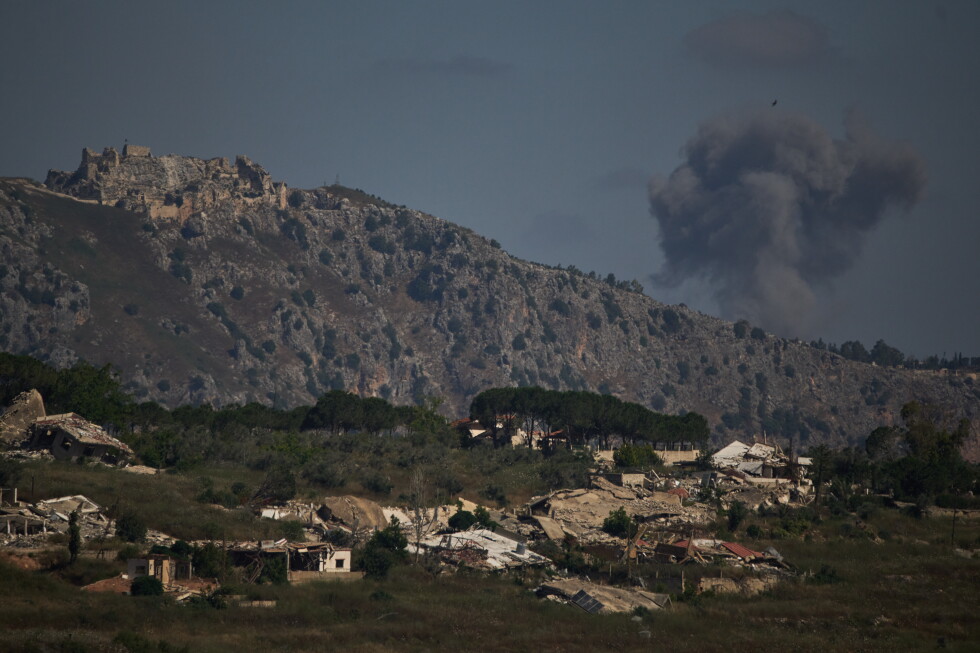
Israeli military strikes in Lebanon" class="entity-link entity-location" data-entity-id="146851" data-entity-type="location">southern Lebanon in intense fighting as US-Iran talks postponed 0 seconds of 1 minute, 10 secondsVolume 0% Press shift question mark to access a list of keyboard shortcuts Keyboard ShortcutsEnabledDisabled Shortcuts Open/Close/ or ? Play/PauseSPACE Increase Volume↑ Decrease Volume↓ Seek Forward→ Seek Backward← Captions On/Offc Fullscreen/Exit Fullscreenf Mute/Unmutem Decrease Caption Size- Increase Caption Size+ or = Seek %0-9 Next Up Trump offers sympathy to Lebanon and said a copy of Iran deal had been sent to Israel 01:42 00:00 01:10 01:10 More Videos 01:42 Trump offers sympathy to Lebanon and said a copy of Iran deal had been sent to Israel 01:00 Israeli settlers burn and deface mosques in overnight attack in occupied West Bank 01:00 Trump ‘not happy’ with Israel’s handling of Hezbollah and Lebanon 00:54 Macron meets Modi and Lebanon's Salam at VivaTech conference in Paris 00:44 Pentagon chief lashes out at NATO allies and announces review of US forces in Europe 01:08 Hegseth announces review of US forces in Europe after perceived lack of support for Iran war 01:27 An ancient oak tree said to have sheltered legendary Robin Hood has died 01:28 Vance warns Israeli critics of the US: Don't attack the 'only powerful ally' you have left Close 1 of 7 | Prime Minister Benjamin Netanyahu said on Thursday that Israel’s military will stay in Lebanon" class="entity-link entity-location" data-entity-id="146851" data-entity-type="location">southern Lebanon, where it has occupied up to 10 kilometers (six miles) from the border. More Videos 0 seconds of 1 minute, 28 secondsVolume 90% Press shift question mark to access a list of keyboard shortcuts Keyboard ShortcutsEnabledDisabled Shortcuts Open/Close/ or ? Play/PauseSPACE Increase Volume↑ Decrease Volume↓ Seek Forward→ Seek Backward← Captions On/Offc Fullscreen/Exit Fullscreenf Mute/Unmutem Decrease Caption Size- Increase Caption Size+ or = Seek %0-9 Next Up Trump ‘not happy’ with Israel’s handling of Hezbollah and Lebanon 01:00 Subtitle Settings OffEnglish(US)_v Font Color White Font Opacity 100% Font Size 100% Font Family Arial Character Edge None Edge Color Black Background Color Black Background Opacity 50% Window Color Black Window Opacity 0% Reset WhiteBlackRedGreenBlueYellowMagentaCyan 100%75%50%25% 200%175%150%125%100%75%50% ArialCourierGeorgiaImpactLucida ConsoleTahomaTimes New RomanTrebuchet MSVerdana NoneRaisedDepressedUniformDrop Shadow WhiteBlackRedGreenBlueYellowMagentaCyan WhiteBlackRedGreenBlueYellowMagentaCyan 100%75%50%25%0% WhiteBlackRedGreenBlueYellowMagentaCyan 100%75%50%25%0% Auto1080p1080p720p540p360p270p180p 00:00 01:28 01:28 More Videos Close 2 of 7 | In a rare rebuke, Vice President JD Vance blasted Israeli officials attacking President Trump over his Iran deal, warning that Trump is “the only head of state in the entire world” currently sympathetic to Israel and urging critics to “wake up” to the country’s reality. 3 of 7 | Smoke rises to the sky in an area near Beaufort Castle following an Israeli military strike in Lebanon" class="entity-link entity-location" data-entity-id="146851" data-entity-type="location">southern Lebanon as seen from northern Israel, Friday, June 19, 2026. (AP Photo/Leo Correa) 4 of 7 | Smoke rises to the sky in an area near Beaufort Castle following an Israeli military strike in Lebanon" class="entity-link entity-location" data-entity-id="146851" data-entity-type="location">southern Lebanon as seen from northern Israel, Friday, June 19, 2026. (AP Photo/Leo Correa) 5 of 7 | Smokes rise to the sky following an Israeli military strike in Lebanon" class="entity-link entity-location" data-entity-id="146851" data-entity-type="location">southern Lebanon as seen from northern Israel, Friday, June 19, 2026. (AP Photo/Leo Correa) 6 of 7 | A girl looks toward what residents said was an Israeli drone flying overhead as a boy checks his family’s water storage tank in Halta, Lebanon" class="entity-link entity-location" data-entity-id="146851" data-entity-type="location">southern Lebanon, Friday, June 12, 2026. (AP Photo/Hassan Ammar) 7 of 7 | Buildings damaged by Israeli strikes are seen through shattered glass from the Jabal Amel Hospital in the southern port city of Tyre, Lebanon, Thursday, June 18, 2026. (AP Photo/Hassan Ammar) By ERIN CUNNINGHAM, DAVID RISING and JON GAMBRELL Updated 9:50 AM MESZ, June 19, 2026 Leer en español Add AP News on Google Add AP News as your preferred source to see more of our stories on Google. Share Share Facebook Copy Link copied Print Email X LinkedIn Bluesky Flipboard Pinterest Reddit JERUSALEM (AP) — Israel’s military said Friday its forces struck targets throughout Lebanon" class="entity-link entity-location" data-entity-id="146851" data-entity-type="location">southern Lebanon overnight as Hezbollah reported intense fighting in the area, threatening the nascent agreement between Iran and the United States to end their war. Talks planned for Friday in Switzerland between Iran and the United States, which Vice President JD Vance had been scheduled to attend, found themselves postponed as the fighting intensified. Mediators worked to reschedule the meetings crucial for starting talks over a permanent end to the Iran war, with much of the attention focused on Lebanon, regional officials said. Meanwhile, the death toll in Lebanon rose sharply. Lebanon’s state-run National News Agency reported at least 18 people were killed in Israeli airstrikes, which the Israeli military said were ongoing. Israel, meantime, said four of its soldiers had been killed in fighting in Lebanon" class="entity-link entity-location" data-entity-id="146851" data-entity-type="location">southern Lebanon, including a lieutenant colonel. An explosive drone attack hurt another five, it added. The Israeli military also struck targets in Lebanon’s eastern Bekaa Valley on Friday. Continued fighting in Lebanon could unravel the newly signed deal, which calls for an immediate halt to military operations “on all fronts, including in Lebanon,” where Israel has been battling the Iran-backed Hezbollah militant group, and for ensuring Lebanon’s “territorial integrity and sovereignty.” Asian shares retreat in thin holiday trading after a tech-led rally on Wall St 3 MIN READ Vance’s push to get Iran talks started hits an early bump 6 MIN READ 56 Senators seek to block Hegseth travel funds until Pentagon releases report on Iran school strike 3 MIN READ 18 The deal aims to end the war and has reopened the Strait of Hormuz to international shipping, while bringing the U.S. and Iran back to the negotiating table over Tehran’s nuclear program. Iran’s stranglehold on the strait had all but stopped the flow of oil through the key waterway. U.S. President Donald Trump said he signed the agreement to avoid “economic catastrophe” in the U.S., after the war caused oil prices to skyrocket, made financial markets skittish and fueled inflation. After the signing of the agreement, more than 12.5 million barrels of oil were shipped through the Strait of Hormuz on Wednesday night, the U.S. said. Israel and Hezbollah are not parties to the agreement. Iran insists Israel must withdraw from the large swath of Lebanon" class="entity-link entity-location" data-entity-id="146851" data-entity-type="location">southern Lebanon it is occupying, but the wording of the interim deal doesn’t explicitly require that. Israeli Prime Minister Benjamin Netanyahu, who faces elections later this year, has refused to withdraw. He said Thursday that Israeli forces will remain in a “security zone” of Lebanon" class="entity-link entity-location" data-entity-id="146851" data-entity-type="location">southern Lebanon as long as “Israel’s security needs require it.” Trump, meantime, has been openly critical of Netanyahu’s recent moves, saying the day before the agreement with Iran was signed that “without the U.S. there would be no Israel.” “Without me, there would be no Israel because no other president was willing to do what I did — I have had a great relationship with Bibi,” Trump said, using a nickname for Netanyahu. “Now Bibi has to be more responsible with respect to Lebanon.” The renewed Israeli attacks in Lebanon came as planned talks in Switzerland between Iran and the United States over their efforts to reach a permanent end to the Iran war were delayed. Vance delays trip to Switzerland as talks postponed U.S. Vice President JD Vance on Thursday put off his trip to Switzerland where he had been set to lead the talks. The White House blamed logistical issues. Two regional officials, speaking to The Associated Press on condition of anonymity to discuss the closed-door talks, said mediators were focused on calming the fighting in Lebanon. One said Iran pulled out of the Switzerland meeting specifically over the fighting and Netanyahu’s comments, describing them as violating the interim deal between Iran and the U.S. Two other regional officials, similarly speaking on condition of anonymity for the same reason, described Pakistan as being “stunned” by Iran’s decision not to go to the talks Friday. Those discussions in Switzerland were to shift the conversation toward sanctions relief, maritime security, nuclear-related measures, verification, sequencing and regional assurances, one of the officials said. Those are key to ensuring a final deal between Iran and the U.S. be reached. Following the signing of the interim deal, the U.S. said it had lifted its blockade, allowing oil tankers to begin freely moving through the Strait of Hormuz after months of being unable to use the critical channel. Still, the tentative agreement has drawn sharp criticism from some in the U.S. — including a few congressional Republicans — who worry Washington ceded too much to Iran with relief from sanctions and a potential $300 billion fund to help with rebuilding. In Iran, Supreme Leader Ayatollah Mojtaba Khamenei seemed to endorse direct negotiations, saying in a statement on state media that “it is obvious that the face-to-face negotiations that will be held in the future will not mean accepting the enemy’s opinion.” It was Khamenei’s first reaction to the agreement, and it was interpreted as a shift in Iran’s approach. Hard-liners, especially Khamenei’s father, the previous supreme leader, have long opposed direct talks, especially after the U.S. pulled out of the 2015 nuclear deal between Iran and world powers. The supreme leader has not been seen in public since he was wounded in a strike at the start of the war. Vance, who was initially personally skeptical of the U.S. going to war with Iran, has increasingly become the administration’s face of the conflict and has been outspoken in defending the deal. On Thursday, he took the relatively unusual step of appearing at the White House to defend the initial deal to extend the ceasefire 60 days and allow for more negotiating — arguing that while it offers concessions, Iran first has to comply with U.S. demands. Vance also offered a blunt warning to Israel, saying Trump was “the only head of state in the entire world who is sympathetic to the nation of Israel at this moment in time.” Gambrell reported from Dubai, United Arab Emirates and Rising reported from Bangkok. Associated Press writers Bassem Mroue in Beirut, Samy Magdy in Cairo and Munir Ahmed in Islamabad contributed to this story. DAVID RISING Rising covers regional Asia-Pacific stories for The Associated Press. He has worked around the world, including covering the wars in Iraq, Afghanistan and Ukraine, and was based for nearly 20 years in Berlin before moving to Bangkok. twitter mailto JON GAMBRELL Gambrell is the news director for the Gulf and Iran for The Associated Press. He has reported from each of the Gulf Cooperation Council countries, Iran and other locations across the world since joining the AP in 2006. twitter instagram mailto
SRCAssociated Press (AP)
LANGEN
LEANCenter
WORDS1 750
ENT12
FRI · 2026-06-19 · 06:53 GMTBRIEF NSR-2026-0619-85695
NSR-2026-0619-85695News Report·EN·Conflict
Israeli military says 4 soldiers have been killed in southern Lebanon as fighting intensifies
Intense fighting in southern Lebanon has resulted in the deaths of four Israeli soldiers, according to the Israeli military. Overnight Israeli airstrikes in southern Lebanon killed at least 18 people, according to Lebanon's state-run news agency.
Associated Press (AP)Filed 2026-06-19 · 06:53 GMTLean · CenterRead · 7 min
Associated Press (AP)FIG 01
Reading time
7min
Word count
1 750words
Sources cited
2cited
Entities identified
12entities
Quality score
100%
§ 01
Briefing Summary
AI-generatedNEWSAR · AI
Intense fighting in southern Lebanon has resulted in the deaths of four Israeli soldiers, according to the Israeli military. Overnight Israeli airstrikes in southern Lebanon killed at least 18 people, according to Lebanon's state-run news agency. These developments have jeopardized planned talks in Switzerland between Iran and the United States aimed at ending the Iran war, as Iran reportedly delayed sending its delegation due to Israel's ongoing military campaign in Lebanon. Israel maintains its operations are necessary to combat Hezbollah, which has been launching attacks into northern Israel. U.S. Vice President JD Vance, who was scheduled to attend the talks, postponed his trip, with the White House citing logistical issues.
Confidence 0.90Sources 2Claims 4Entities 12
§ 02
Article analysis
Model · rule-basedFraming
Conflict
National Security
Tone
Mixed Tone
AI-assessed
CalmNeutralAlarmist
Factuality
0.70 / 1.00
Factual
LowHigh
Sources cited
2
Limited
FewMany
§ 03
Key claims
4 extracted01
Vice President JD Vance warned Israeli critics of President Trump.
quoteJD Vance
Confidence
0.95
02
Israel's military will stay in southern Lebanon, occupying up to 10 kilometers from the border.
quoteBenjamin Netanyahu
Confidence
0.95
03
Israeli military says 4 soldiers have been killed in southern Lebanon.
factualIsraeli military
Confidence
0.90
04
Intense fighting is occurring in southern Lebanon.
factual
Confidence
0.85
§ 04
Full report
7 min read · 1 750 words§ 05
Entities
12 identifiedKey playerOppositionContextPositiveNeutralNegative
People4
§ 06
Keywords & salience
8 termsisraeli military
1.00
southern lebanon
1.00
fighting intensifies
0.90
hezbollah
0.70
iran deal
0.60
us-iran talks
0.50
occupied west bank
0.40
benjamin netanyahu
0.40
§ 07
Topic connections
Interactive graph Network visualization showing 51 related topics
View Full Graph Person Organization Location Event|Click node to navigate|Edge numbers = shared articles