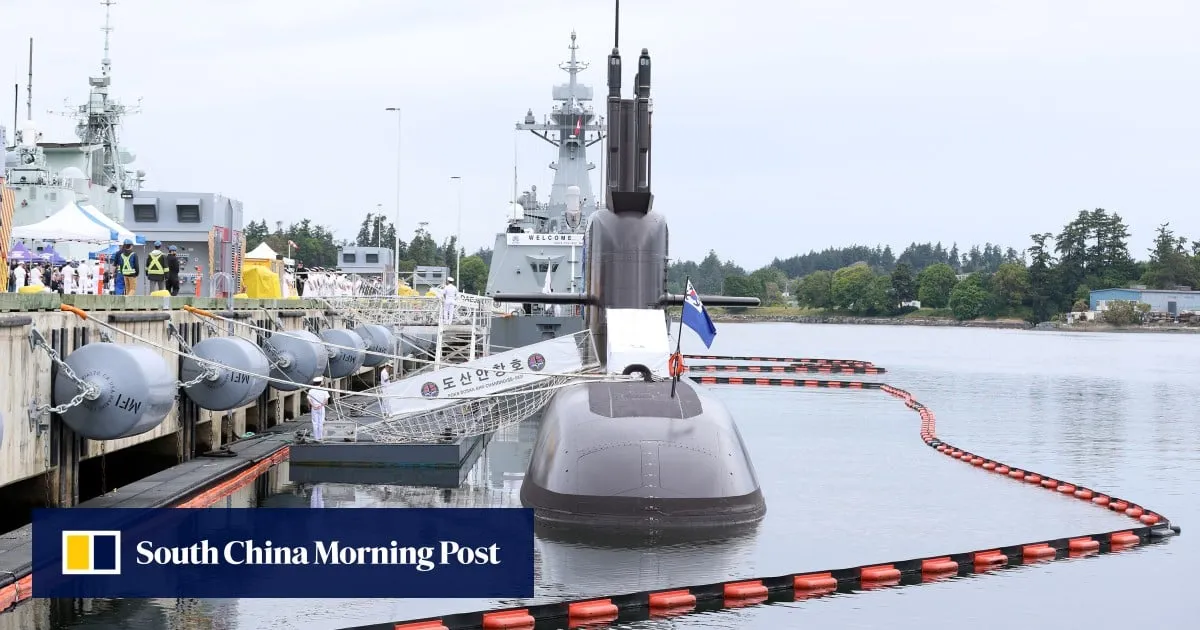
The South Korean government and defence players are making last-ditch efforts to win Canada’s next-generation submarine project worth up to 60 trillion won (US$39.14 billion), as Ottawa is expected to select a preferred bidder by the end of this month.Under the Canadian Patrol Submarine Project, the Royal Canadian Navy’s ageing fleet of four Victoria-class submarines will be replaced with 12 new 3,000-tonne diesel-electric vessels. The comprehensive contract includes long-term maintenance, repair and overhaul (MRO) life cycles.With a decision looming, Seoul has elevated its bid to top-tier head-of-state diplomacy, seeking to give South Korea’s consortium, led by Hanwha Ocean, an edge over rival bidder TKMS of Germany – a traditional heavyweight in submarine technology – in the closely contested race.President Lee Jae Myung recently provided critical diplomatic backing during a bilateral summit with Canadian Prime Minister Mark Carney on the sidelines of the Group of Seven summit in Evian-les-Bains, France. Lee said he emphasised South Korea’s readiness to contribute to Canada’s defence capabilities, but acknowledged during a Friday press conference that the outcome remains difficult to predict.Hanwha Ocean’s bid centres on the 3,000-tonne Dosan Ahn Chang-ho, a KSS-III-class submarine built by its predecessor Daewoo Shipbuilding & Marine Engineering. The company has proposed delivering the first four vessels to Canada by 2035 and completing all 12 by 2043.Unlike TKMS’ paper design, the KSS-III’s main selling point is its proven track record, as it is already actively deployed and operated by the South Korean Navy.Moon Keun-sik, a professor at Hanyang University’s Graduate School of Public Policy and a former South Korean submarine captain, believes Seoul holds a slight technological edge.“In terms of submarine performance and operational combat capability, Korea is on par with or slightly ahead of Germany,” Moon said. “The Dosan Ahn Chang-ho is a proven, operational 3,000-tonne vessel, whereas Germany would have to build its proposal from scratch.”South Korean President Lee Jae Myung (right) with Canadian Prime Minister Mark Carney at the G7 summit in France on Tuesday. Photo: EPA/YonhapWhile technical specifications account for roughly 20 per cent of Canada’s evaluation, the remaining 80 per cent hinges on factors such as MRO capabilities and industrial cooperation – areas in which Hanwha also believes it has a competitive edge.“The Korean government’s recent strong commitment to supporting the hydrogen and energy sectors with Canada may tip the scales in our favour,” he said, adding that recent joint naval drills involving the South Korean Navy’s Dosan Ahn Chang-ho in Canadian waters have generated highly favourable sentiment among both the Canadian public and military.However, Moon cautioned that Germany and Canada’s shared Nato membership remains a significant political obstacle for Seoul.To offset that disadvantage, the Hanwha-led “Team Korea” has pitched an extensive industrial cooperation package spanning hydrogen, liquefied natural gas, aerospace and crude oil, backed by roughly 75 memorandums of understanding signed with Canadian firms.Further ReadingMost notably, Seoul unveiled Hyundai Motor Group’s Project Beaver investment initiative worth around 4 trillion won. Under the proposal, the South Korean carmaker would establish a comprehensive hydrogen mobility ecosystem – including hydrogen liquefaction plants, fuelling stations and a hydrogen truck manufacturing facility – in Canada, if South Korea secures the submarine deal.Yang Uk, a research fellow at the Asan Institute for Policy Studies, questioned whether South Korea’s proposal aligns with Canada’s strategic goals.“Canada’s primary concern goes beyond mere hardware manufacturing,” Yang said.“They seek deeper naval cooperation and interoperability across the Arctic region. Germany already maintains robust naval ties with Canada under the Nato framework in the area. Against the backdrop, Berlin remains better positioned than Seoul in terms of both long-term naval cooperation capacity and strategic alignment.”
SRCSouth China Morning Post
LANGEN
LEANCenter-Right
WORDS597
ENT12
SUN · 2026-06-21 · 06:34 GMTBRIEF NSR-2026-0621-86090
NSR-2026-0621-86090News Report·EN·Diplomatic
South Korea jostles with Germany for US$39 billion Canadian submarine deal
South Korea is making a final push to win Canada's US$39 billion submarine deal, with a decision expected by the end of the month. The Canadian Patrol Submarine Project aims to replace the Royal Canadian Navy's aging fleet with 12 new diesel-electric vessels.
The Korea TimesSouth China Morning PostFiled 2026-06-21 · 06:34 GMTLean · Center-RightRead · 3 min
South China Morning PostFIG 01
Reading time
3min
Word count
597words
Sources cited
2cited
Entities identified
12entities
Quality score
100%
§ 01
Briefing Summary
AI-generatedNEWSAR · AI
South Korea is making a final push to win Canada's US$39 billion submarine deal, with a decision expected by the end of the month. The Canadian Patrol Submarine Project aims to replace the Royal Canadian Navy's aging fleet with 12 new diesel-electric vessels. South Korea's consortium, led by Hanwha Ocean, is competing against Germany's TKMS. Hanwha is highlighting its proven KSS-III submarine design, already in operation with the South Korean Navy, as a key advantage over Germany's proposal. South Korea is also offering extensive industrial cooperation, including a significant hydrogen mobility investment from Hyundai Motor Group, to bolster its bid. However, Germany's existing NATO ties with Canada present a political challenge for Seoul.
Confidence 0.90Sources 2Claims 5Entities 12
§ 02
Article analysis
Model · rule-basedFraming
Diplomatic
Economic Impact
Tone
Measured
AI-assessed
CalmNeutralAlarmist
Factuality
0.70 / 1.00
Factual
LowHigh
Sources cited
2
Limited
FewMany
§ 03
Key claims
5 extracted01
South Korea's bid features the Dosan Ahn Chang-ho submarine, which is already deployed and operated by the South Korean Navy.
factual
Confidence
1.00
02
The Canadian Patrol Submarine Project aims to replace the Royal Canadian Navy's four aging Victoria-class submarines with 12 new diesel-electric vessels.
factual
Confidence
1.00
03
South Korea is vying with Germany for a Canadian submarine deal worth up to US$39.14 billion.
factual
Confidence
1.00
04
Canada's evaluation criteria for the submarine deal prioritize MRO capabilities and industrial cooperation over technical specifications.
factual
Confidence
0.90
05
A South Korean professor believes Seoul holds a slight technological edge over Germany in submarine capabilities.
quoteMoon Keun-sik
Confidence
0.90
§ 04
Full report
3 min read · 597 words§ 05
Entities
12 identifiedKey playerOppositionContextPositiveNeutralNegative
Organizations4
Locations5
§ 06
Keywords & salience
8 termssubmarine deal
1.00
canadian patrol submarine project
0.90
hanwha ocean
0.80
tkms
0.70
defence capabilities
0.60
maintenance, repair and overhaul
0.50
diesel-electric vessels
0.50
g7 summit
0.40
§ 07
Topic connections
Interactive graph Network visualization showing 51 related topics
View Full Graph Person Organization Location Event|Click node to navigate|Edge numbers = shared articles