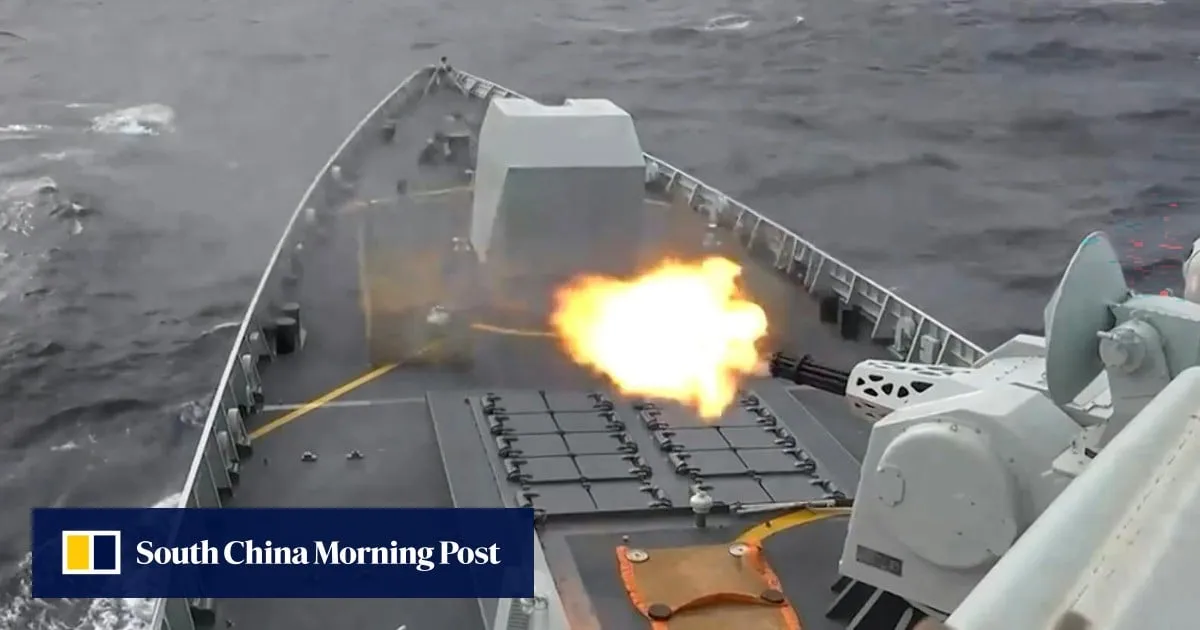
People’s Liberation Army activities in the Taiwan-strait" class="entity-link entity-location" data-entity-id="5508" data-entity-type="location">Taiwan Strait are being closely watched by the United States and Japan and it needs to find a way to operate effectively while being surveilled, according to analysts.A report by Beijing-based defence think tank Lande said the PLA’s most recent large-scale drills around Taiwan – dubbed Justice Mission 2025 – were launched with no warning yet the response from the US and Japan was immediate.It said that highlighted the constant presence in the region of the two militaries and their ability to react quickly.“Multi-dimensional surveillance” was also pointed out by other analysts, who said the PLA must factor this into planning if its goal was to carry out a surprise attack across the strait.The think tank report said that when the two-day PLA exercise began on December 29, US and Japanese spy planes had either diverted from routine patrol routes to circle nearby or they carried out sorties to the drill areas.PLA kicks off military exercises around TaiwanPLA kicks off military exercises around TaiwanThe aircraft included the US MQ-4C Triton drone and Japanese surveillance plane the Falcon 2000MSA, according to the report, which cited open-source flight path tracking data.
SRCSouth China Morning Post
LANGEN
LEANCenter-Right
WORDS195
ENT6
MON · 2026-01-19 · 10:00 GMTBRIEF NSR-2026-0119-8612
NSR-2026-0119-8612News Report·EN·National Security
PLA urged to find a way to operate effectively under the gaze of US and Japan
A recent report by a Beijing-based defense think tank, Lande, suggests the People's Liberation Army (PLA) needs to adapt its operations due to constant surveillance by the United States and Japan in the Taiwan Strait. The report highlights the rapid response of US and Japanese militaries to the PLA's "Justice Mission 2025" drills around Taiwan in late December.
Liu Zhen,Zhao ZiwenSouth China Morning PostFiled 2026-01-19 · 10:00 GMTLean · Center-RightRead · 1 min
South China Morning PostFIG 01
Reading time
1min
Word count
195words
Sources cited
1cited
Entities identified
6entities
Quality score
100%
§ 01
Briefing Summary
AI-generatedNEWSAR · AI
A recent report by a Beijing-based defense think tank, Lande, suggests the People's Liberation Army (PLA) needs to adapt its operations due to constant surveillance by the United States and Japan in the Taiwan Strait. The report highlights the rapid response of US and Japanese militaries to the PLA's "Justice Mission 2025" drills around Taiwan in late December. Analysts emphasize the "multi-dimensional surveillance" capabilities of the US and Japan, including the use of spy planes such as the US MQ-4C Triton drone and the Japanese Falcon 2000MSA. The report indicates that the PLA must consider this constant monitoring when planning operations, particularly any potential surprise attacks across the strait. The PLA is urged to find ways to operate effectively despite this persistent observation.
Confidence 0.90Sources 1Claims 5Entities 6
§ 02
Article analysis
Model · rule-basedFraming
National Security
Political Strategy
Tone
Measured
AI-assessed
CalmNeutralAlarmist
Factuality
0.70 / 1.00
Factual
LowHigh
Sources cited
1
Limited
FewMany
§ 03
Key claims
5 extracted01
The aircraft included the US MQ-4C Triton drone and Japanese surveillance plane the Falcon 2000MSA.
factualLande
Confidence
0.90
02
PLA activities in the Taiwan Strait are being closely watched by the United States and Japan.
factualanalysts
Confidence
0.90
03
The PLA’s most recent large-scale drills around Taiwan were launched with no warning.
factualLande
Confidence
0.80
04
US and Japanese spy planes diverted from routine patrol routes or carried out sorties to the drill areas.
factualLande
Confidence
0.70
05
The PLA needs to find a way to operate effectively while being surveilled.
predictionanalysts
Confidence
0.60
§ 04
Full report
1 min read · 195 words§ 05
Entities
6 identifiedKey playerOppositionContextPositiveNeutralNegative
§ 06
Keywords & salience
9 termspla
1.00
taiwan strait
0.90
us
0.80
japan
0.80
surveillance
0.70
military exercises
0.70
military operations
0.60
spy planes
0.50
defence
0.40
§ 07
Topic connections
Interactive graph Network visualization showing 46 related topics
View Full Graph Person Organization Location Event|Click node to navigate|Edge numbers = shared articles