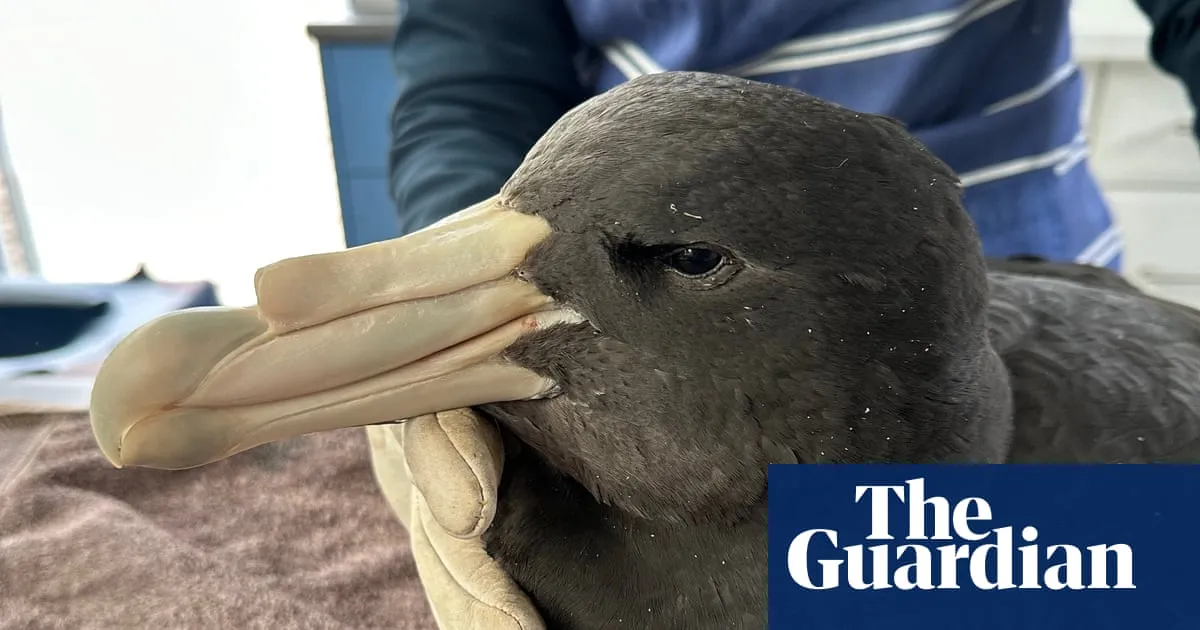
A Department of Primary Industries and Regional Development veterinarian tests a giant petrel for H5N1 bird flu. The bird was brought into care on 18 June from Wylie Bay beach in Australia" class="entity-link entity-location" data-entity-id="706" data-entity-type="location">Western Australia. Photograph: Lori-Ann Shibish/Esperance Wildlife Hospital and Sanctuary. View image in fullscreen A Department of Primary Industries and Regional Development veterinarian tests a giant petrel for H5N1 bird flu. The bird was brought into care on 18 June from Wylie Bay beach in Australia" class="entity-link entity-location" data-entity-id="706" data-entity-type="location">Western Australia. Photograph: Lori-Ann Shibish/Esperance Wildlife Hospital and Sanctuary. Western Australian poultry farms locked down after H5N1 bird flu discovered in wild birds Poultry producer Ingham’s announces move after brown skua confirmed to have virus and petrel being tested, in first cases seen on Australia’s mainland Follow our Australia news live blog for latest updates Get our breaking news email, free app or daily news podcast Poultry farms in Australia" class="entity-link entity-location" data-entity-id="706" data-entity-type="location">Western Australia have gone into lockdown after confirmation the deadly H5N1 bird flu has arrived on the country’s mainland. On Monday, the Ingham’s Group – Australia’s largest poultry producer – announced a “complete lockdown” in WA, despite no commercial detections of H5N1. It came after a brown skua, found on a remote beach near Esperance, was discovered to have the “highly pathenogenic” H5N1 virus on the weekend. A giant petrel in the same area was also tested and returned a preliminary positive result, while there have been reports of more than a dozen cases of sick or dead birds along the WA coast. Before the confirmation of H5N1’s arrival, Australia had been the only continent free of the virus, which has killed millions of birds and thousands of marine mammals since 2021. Ingham’s said in a statement it would ask the state government to allow free-range chickens to be kept indoors, while all nonessential access to its operations would be stopped. Australia’s chief veterinary officer, Beth Cookson, told ABC’s Radio National the virus had not been detected in wildlife, poultry or agricultural systems. But Cookson said authorities were trying to work out whether the infected birds had spread the disease into other populations. “Our approach is to really learn from the overseas experience and look at the practical actions that can be put in place to mitigate the impacts as far as possible,” she said on Monday. Shares in Ingham’s dropped as much as 14% on Monday, according to Bloomberg. The share price has been sliding for four months and was down more than 23% in the year to date, according to the news agency. The Australian Financial Review reported on 1 June that the $777m company was “deep in turnaround mode”, after a contract with Woolworths was restructured. The federal environment minister, Murray Watt, said Cookson and the threatened species commissioner, Dr Fiona Fraser, would brief state and federal environment ministers about the virus on Monday. “We’ve been working very hard with states, industry, environment groups [and] scientists over the last couple of years to make sure that we are as well prepared as we possibly could be,” he said. “As a government, we’ve invested $113m, including $11m in the most recent budget in those preparedness efforts. So I feel confident that we’ve got the systems in place, and that we’re working cooperatively with states, territories and others to make sure that we can manage this outbreak if it does get more serious.” Explore more on these topics Bird flu Health Chicken Food Infectious diseases Birds news Share Reuse this content
SRCThe Guardian - World News
LANGEN
LEANCenter-Left
WORDS576
ENT9
MON · 2026-06-22 · 02:45 GMTBRIEF NSR-2026-0622-86276
NSR-2026-0622-86276News Report·EN·Public Health
Western Australian poultry farms locked down after H5N1 bird flu discovered in wild birds
Western Australian poultry farms have been placed under lockdown following the confirmation of the H5N1 bird flu virus in wild birds. Ingham’s Group, Australia's largest poultry producer, announced a complete lockdown in WA after a brown skua tested positive for the virus.
Tory ShepherdThe Guardian - World NewsFiled 2026-06-22 · 02:45 GMTLean · Center-LeftRead · 3 min
The Guardian - World NewsFIG 01
Reading time
3min
Word count
576words
Sources cited
3cited
Entities identified
9entities
Quality score
100%
§ 01
Briefing Summary
AI-generatedNEWSAR · AI
Western Australian poultry farms have been placed under lockdown following the confirmation of the H5N1 bird flu virus in wild birds. Ingham’s Group, Australia's largest poultry producer, announced a complete lockdown in WA after a brown skua tested positive for the virus. A giant petrel in the same area also returned a preliminary positive result, marking the first mainland detections of H5N1 in Australia. While the virus has not been detected in commercial poultry or agricultural systems, authorities are investigating potential spread. The government has invested in preparedness efforts and is working with states and industry to manage the outbreak.
Confidence 0.90Sources 3Claims 5Entities 9
§ 02
Article analysis
Model · rule-basedFraming
Public Health
Economic Impact
Tone
Measured
AI-assessed
CalmNeutralAlarmist
Factuality
0.80 / 1.00
Factual
LowHigh
Sources cited
3
Well sourced
FewMany
§ 03
Key claims
5 extracted01
Shares in Ingham’s dropped as much as 14% on Monday.
statisticBloomberg
Confidence
1.00
02
Australia was previously the only continent free of the H5N1 virus.
factual
Confidence
1.00
03
A brown skua and a giant petrel found near Esperance tested positive for the H5N1 virus.
factual
Confidence
1.00
04
Poultry producer Ingham’s has announced a 'complete lockdown' in Western Australia due to the bird flu detection.
factualIngham's Group
Confidence
1.00
05
H5N1 bird flu has been confirmed in wild birds in Western Australia, marking its arrival on the Australian mainland.
factual
Confidence
1.00
§ 04
Full report
3 min read · 576 words§ 05
Entities
9 identifiedKey playerOppositionContextPositiveNeutralNegative
People1
Organizations4
Locations3
Topics1
§ 06
Keywords & salience
8 termsh5n1 bird flu
1.00
poultry farms
0.90
western australia
0.80
wild birds
0.70
lockdown
0.60
ingham's group
0.50
highly pathogenic
0.40
avian influenza
0.40
§ 07
Topic connections
Interactive graph Network visualization showing 2 related topics
View Full Graph Person Organization Location Event|Click node to navigate|Edge numbers = shared articles