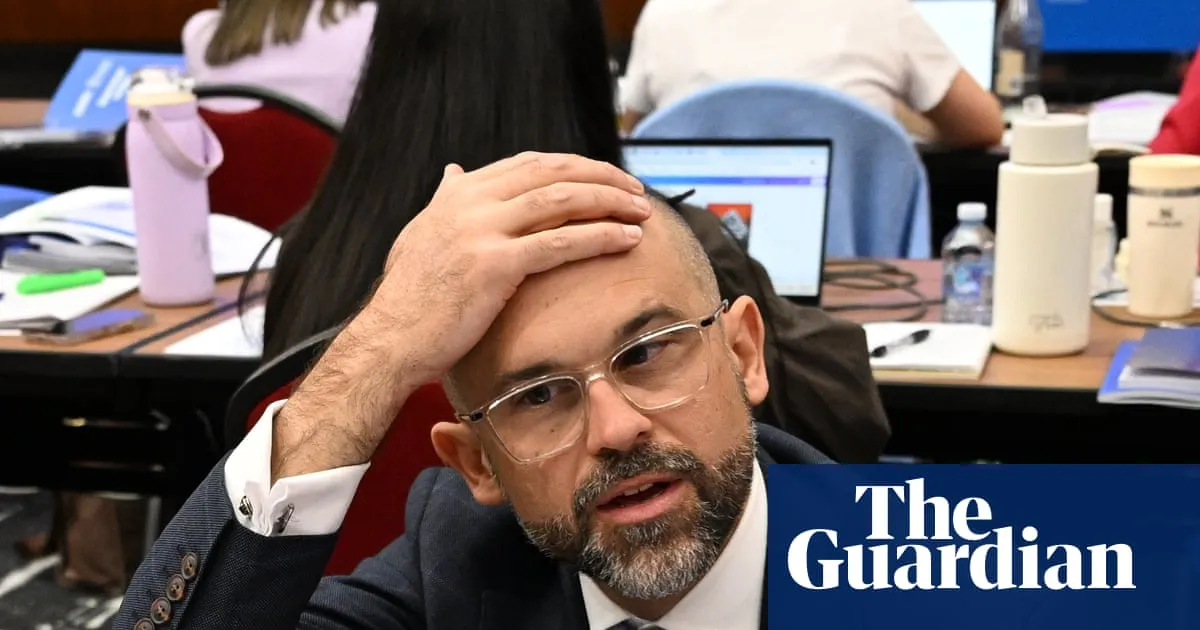
Queensland treasurer David Janetzki has promised a budget surplus in 2029-30, the year after the state’s next election – but only after years of billion-dollar deficits. Photograph: Susie Dodds/AAP View image in fullscreen Queensland treasurer David Janetzki has promised a budget surplus in 2029-30, the year after the state’s next election – but only after years of billion-dollar deficits. Photograph: Susie Dodds/AAP Queensland’s economy teeters on edge of ratings downgrade despite coal royalty windfall Earnings from mining the fossil fuel set to increase to $6.9bn over financial year, up from $4.8bn, with budget deficit to reach $6.2bn Follow our Australia news live blog for latest updates Get our breaking news email, free app or daily news podcast Queensland’s treasurer says he’s “not giving up” on halting a ratings downgrade of the state’s finances after handing down a budget full of red ink, amid predictions state borrowing will top $200bn in three years. David Janetzki promised a budget surplus in 2029-30, the year after the state’s next election – but only after years of billion-dollar deficits. Handing down his second budget on Tuesday, Janetzki forecast relatively positive economic growth and a strong labour market despite volatility caused by the conflict in Iran – and billions more in coal royalties to the state, driven by a 6% rise in exports in 2026-27. The state will earn $6.9bn in coal royalties that year alone, up from $4.79bn in 2025-26, according to the budget. But despite a forecast recovery in coal prices, the state continues to teeter on the edge of a credit rating downgrade. “Labor’s legacy left us highly likely, or even an air of an inevitability, to getting a rating down grade, but I’m not giving up,” the treasurer said. “We’re not giving up because we’re making the budget improvements while delivering what we promised.” In February the rating agency S&P affirmed a negative outlook for Queensland government debt, warning of “large deficits”. It described the state’s budgetary performance as “weak” but refrained from a credit downgrade, saying it expected a return to operating surplus in the 2028 fiscal year. But Janetzki’s budget forecasts a $1.9bn deficit in 2028-29, with state borrowings topping $202bn that year. There would be a $619m surplus the year after, he said. The state is running a $6.2bn operating deficit this year. Government revenue will increase 5.1% over the forward estimates, driven by increases in government duties, payroll tax and royalties. Spending will grow, rising from $100.8bn in 2025-26 to $111.6bn in 2029-30. The government says it is committed to returning the budget to a “fiscally sustainable position through strong expenditure management”, with expense growth dropping from 4.9% in 2026-27 to an average of 2.6% over the four years to 2029-30. Half a billion dollars will be saved through better coordinating procurement, reducing the cap on senior executive positions and reduced spending on contractors and consultants. $119.2bn for new roads, transport projects and other infrastructure in the next four years. Construction funding for the long-awaited Borumba pumped hydro scheme, and no money for the multiple smaller hydroelectric projects promised by the LNP at the last election. Compared with Labor’s last budget, there’s limited short-term cost of living relief, with premier David Crisafulli saying there were no “sugar hits” in his budget. Janetzki said the state also wanted to ease financial pressure on households with measures including: Exempting first home buyers from stamp duty when building or buying a new home. The state will also extend the $30,000 First Home Owner Grant. An increase in the Back to School payment by $50, now paying $150 for school supplies. A freeze of bulk water prices for two years, a saving of about $130 for residents in Southeast Queensland. A continuation of the state’s free kindergarten for another four years, paying fifteen hours of free kindy a week for all four-year-olds. Funding for the state’s 50 cent fare scheme, which will be legislated. Funding for the Queensland revenue office to pursue existing tax and penalty debt”, a scheme expected to raise about $220m in revenue and $612 in debt recovery in the next four years. The premier, David Crisafulli, said the government had fulfilled his promise of no new or increased taxes. “We haven’t taken the easy road, haven’t found justifications to whack people with new taxes under the cover of global crises,” Crisafulli said on Tuesday. “We’re on your side, and we’re going to continue to drive down tax, not find new ways to tax you.” Brisbane’s 2032 Olympics are another challenge for the state budget, though Crisafulli pointed out the state would spend more than twice as much on health infrastructure as it would on the Games. The government has yet to break down the budget for Queensland’s 17 Olympics venues beyond the global $7.1 figure for the Games as a whole. Crisafulli defended his decision not to reveal the cost of the projects. “Queenslanders will get full visibility on every one of those projects,” he said. “Right now, we’re arm wrestling and driving down contract prices. “I’m very, very confident about the $7.1bn figure for the games venues.” The Liberal National party government was elected on a platform of cracking down on crime, particularly youth crime. Queensland’s jails are now 135.5% full, down on last year’s 144.5%, due to the opening of the new 1,500-bed Lockyer correctional centre last September. Explore more on these topics Queensland politics Queensland David Crisafulli Liberal National party Australian economy Mining Brisbane Olympic Games 2032 news Share Reuse this content
SRCThe Guardian - World News
LANGEN
LEANCenter-Left
WORDS918
ENT9
TUE · 2026-06-23 · 04:24 GMTBRIEF NSR-2026-0623-86574
NSR-2026-0623-86574News Report·EN·Economic Impact
Queensland’s economy teeters on edge of ratings downgrade despite coal royalty windfall
Queensland's Treasurer David Janetzki has presented a budget forecasting significant deficits for several years, despite a projected windfall in coal royalties reaching $6.9 billion this financial year. The state faces a $6.2 billion operating deficit and is at risk of a credit rating downgrade, with borrowings expected to exceed $200 billion in three years.
Andrew MessengerThe Guardian - World NewsFiled 2026-06-23 · 04:24 GMTLean · Center-LeftRead · 4 min
The Guardian - World NewsFIG 01
Reading time
4min
Word count
918words
Sources cited
2cited
Entities identified
9entities
Quality score
100%
§ 01
Briefing Summary
AI-generatedNEWSAR · AI
Queensland's Treasurer David Janetzki has presented a budget forecasting significant deficits for several years, despite a projected windfall in coal royalties reaching $6.9 billion this financial year. The state faces a $6.2 billion operating deficit and is at risk of a credit rating downgrade, with borrowings expected to exceed $200 billion in three years. The government aims for a budget surplus in 2029-30 through expenditure management and revenue increases from duties, payroll tax, and royalties. The budget includes $119.2 billion for infrastructure and some cost-of-living relief measures, such as stamp duty exemptions for first home buyers and extended free kindergarten. Premier David Crisafulli emphasized no new or increased taxes.
Confidence 0.90Sources 2Claims 5Entities 9
§ 02
Article analysis
Model · rule-basedFraming
Economic Impact
Political Strategy
Tone
Mixed Tone
AI-assessed
CalmNeutralAlarmist
Factuality
0.70 / 1.00
Factual
LowHigh
Sources cited
2
Limited
FewMany
§ 03
Key claims
5 extracted01
S&P affirmed a negative outlook for Queensland government debt in February, warning of large deficits.
factualS&P
Confidence
0.95
02
The state will earn $6.9 billion in coal royalties in 2026-27, up from $4.79 billion in 2025-26.
statistic
Confidence
0.90
03
Queensland's economy is on the edge of a ratings downgrade despite a significant increase in coal royalty earnings.
factual
Confidence
0.90
04
State borrowing is predicted to top $200 billion in three years.
prediction
Confidence
0.85
05
The state treasurer promised a budget surplus in 2029-30, but only after years of billion-dollar deficits.
predictionDavid Janetzki
Confidence
0.80
§ 04
Full report
4 min read · 918 words§ 05
Entities
9 identifiedKey playerOppositionContextPositiveNeutralNegative
Organizations2
§ 06
Keywords & salience
10 termsratings downgrade
1.00
coal royalty
0.90
budget surplus
0.80
budget deficit
0.80
state borrowing
0.70
economic growth
0.60
credit rating
0.50
david janetzki
0.40
queensland
0.40
labor market
0.40
§ 07
Topic connections
Interactive graph Network visualization showing 42 related topics
View Full Graph Person Organization Location Event|Click node to navigate|Edge numbers = shared articles