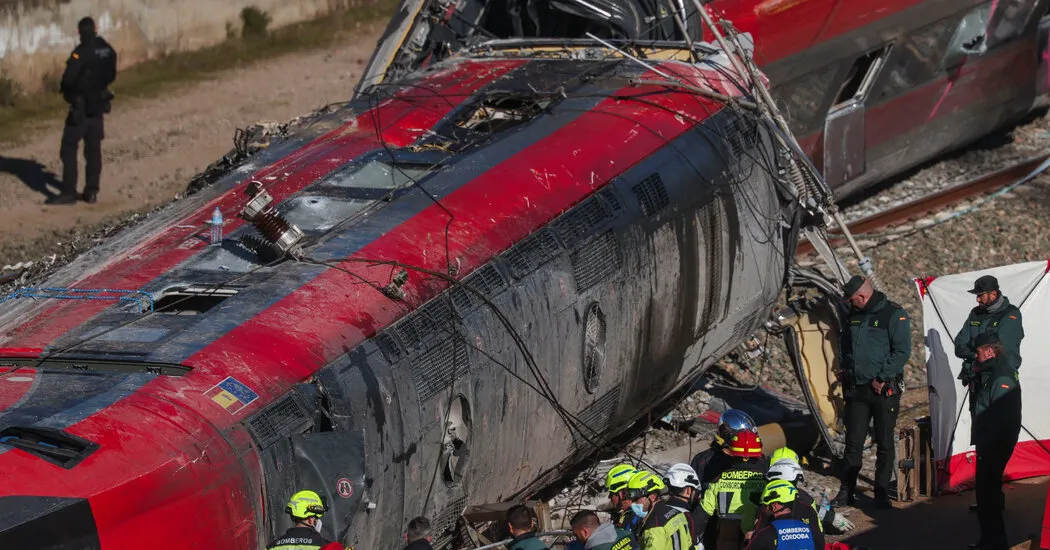
PinnedUpdated Here’s the latest.Harrowing accounts from survivors and rescuers were emerging Monday after two high-speed trains collided in southern Spain, killing at least 39 people and injuring dozens of others in the country’s deadliest train crash since at least 2013.Visiting the scene, Óscar Puente, Spain’s transport minister, warned that the death toll was “not final,” as emergency workers scoured the wreckage, and footage showed desperate passengers climbing out of windows of mangled carriages.Juanma Moreno, the president of the regional government of Andalucía, told Spain’s RNE radio that some bodies had been found hundreds of feet away from the crash site. He said rescuers feared that more people may be trapped beneath the train cars.Authorities said the two trains collided at around 7:45 p.m. local time on Sunday in Adamuz, near the city of Córdoba in the southern region of Andalucía, along the main high-speed rail line connecting southern Spain with Madrid, the country’s capital.The rear cars of a northbound train traveling to Madrid from Málaga, on the country’s southern coast, derailed and “veered onto the adjacent track for still unknown reasons,” the train’s private operating company, Iryo, said in a statement on Monday. The derailed carriages then hit an oncoming southbound train, operated by Spain’s national rail company, Renfe, that had departed from Madrid and was heading for the southern city of Huelva, west of Sevilla.“The accident is extremely strange,” Mr. Puente told reporters. “It happened on a straightaway. All the experts we have consulted are extremely baffled.”Work to replace the tracks, switches and junctions was completed last May, he said, and the derailed Iryo train had undergone its most recent inspection on Jan. 15, according to the company.Iryo said around 300 passengers were on board its train at the time of the crash. Renfe has not said how many passengers the second train was carrying.Álvaro Fernández Heredia, the president of Renfe, told the state broadcaster RNE that the trains had not been speeding before the crash and that human error was unlikely because the trains’ systems had measures to correct such errors.The Iryo train was a new Freccia 1000, a train that can reach top speeds of 300 kilometers an hour (186 miles per hour), said Carlo Valentino, a spokesman for the Italian rail company Ferrovie dello Stato, Iryo’s majority owner, adding that it had joined the fleet roughly three years ago.Spain’s leaders cleared their schedules and rushed to the scene of the collision, as authorities promised investigations and urged the hundreds of passengers who had survived the crash to contact loved ones.Here’s what else to know:The victims: The Andalucía emergency service department said in a statement that 73 people had been hospitalized. Of the patients, 24 were in serious condition, including four children. The Andalucía government set up a medical post at the crash site to treat victims, and the Córdoba city government issued an urgent appeal for doctors to help treat the injured.Rail suspensions: High-speed train services across much of southern Spain will be suspended on Monday, Spain’s railway infrastructure operator said on social media. Renfe said that rail service could be disrupted for days.Spain’s rail network: The country ranks second worldwide behind China in high-speed rail network length, according to the International Union of Railways. About 40 million passengers use Spain’s high-speed rail network every year, according to Renfe, and its average speeds rival those of global leaders like Japan and France.Survivors of the crash describe hellish scenes.ImageMembers of the Spanish Civil Guard, along with other emergency personnel, work next to one of the trains involved in the accident near Adamuz, Spain, on Monday.Credit...Susana Vera/ReutersSurvivors of the high-speed train crash in southern Spain described chaotic and hellish scenes on Monday, telling of wrecked train cars, falling luggage and the sound of screams.Several passengers posted accounts on social media after the collision in Adamuz, near the city of Córdoba. At least 39 people were killed and dozens more injured, officials said.Salvador Jiménez, a journalist with RTVE, Spain’s national public broadcaster, said he was a passenger in the first car of one of the trains. “There was a moment when it felt like an earthquake,” Mr. Jiménez told the broadcaster.María Vidal, 32, told the Spanish newspaper El País that medics had rushed to the mangled cars after of the crash, and that ambulances had carried away the dead and injured.“I’m in shock,” Ms. Vidal said. “Horrible screams. I’m shaking.”Photographs from the scene published by news agencies on Monday show wrecked train cars at odd angles across train tracks and a tangled mess of metal, wires and broken glass. At least one car had tipped onto its side, and rescue workers were on top of it. Footage showed some survivors climbing out of smashed windows.Some bodies were thrown from the train cars.“The impact was so severe that we have found bodies hundreds of meters from the impact,” Mr. Moreno, the regional president, said on Spanish radio, the national broadcaster said.Some survivors were hurried to safe areas in nearby fields. One survivor, identified by El País only as Ana, who was traveling with her sister and dog, said that she saw people dying and could not help them.“We could see that they were slipping away, and there was nothing we could do about it,” she told reporters.She said that her sister was rescued by firefighters and taken to the hospital. “Now that she’s under observation and waiting,” she said, “I’m taking the opportunity to look for my dog.”Gonzalo Sánchez Aguilar, 46, happened to be driving his car near the crash site and went to help. He said he saw seven or eight dead bodies as he loaded injured survivors into his car and rushed them to a hospital. “I saw a lot of dead bodies,” he said in an interview. “Really bad injuries.”The mayor of Adamuz, Rafael Ángel Moreno, rushed to the crash site and described “a terrible scene.” “People were trying to get out of the train, there were many injured. It was utter chaos,” he said, his voice quavering. “We are continuing to work to recover the last bodies.”Amelia Nierenberg contributed reporting.Juanma Moreno, the president of the regional government of Andalucía, said that heavy machinery would soon be arriving at the collision site to lift the worst-affected train cars. “Unfortunately, it is very likely that more deceased individuals will be found under the tangle of metal,” he said on social media, adding that victims would be identified as quickly as possible.Samuel GranadosReporting from Adamuz, SpainGonzalo Sánchez Aguilar, 46, was driving nearby when the trains crashed. He loaded injured survivors into his car and rushed them to the hospital. “I saw a lot of dead bodies,” he said in an interview. “Really bad injuries.”ImageCredit...Samuel Granados for The New York TimesOne survivor said that she saw people dying but that she could not help. “We could see that they were slipping away, and there was nothing we could do about it,” Ana, a survivor from Málaga, said in an interview released by the Reuters news agency. Ana, who was traveling on one of the trains with her sister and dog, said she was pulled out of a window covered in blood.VideoCreditCredit...ReutersSamuel GranadosReporting from Adamuz, SpainAndres Pastor Valverde, 53, a metalworker, was watching his son’s soccer game when he heard the crash near his house, followed by a constant stream of sirens and alarms. When he saw on the news what had happened, Mr. Valverde rushed to the scene with his son, bringing blankets and a generator to help emergency workers.Samuel GranadosReporting from Adamuz, SpainResidents gathered at Adamuz City Hall for a minute of silence.
SRCNew York Times - World
LANGEN
LEANCenter-Left
WORDS1 264
ENT12
MON · 2026-01-19 · 11:55 GMTBRIEF NSR-2026-0119-8682
NSR-2026-0119-8682News Report·EN·Human Interest
Live Updates: At Least 39 Are Dead in High-Speed Train Crash in Spain
A high-speed train collision in southern Spain, near Córdoba, has resulted in at least 39 fatalities and numerous injuries, making it the country's deadliest train crash since 2013. The incident occurred on Sunday around 7:45 p.m.
The New York TimesNew York Times - WorldFiled 2026-01-19 · 11:55 GMTLean · Center-LeftRead · 6 min
New York Times - WorldFIG 01
Reading time
6min
Word count
1 264words
Sources cited
6cited
Entities identified
12entities
Quality score
100%
§ 01
Briefing Summary
AI-generatedNEWSAR · AI
A high-speed train collision in southern Spain, near Córdoba, has resulted in at least 39 fatalities and numerous injuries, making it the country's deadliest train crash since 2013. The incident occurred on Sunday around 7:45 p.m. local time when the rear cars of a northbound train traveling from Málaga to Madrid derailed and struck an oncoming southbound train heading from Madrid to Huelva. The cause of the derailment is currently unknown, but officials stated that the accident occurred on a straight section of track that had recently been updated. Rescue workers are still searching the wreckage, and the transport minister warned that the death toll may rise. Both train companies involved, Iryo and Renfe, are cooperating with the investigation.
Confidence 0.90Sources 6Claims 5Entities 12
§ 02
Article analysis
Model · rule-basedFraming
Human Interest
Political Strategy
Tone
Measured
AI-assessed
CalmNeutralAlarmist
Factuality
0.90 / 1.00
Factual
LowHigh
Sources cited
6
Well sourced
FewMany
§ 03
Key claims
5 extracted01
73 people had been hospitalized.
statisticThe Andalucía emergency service department
Confidence
1.00
02
The rear cars of a northbound train derailed and “veered onto the adjacent track for still unknown reasons.”
quoteIryo
Confidence
1.00
03
The two trains collided at around 7:45 p.m. local time on Sunday in Adamuz.
factualAuthorities
Confidence
1.00
04
The death toll was “not final.”
quoteÓscar Puente, Spain’s transport minister
Confidence
1.00
05
At least 39 people are dead in a high-speed train crash in southern Spain.
factualArticle
Confidence
1.00
§ 04
Full report
6 min read · 1 264 words§ 05
Entities
12 identifiedKey playerOppositionContextPositiveNeutralNegative
People3
Organizations4
§ 06
Keywords & salience
8 termstrain crash
1.00
high-speed train
0.80
spain
0.70
train collision
0.70
rail accident
0.60
derailment
0.60
investigation
0.50
rail safety
0.50
§ 07
Topic connections
Interactive graph Network visualization showing 51 related topics
View Full Graph Person Organization Location Event|Click node to navigate|Edge numbers = shared articles