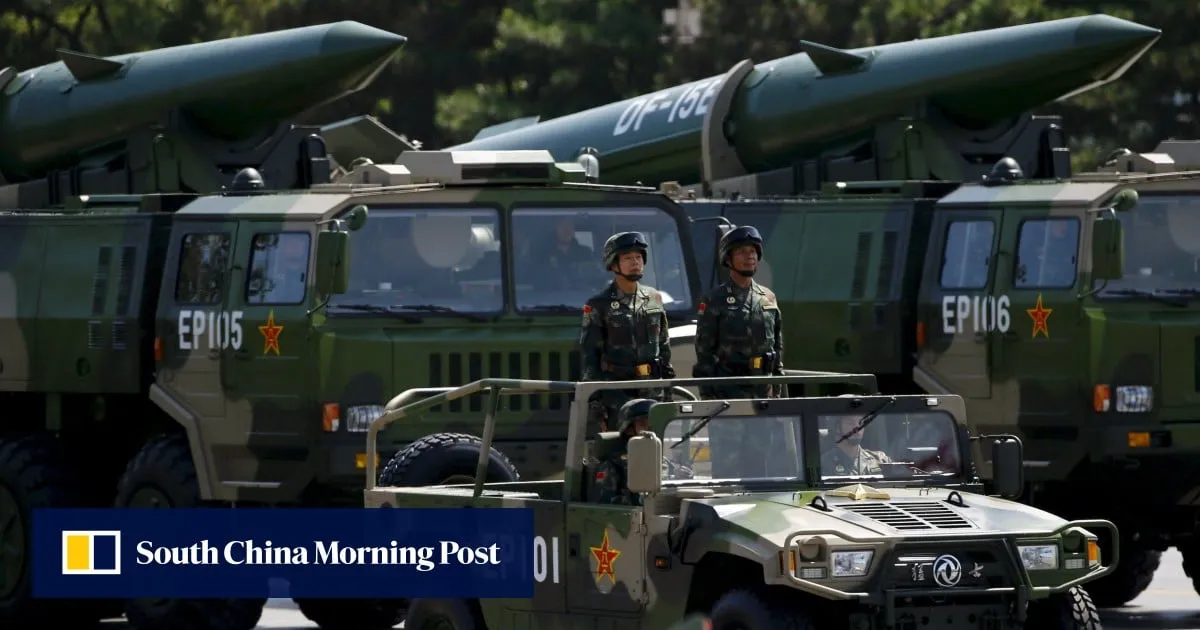
Lessons from the Iran war suggest that China’s ageing Dongfeng-15B short-range missiles may be more useful in penetrating modern missile defences than previously thought, according to military analysts.The suggestion surfaced this month in an article published by Ordnance Science and Technology which said that missiles with biconic manoeuvring re-entry vehicles (MRVs) could achieve a penetration effect close to that of hypersonic projectiles.The article, written under the byline Ma Lihua, referred to Iranian claims that its short-range missiles, equipped with biconic MRVs, repeatedly penetrated US missile defence networks around bases in the United Arab Emirates, Kuwait and Bahrain.
SRCSouth China Morning Post
LANGEN
LEANCenter-Right
WORDS97
ENT9
THU · 2026-06-25 · 11:00 GMTBRIEF NSR-2026-0625-87314
NSR-2026-0625-87314Analysis·EN·National Security
Did the Iran war just prove that China’s ageing DF-15Bs are still big guns?
Military analysts suggest that China's older Dongfeng-15B short-range missiles might be more effective at penetrating modern missile defenses than previously believed, based on lessons from recent conflicts. An article in Ordnance Science and Technology, attributed to Ma Lihua, posits that missiles equipped with biconic maneuvering re-entry vehicles (MRVs) can achieve a penetration effect comparable to hypersonic projectiles.
Alcott WeiSouth China Morning PostFiled 2026-06-25 · 11:00 GMTLean · Center-RightRead · 1 min
South China Morning PostFIG 01
Reading time
1min
Word count
97words
Sources cited
1cited
Entities identified
9entities
Quality score
100%
§ 01
Briefing Summary
AI-generatedNEWSAR · AI
Military analysts suggest that China's older Dongfeng-15B short-range missiles might be more effective at penetrating modern missile defenses than previously believed, based on lessons from recent conflicts. An article in Ordnance Science and Technology, attributed to Ma Lihua, posits that missiles equipped with biconic maneuvering re-entry vehicles (MRVs) can achieve a penetration effect comparable to hypersonic projectiles. This idea emerged this month, referencing Iranian claims that its short-range missiles with biconic MRVs successfully penetrated US missile defense systems around bases in the UAE, Kuwait, and Bahrain. The article implies these capabilities could make the DF-15B a valuable asset in overcoming advanced defenses.
Confidence 0.85Sources 1Claims 3Entities 9
§ 02
Article analysis
Model · rule-basedFraming
National Security
Technology
Tone
Mixed Tone
AI-assessed
CalmNeutralAlarmist
Factuality
0.60 / 1.00
Mixed
LowHigh
Sources cited
1
Limited
FewMany
§ 03
Key claims
3 extracted01
China's Dongfeng-15B missiles with biconic MRVs may be more effective at penetrating modern missile defenses than previously thought.
factualmilitary analysts
Confidence
0.70
02
Missiles with biconic MRVs could achieve a penetration effect close to that of hypersonic projectiles.
factualOrdnance Science and Technology article (Ma Lihua)
Confidence
0.60
03
Iranian short-range missiles with biconic MRVs repeatedly penetrated US missile defense networks.
factualIranian claims (reported in Ordnance Science and Technology)
Confidence
0.50
§ 04
Full report
1 min read · 97 words§ 05
Entities
9 identifiedKey playerOppositionContextPositiveNeutralNegative
Organizations1
Locations6
§ 06
Keywords & salience
8 termsdf-15b missiles
1.00
missile defence
0.90
iran war
0.80
biconic manoeuvring re-entry vehicles
0.70
penetration effect
0.60
short-range missiles
0.50
hypersonic projectiles
0.40
military analysts
0.40
§ 07
Topic connections
Interactive graph Network visualization showing 51 related topics
View Full Graph Person Organization Location Event|Click node to navigate|Edge numbers = shared articles