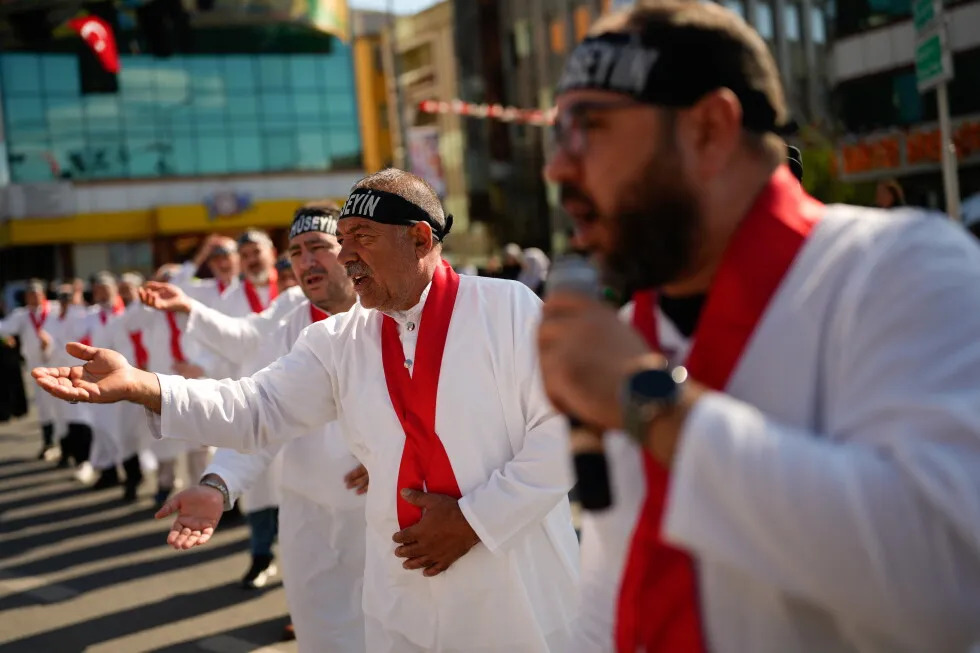
Shiite Muslims mark holy day of Ashoura after months of war in Iran and Lebanon 1 of 4 | Shiite faithful Muslims attend an Ashoura procession which commemorates the 7th-century martyrdom of Imam Hussein in Istanbul, Turkey, Thursday, June 25, 2026. (AP Photo/Emrah Gurel) 2 of 4 | Iranian mourners beat their heads and chests during a ceremony in Tehran, Iran, Tuesday, June 23, 2026, prior to Ashoura, which commemorates the 7th-century martyrdom of Imam Hussein, one of Prophet Muhammad’s grandsons and one of Shiite Islam’s most beloved saints, and 72 of his companions, who were killed in a battle in Karbala in present-day Iraq. (AP Photo/Vahid Salemi) 3 of 4 | Shiite faithful Muslims attend an Ashoura procession which commemorates the 7th-century martyrdom of Imam Hussein in Istanbul, Turkey, Thursday, June 25, 2026. (AP Photo/Emrah Gurel) 4 of 4 | Shiite faithful Muslims attend an Ashoura procession which commemorates the 7th-century martyrdom of Imam Hussein in Istanbul, Turkey, Thursday, June 25, 2026. (AP Photo/Emrah Gurel) By KAREEM CHEHAYEB Updated 1:22 PM MESZ, June 25, 2026 Leer en español Add AP News on Google Add AP News as your preferred source to see more of our stories on Google. Share Share Facebook Copy Link copied Print Email X LinkedIn Bluesky Flipboard Pinterest Reddit BEIRUT (AP) — Shiite Muslims around the world on Thursday marked Ashoura, a holy day symbolizing sacrifice and martyrdom that holds special significance for many this year after months of war in Iran and Lebanon. Ashoura commemorates the martyrdom of Imam Hussein, grandson of the Prophet Muhammad, at the Battle of Karbala in A.D. 680 Imam Hussein was killed with his family and companions after refusing to pledge allegiance to the Umayyad caliphate. The event cemented the schism between Sunni and Shiite Islam and remains a powerful symbol of resistance against oppression and injustice. The holiest day in the Shiite calendar This year, Ashoura comes after months of war in Iran and Lebanon, homes to two of the world’s largest Shiite populations. Iran and the U.S. this week launched talks aimed at finalizing a fragile ceasefire agreement. On the first day of the war, on Feb. 28, Iran’s supreme leader, Ayatollah Ali Khamenei, was killed in an Israeli airstrike. The 86-year-old Khamenei was not just Iran’s top political leader. He also had a final say on all religious matters and was revered by millions of Shiites worldwide. Ashoura comes just days before his funeral procession. The war also spilled over into Lebanon, where Iran’s key ally, the Hezbollah militant group, has been battling Israeli troops for months. Oil tankers navigate the Strait of Hormuz despite threats from Iran’s Revolutionary Guard 4 MIN READ Senate Republicans reject war powers resolution after Trump berates them at Capitol meeting 5 MIN READ 269 Rebound in tech shares pushes world markets higher, while oil prices fall 3 MIN READ Hezbollah entered the fighting days into the war by firing rockets into northern Israel in solidarity with Tehran. That sparked widespread Israeli aerial bombardment and a ground invasion that decimated large swaths of predominantly Shiite areas in southern Lebanon and Beirut’s southern suburbs. Ashoura comes as many of the more than one million displaced Lebanese people are trying to return to their villages in southern Lebanon. Cities and towns had held sermons and events in the buildup to the holy day surrounded by buildings reduced to rubble and ruins. Ashoura is the holiest day in the Shiite calendar, marked by traditional mourning rituals that include chest-beating, elegies and lamentations. It is held on the 10th day of the month of Muharram. In Karbala, the southern Iraqi city holy to Shiite Muslims, security was tightened as visitors arrived. Religious banners flew from the walls of Imam Hussein’s golden-domed shrine and actors played out scenes from the 7th century. “We see all kinds of people here and they don’t lack food, drinks or services, thanks to God, despite the massive gathering,” Redha Nouri, who traveled from Ahwaz in Iran, said. “There will be more crowds coming tomorrow, but the Iraqi people are here and will serve them.” In war-stricken Iran, black-clad mourners filled streets, mosques and neighborhood religious halls across Tehran for a public holiday that brought much of the capital to a halt. Shops were shuttered in many areas as processions of men beating their chests marched past and loudspeakers played elegies. Volunteers handed out tea and dates. The previous evening mourners had gathering at the shrine of Imam Ruhollah Khomeini south of Tehran in a ceremony attended by President Masoud Pezeshkian and other officials, Iranian state media reported. Khomeini led the 1979 revolution that ushered in Iran’s Islamic republic. In a social media post laden with an apparent message of resistance to the U.S. and Israeli attacks on Iran, Pezeshkian noted how Hussein taught people to stand against oppression, the temptation of power and the pursuit of self-interest. “We should neither oppress, nor accept oppression, nor remain silent before it,” he wrote. The commander of the Islamic Revolutionary Guard’s Quds Force, Gen. Esmail Ghaani, invoked the “spirit of Ashoura” in warning Israel to withdraw its forces from Lebanon or face defeat. The annual ceremonies came as Iran’s leadership continues to draw on Ashoura’s language of sacrifice and resistance at a time of deep political and economic pressure. The faithful in Lebanon attend sermons and visit graves Families in the Lebanese coastal city of Tyre who lost relatives fighting with Hezbollah or working as paramedics wept during a sermon on the third day of Muharram. A cleric, who sat between portraits of current Iranian Supreme Leader Mojtaba Khamenei and Hezbollah Secretary-General Naim Kassem, compared the struggles the modern-day leaders faced in the war to that of Hussein and his companions in Karbala. Banners in red and black bearing Hussein’s name were hung on every street. In Beirut’s southern suburbs, many flocked to the grave of former Hezbollah leader Hassan Nasrallah, who was killed in an Israeli strike in September 2024. Security is raised in Pakistan to protect the Shiite minority Elsewhere, Pakistan deployed thousands of police and paramilitary personnel across the country following intelligence reports warning of possible militant attacks on Shiite Muslims, a minority in the predominantly Sunni country. Although most Sunnis and Shiites live peacefully alongside one another, militant groups have repeatedly targeted Shiite communities, mosques, and religious gatherings in sectarian attacks that have claimed hundreds of lives. As members of Pakistan’s Shiite minority prepare to take part in mourning processions, mobile phone service in some areas is expected to be suspended temporarily to help prevent attacks. “Imam Hussein is a symbol of the highest struggle and sacrifice,” said Saadia Shah, 33, as she entered a congregation hall in the eastern city of Lahore with her two children. “His name gives us the courage to stand up to tyranny, to say what is right and oppose what is wrong.” Associated Press journalists Munir Ahmed in Islamabad, Amir Vahdat in Tehran, Iran, and Ali Sadiq in Karbala, Iraq, contributed to this report. KAREEM CHEHAYEB Chehayeb is an Associated Press reporter in Beirut. twitter instagram mailto
SRCAssociated Press (AP)
LANGEN
LEANCenter
WORDS1 183
ENT12
THU · 2026-06-25 · 10:23 GMTBRIEF NSR-2026-0625-87329
NSR-2026-0625-87329News Report·EN·Conflict
Shiite Muslims mark holy day of Ashoura after months of war in Iran and Lebanon
Shiite Muslims worldwide observed Ashoura, a holy day commemorating the 7th-century martyrdom of Imam Hussein. This year's observance holds particular significance following months of war in Iran and Lebanon, regions with large Shiite populations.
Associated Press (AP)Filed 2026-06-25 · 10:23 GMTLean · CenterRead · 5 min
Associated Press (AP)FIG 01
Reading time
5min
Word count
1 183words
Sources cited
0cited
Entities identified
12entities
Quality score
100%
§ 01
Briefing Summary
AI-generatedNEWSAR · AI
Shiite Muslims worldwide observed Ashoura, a holy day commemorating the 7th-century martyrdom of Imam Hussein. This year's observance holds particular significance following months of war in Iran and Lebanon, regions with large Shiite populations. In Iran, the war resulted in the death of Supreme Leader Ayatollah Ali Khamenei, with his funeral procession imminent. The conflict also impacted Lebanon, where Hezbollah engaged in fighting with Israeli troops, leading to widespread damage in Shiite areas. Mourning rituals, including chest-beating and elegies, were observed in both countries, with leaders drawing parallels between Imam Hussein's resistance against oppression and current struggles. In Pakistan, security was heightened for the Shiite minority due to concerns of militant attacks.
Confidence 0.90Claims 5Entities 12
§ 02
Article analysis
Model · rule-basedFraming
Conflict
Human Interest
Tone
Measured
AI-assessed
CalmNeutralAlarmist
Factuality
0.80 / 1.00
Factual
LowHigh
Sources cited
0
No named sources
FewMany
§ 03
Key claims
5 extracted01
Hezbollah has been battling Israeli troops in Lebanon for months.
factual
Confidence
1.00
02
Iran's supreme leader, Ayatollah Ali Khamenei, was killed in an Israeli airstrike on Feb. 28.
factual
Confidence
1.00
03
This year's Ashoura follows months of war in Iran and Lebanon, which have large Shiite populations.
factual
Confidence
1.00
04
Ashoura commemorates the martyrdom of Imam Hussein, grandson of the Prophet Muhammad, at the Battle of Karbala in A.D. 680.
factual
Confidence
1.00
05
Shiite Muslims around the world marked Ashoura on Thursday, a holy day symbolizing sacrifice and martyrdom.
factual
Confidence
1.00
§ 04
Full report
5 min read · 1 183 words§ 05
Entities
12 identifiedKey playerOppositionContextPositiveNeutralNegative
People3
Organizations1
Locations6
Events1
§ 06
Keywords & salience
9 termsshiite muslims
1.00
ashoura
1.00
martyrdom
0.90
imam hussein
0.90
war in iran and lebanon
0.80
resistance against oppression
0.70
battle of karbala
0.60
ayatollah ali khamenei
0.50
ceasefire agreement
0.40
§ 07
Topic connections
Interactive graph No topic relationship data available yet. This graph will appear once topic relationships have been computed.