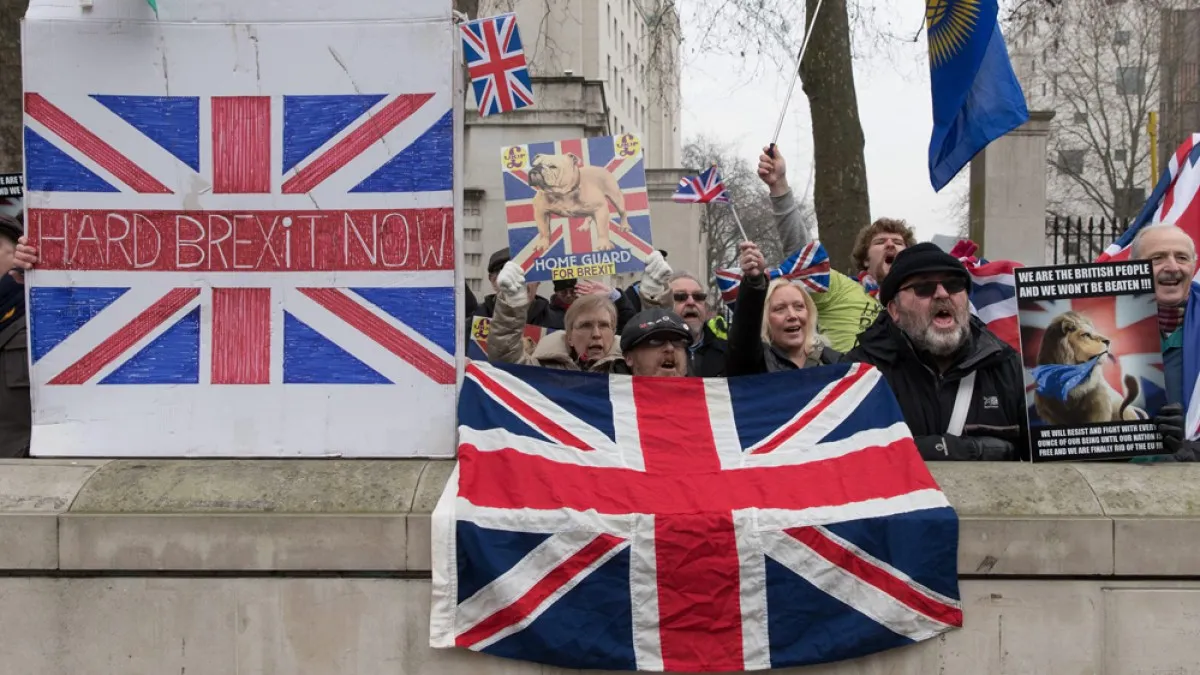
‘We did regain control’: The Brexit voters with no regrets 10 years onThe UK may have squandered the freedoms it won, but leaving the EU was the right decision, say pro-Brexit Britons.A slim majority of Britons voted for the United Kingdom to leave the European Union in June 2016 [Hayoung Jeon/EPA]Published On 25 Jun 2026Despite polls showing that most Britons regret leaving the European Union, many others believe the case for quitting the bloc still holds.“The arguments for Brexit now are largely the same as they were then: sovereignty, democracy and taking back control,” University of Cambridge professor and Brexit supporter Robert Tombs told Al Jazeera.Recommended Stories list of 4 itemslist 1 of 4Political turmoil: UK will see its seventh prime minister in 10 yearslist 2 of 4Brexit 10 years on: What has changed in the UK explained in maps and chartslist 3 of 4After a decade, Brexit’s cost to Britain is not only economiclist 4 of 4Why do the UK’s prime ministers keep resigning?end of listControl was a central theme of the “Leave” camp.Brexiters called for more control over migration to protect borders from foreign supranational powers, as well as wresting sovereignty back from the bloc – which they portrayed as an out-of-touch middle-class group of elites – and returning it to the people.“Britain was never especially happy in the EU, but then Greece, Italy and others do not appear to be especially happy either,” Tombs said. “One of the arguments for leaving was that Britain has always been more closely tied to countries outside the EU, especially English-speaking ones, than to countries within the bloc,” he continued.The landmark referendum 10 years ago saw Britain break its association with the EU after more than 43 years of an occasionally volatile membership.Those who remain committed to Brexit blame successive governments for failing to maximise the perceived freedoms of leaving the bloc. They also say that the negative predictions associated with “project fear”, narratives among those who campaigned to remain within the union, have failed to materialise.Noted Brexit supporter, Robert Tombs [Courtesy of Creative Commons]Troubled unionFrom when the UK joined the European project in the 1970s through to its departure, the relationship has often been tense.There were numerous crisis points, such as the UK’s dominant Conservative Party’s fundamental divisions on the issue of its membership.Other sore points were the financial crisis of 1992, dubbed “Black Wednesday” in the media, when the UK failed to maintain sterling in the EU’s exchange rate mechanism, and the bitter battle over the Maastricht Treaty.The issue of Europe has turned into a defining fault line in British politics, one that never fully healed and ultimately culminated in Brexit.Tombs said that the UK had an Atlanticist positioning when it joined the EU and that even the former French President Charles DeGaulle described the UK as shutting itself in.Taking back controlMany pro-Brexit Britons hoped their vote would see immigration decline.In the build-up to the vote, Reform Party leader Nigel Farage, then the head of UKIP, and his campaign drew criticism for his “Breaking Point” poster featuring Syrian refugees massing near the Croatia-Slovenia border as though they were seeking entry into the UK.Leader of the United Kingdom Independence Party (UKIP) Nigel Farage poses during a media launch for a ‘Leave’ EU referendum poster in London, Britain, on June 16, 2016 [Stefan Wermuth/Reuters]Nevertheless, despite the assurances offered at the time, immigration increased, ballooning in what right-wing critics called the ”Boriswave,” named after former premier and Brexit campaigner Boris Johnson. His post-Brexit administration saw net migration into the UK rise from about 224,000 people in 2019 to more than 600,000 in 2022 – increasing to 906,000 in 2023, representing an increase of 302 percent.“We did regain control over immigration,” said David Goodhart, head of demography, immigration and integration at Policy Exchange, a right-leaning think tank. “But the point is we used that freedom to expand it,” he said.He blamed the UK’s failure to align with a post-Brexit world. The country officially withdrew from the bloc on January 31, 2020, four and half years after the referendum.“We spent years arguing over what kind of Brexit we wanted,” Goodhart continued. “[Boris] Johnson came in, saying he’d get Brexit done and blew it.”People who felt abandoned by the British political system before the Brexit referendum feel no more included now, Goodhart said, adding that the COVID-19 pandemic, war in Ukraine and political chaos at home have also fuelled social anxiety.Missed opportunitiesWhile Brexit may have failed to ignite the UK economy, some of the “Remain” camp’s predictions have not come true, either.It had been forecast that the vote to leave would immediately tip the UK economy into recession, that it would trigger job losses on an unprecedented scale and see an exodus of talent from the UK’s critical financial services sector. The departure was also feared to break down constitutional rule in the UK and even Europe.“Brexit has not been the economic disaster many claimed,” Goodhart said. “In fact, it’s actually had remarkably little impact,” he added, pointing to a downturn in global economies.“There have also been gains from the UK breaking free from the EU, which is quite conservative and regulatory by nature. If you look at the advances in areas like fintech and gene editing that have been made in the UK, it’s hard to imagine British industries doing the same in the EU.”Elsewhere, if growth on the scale promised by leave campaigners has yet to materialise, some say that the fault lies with the successive UK governments’ failure to sufficiently reduce regulation and free up the British economy rather than in Brexit itself.According to Kristian Niemietz, the editorial director at the Institute of Economic Affairs, many of whose members had been keen advocates of the vote to leave, “free-market Brexiteers thought that Brexit was likely to be followed by liberalisations. Free-market remainers thought that a liberalising Brexit was possible, but unlikely.”He told Al Jazeera that a decade on, there have been some liberalisations, but the UK has been “too timid to cancel out the disruptions caused by Brexit”.“The UK has signed up to some additional trade deals that it could not have concluded as an EU member. There have also been some mild deregulation measures, such as on gene editing, which would not have happened in the EU,” he said, adding that, while these were relatively small steps, they provided some indication of the opportunities that, 10 years after the vote, had yet to be seized.“Free trade and light-touch regulation are the way to make Brexit a belated success.”The point, for many of those Brexit campaigners 10 years on, is that the UK has survived in the face of those who predicted failure.Looking ahead, might other European countries have Brexit envy?“The main difference [between the UK and other EU states] is that we were given the vote,” Tombs said, citing a recent television appearance by the current French President Emmanuel Macron, conceding that, were the French public to be given an opportunity to leave the EU, it was one they may well take.“No one else in Europe has been given the choice,” he added. “We were.”
SRCAl Jazeera
LANGEN
LEANCenter
WORDS1 184
ENT8
THU · 2026-06-25 · 12:40 GMTBRIEF NSR-2026-0625-87337
NSR-2026-0625-87337News Report·EN·Human Interest
‘We did regain control’: The Brexit voters with no regrets 10 years on
Ten years after the UK voted to leave the European Union, many pro-Brexit Britons maintain that the decision was correct, emphasizing regained sovereignty and control. While acknowledging that the freedoms gained may have been squandered, supporters like Professor Robert Tombs argue that the core reasons for leaving—sovereignty, democracy, and control—remain valid.
Simon Speakman CordallAl JazeeraFiled 2026-06-25 · 12:40 GMTLean · CenterRead · 5 min
Al JazeeraFIG 01
Reading time
5min
Word count
1 184words
Sources cited
1cited
Entities identified
8entities
Quality score
100%
§ 01
Briefing Summary
AI-generatedNEWSAR · AI
Ten years after the UK voted to leave the European Union, many pro-Brexit Britons maintain that the decision was correct, emphasizing regained sovereignty and control. While acknowledging that the freedoms gained may have been squandered, supporters like Professor Robert Tombs argue that the core reasons for leaving—sovereignty, democracy, and control—remain valid. They attribute current challenges to successive governments failing to maximize post-Brexit opportunities and dismiss negative predictions from the "Remain" campaign as unfulfilled. Despite increased immigration figures, some believe the UK has regained control over its borders, even if that freedom has been used to expand immigration. The article notes that the UK officially withdrew from the EU on January 31, 2020, after a long and often tense membership.
Confidence 0.90Sources 1Claims 5Entities 8
§ 02
Article analysis
Model · rule-basedFraming
Human Interest
Political Strategy
Tone
Measured
AI-assessed
CalmNeutralAlarmist
Factuality
0.40 / 1.00
Mixed
LowHigh
Sources cited
1
Limited
FewMany
§ 03
Key claims
5 extracted01
The UK broke its association with the EU after more than 43 years of membership.
factual
Confidence
1.00
02
Many Brexit voters believe the case for quitting the EU still holds, citing sovereignty, democracy, and taking back control.
quoteRobert Tombs
Confidence
0.90
03
Brexiters called for more control over migration and wresting sovereignty back from the EU.
factual
Confidence
0.80
04
Pro-Brexit Britons blame successive governments for failing to maximize the freedoms of leaving the bloc.
factual
Confidence
0.70
05
Negative predictions associated with 'project fear' have failed to materialize.
factual
Confidence
0.60
§ 04
Full report
5 min read · 1 184 words§ 05
Entities
8 identifiedKey playerOppositionContextPositiveNeutralNegative
People1
Organizations3
§ 06
Keywords & salience
8 termsbrexit
1.00
sovereignty
0.90
taking back control
0.90
european union
0.80
uk
0.70
democracy
0.60
migration
0.50
referendum
0.40
§ 07
Topic connections
Interactive graph Network visualization showing 51 related topics
View Full Graph Person Organization Location Event|Click node to navigate|Edge numbers = shared articles