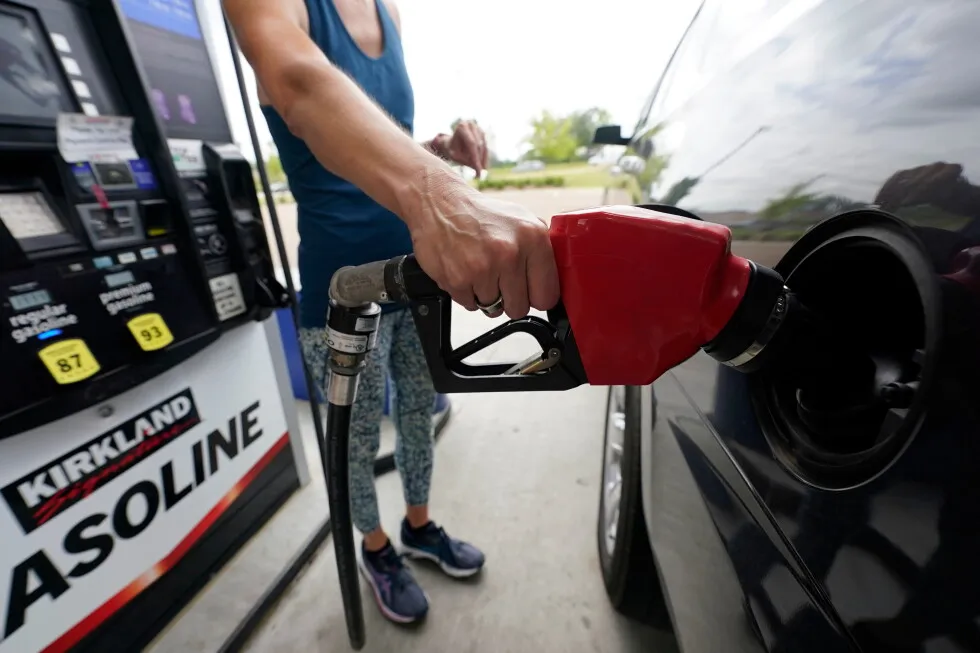
Key inflation gauge jumps to 3-year high in latest sign of affordability challenges 0 seconds of 1 minute, 23 secondsVolume 0% Press shift question mark to access a list of keyboard shortcuts Keyboard ShortcutsEnabledDisabled Shortcuts Open/Close/ or ? Play/PauseSPACE Increase Volume↑ Decrease Volume↓ Seek Forward→ Seek Backward← Captions On/Offc Fullscreen/Exit Fullscreenf Mute/Unmutem Decrease Caption Size- Increase Caption Size+ or = Seek %0-9 Next Up 'Nobody cares' says Trump as Energy Secretary attempts to get dates right 01:25 Subtitle Settings OffEnglish(US)_v Font Color White Font Opacity 100% Font Size 100% Font Family Arial Character Edge None Edge Color Black Background Color Black Background Opacity 50% Window Color Black Window Opacity 0% Reset WhiteBlackRedGreenBlueYellowMagentaCyan 100%75%50%25% 200%175%150%125%100%75%50% ArialCourierGeorgiaImpactLucida ConsoleTahomaTimes New RomanTrebuchet MSVerdana NoneRaisedDepressedUniformDrop Shadow WhiteBlackRedGreenBlueYellowMagentaCyan WhiteBlackRedGreenBlueYellowMagentaCyan 100%75%50%25%0% WhiteBlackRedGreenBlueYellowMagentaCyan 100%75%50%25%0% 00:00 01:23 01:23 More Videos 01:25 'Nobody cares' says Trump as Energy Secretary attempts to get dates right 01:15 Meet Osito, the rescue dog who steals hearts at the World Cup 01:32 Trump unveils new Air Force One, says ships are 'pouring out' Strait of Hormuz 01:42 Senate approves a war powers resolution in a rebuke to Trump over Iran 00:35 Dragon boat festival brings annual fearsome competition to Hong Kong 01:17 Prada goes back to basics 01:51 Against all odds, blind Kenyan tailor defies glaucoma to keep his business running 01:00 Serbia's raspberry growers face climate change and low prices Close 1 of 3 | When the cost of nearly everything is rising, economists call it inflation. Even if paychecks also rise, inflation typically leads people feel like it’s harder to make ends meet, and it often becomes a major political issue. 2 of 3 | A customer readies to pump gas at this Ridgeland, Miss., Costco, Tuesday, May 24, 2022. s. (AP Photo/Rogelio V. Solis, File) 3 of 3 | A person looks at the fresh fish at a grocery store Monday, May 11, 2026, in Nashville, Tenn. (AP Photo/George Walker IV, File) By Christopher Rugaber Updated 3:54 PM MESZ, June 25, 2026 Leer en español Add AP News on Google Add AP News as your preferred source to see more of our stories on Google. Share Share Facebook Copy Link copied Print Email X LinkedIn Bluesky Flipboard Pinterest Reddit WASHINGTON (AP) — The Federal Reserve’s preferred inflation gauge rose to a new three-year high in May as gas prices peaked, a sign rising costs could pose political problems for President Donald Trump and his political party as midterm elections near. Consumer prices rose 4.1% in May from a year earlier, the Commerce Department said Thursday, the largest annual increase since April 2023. On a monthly basis, inflation was 0.4% last month, matching April’s increase and down from 0.7% in March. The increase was largely driven by more expensive gas, as well as pricier semiconductors and other computer equipment that are in high demand for the AI buildout. Rising prices have caused the inflation-fighters at the Federal Reserve to keep their key rate unchanged this year, a reversal from January when they had penciled in two cuts. Some economists forecast the central bank could lift rates this year instead. “Underyling inflation is closer to 3% rather than 2%,” said Mark Vitner, chief economist at Piedmont Crescent Capital. “It does suggest to me that the next Fed move, whenever it comes, is more likely to be a hike than a cut.” The Fed probably won’t raise rates until next year, he added. Wall Street drifts in mixed trading after Micron soars and Apple drops 2 MIN READ Sharp drops in Big Tech companies pull indexes mostly lower on Wall Street 3 MIN READ World shares are mixed and US futures fall after a tech-led rally on Wall St 3 MIN READ Oil and gas prices have fallen substantially since Trump agreed to a peace deal with Iran earlier this month, but the conflict lifted gas prices to nearly $4.50 a gallon on average nationwide in May. They have since fallen back to $3.92 as of Thursday, according to AAA, but that’s more than 20% above prices at this time last year as the driving season gets underway. Declining gas prices will likely pull down headline inflation next month, yet measures of underlying inflation remain stubbornly elevated and will be a concern for the Fed. Excluding the volatile energy and food categories, core prices rose 3.4% in May compared with a year earlier, up from 3.3% in April and the largest increase since October 2023. On a monthly basis, they rose 0.3% from April to May, the same as the previous month. Higher gas prices aren’t the only thing worsening inflation. The AI buildout has made computer components more expensive, and Apple announced last week that it would raise prices for its computers and iPads because of the higher costs. Services prices also rose sharply last month, lifted by more expensive restaurant meals, hotel rooms, auto repairs, and health care. At the same time, consumers appear willing to keep spending and boost the economy. Adjusted for inflation, spending rose 0.3% from April to May. And inflation-adjusted incomes rose for the first time in four months, picking up 0.3%, which could bolster consumer spending in coming months. A separate report Thursday showed that the economy expanded at a 2.1% annual rate in the first three months of the year, an upgrade from a previous estimate of 1.6%. And the number of people seeking unemployment benefits fell last week, a sign that layoffs remain low. New Fed chair Kevin Warsh last week underscored the central bank’s determination to drive inflation back to its 2% target, but he gave no sign of what steps the Fed might take. Some economists, however, now expect the central bank to increase rates this year. Those expectations upended U.S. markets this week, hammering fast-growing sectors like tech. inflation has been above the Fed’s 2% target for more than five years, leaving many Americans more gloomy about the future. Vitner points out that inflation hadn’t topped 2.5% for nearly a decade before the pandemic, likely making the inflation spikes since then even harder to accept for most households. Thursday’s report covers the personal consumption expenditures price index, a lesser-known measure compared to the consumer price index, which was released earlier this month and showed a similarly large increase. The Fed prefers the PCE index because it puts less weight on housing and also reflects changes in how Americans shop when prices rise, such as when consumers buy cheaper off-brand items. The new inflation data arrives a day after Trump refused to sign housing legislation, approved by Congress, that is intended to spur more construction and lower home prices over time, a response to Americans’ concerns about rising costs. Trump responded to the CPI report earlier this month by saying he “loved the inflation.” He has previously dismissed Democrats’ focus on “affordability” as a “hoax.” inflation jumped to 9.1% under former President Joe Biden, but even as it fell back closer to 2% in 2024, voters remained angry about the cumulative rise in the cost of groceries, rent, and other necessities. The PCE price index was last below 2.5% in April 2025, when Trump unveiled his “Liberation Day” tariffs. inflation then climbed steadily to 2.9% just before the Iran war. Christopher Rugaber Rugaber has covered the Federal Reserve and the U.S. economy for the AP for 16 years. He is a two-time finalist for the Gerald Loeb award for business reporting. twitter mailto
SRCAssociated Press (AP)
LANGEN
LEANCenter
WORDS1 240
ENT12
THU · 2026-06-25 · 13:23 GMTBRIEF NSR-2026-0625-87363
NSR-2026-0625-87363News Report·EN·Economic Impact
Key inflation gauge jumps to 3-year high in latest sign of affordability challenges
The Federal Reserve's preferred inflation gauge, the PCE price index, reached a three-year high in May, increasing 4.1% annually. This rise was primarily driven by higher gas prices, which peaked in May, and increased costs for semiconductors and computer equipment.
Associated Press (AP)Filed 2026-06-25 · 13:23 GMTLean · CenterRead · 5 min
Associated Press (AP)FIG 01
Reading time
5min
Word count
1 240words
Sources cited
1cited
Entities identified
12entities
Quality score
100%
§ 01
Briefing Summary
AI-generatedNEWSAR · AI
The Federal Reserve's preferred inflation gauge, the PCE price index, reached a three-year high in May, increasing 4.1% annually. This rise was primarily driven by higher gas prices, which peaked in May, and increased costs for semiconductors and computer equipment. Core inflation, excluding food and energy, also saw a slight increase. These persistent inflationary pressures have led the Federal Reserve to hold interest rates steady this year, with some economists now predicting potential rate hikes instead of cuts. The rising costs are creating affordability challenges for consumers and could impact upcoming midterm elections. While gas prices have since fallen, underlying inflation remains elevated, posing a concern for the Fed's goal of a 2% inflation target.
Confidence 0.90Sources 1Claims 4Entities 12
§ 02
Article analysis
Model · rule-basedFraming
Economic Impact
Political Strategy
Tone
Measured
AI-assessed
CalmNeutralAlarmist
Factuality
0.80 / 1.00
Factual
LowHigh
Sources cited
1
Limited
FewMany
§ 03
Key claims
4 extracted01
On a monthly basis, inflation was 0.4% last month, matching April’s increase.
statistic
Confidence
1.00
02
Consumer prices rose 4.1% in May from a year earlier, the largest annual increase since April 2023.
statisticCommerce Department
Confidence
1.00
03
The Federal Reserve’s preferred inflation gauge rose to a new three-year high in May.
statistic
Confidence
1.00
04
Rising costs could pose political problems for President Donald Trump and his political party as midterm elections near.
prediction
Confidence
0.70
§ 04
Full report
5 min read · 1 240 words§ 05
Entities
12 identifiedKey playerOppositionContextPositiveNeutralNegative
Organizations2
Locations7
§ 06
Keywords & salience
7 termsinflation
1.00
affordability challenges
0.90
economic gauge
0.80
cost of living
0.70
price increases
0.60
economic policy
0.50
consumer spending
0.40
§ 07
Topic connections
Interactive graph Network visualization showing 51 related topics
View Full Graph Person Organization Location Event|Click node to navigate|Edge numbers = shared articles