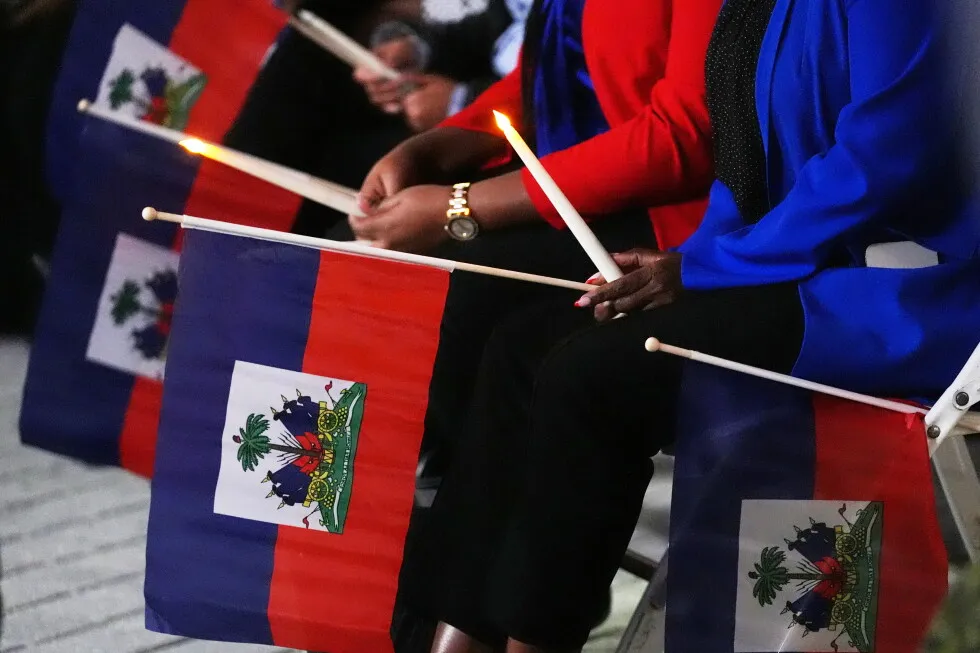
Supreme Court’s ruling to end protections for Haitian, Syrian immigrants could have broader impact 0 seconds of 59 secondsVolume 0% Press shift question mark to access a list of keyboard shortcuts Keyboard ShortcutsEnabledDisabled Shortcuts Open/Close/ or ? Play/PauseSPACE Increase Volume↑ Decrease Volume↓ Seek Forward→ Seek Backward← Captions On/Offc Fullscreen/Exit Fullscreenf Mute/Unmutem Decrease Caption Size- Increase Caption Size+ or = Seek %0-9 Next Up Statue and mural honor Lionel Messi in Argentina 01:16 Subtitle Settings OffEnglish(US)_v Font Color White Font Opacity 100% Font Size 100% Font Family Arial Character Edge None Edge Color Black Background Color Black Background Opacity 50% Window Color Black Window Opacity 0% Reset WhiteBlackRedGreenBlueYellowMagentaCyan 100%75%50%25% 200%175%150%125%100%75%50% ArialCourierGeorgiaImpactLucida ConsoleTahomaTimes New RomanTrebuchet MSVerdana NoneRaisedDepressedUniformDrop Shadow WhiteBlackRedGreenBlueYellowMagentaCyan WhiteBlackRedGreenBlueYellowMagentaCyan 100%75%50%25%0% WhiteBlackRedGreenBlueYellowMagentaCyan 100%75%50%25%0% 00:00 00:59 00:59 More Videos 01:16 Statue and mural honor Lionel Messi in Argentina 01:44 World Cup fans seek photos and some luck at Philadelphia's Rocky statue 01:00 AP top stories June 24 00:56 AP Top Stories June 23 01:01 AP top stories June 25 00:58 AP Top Stories June 25 00:50 Sharp drops in Big Tech companies pull the Nasdaq lower 00:59 AP Top Stories June 22 Close 1 of 2 | The 6-3 decision overturns lower court orders and allows the Department of Homeland Security to swiftly end Temporary Protected Status, a program that protects a total of 1.3 million people from 17 countries. 2 of 2 | People hold Haitian flags and candles during a vigil at the Haiti-cultural-complex" class="entity-link entity-location" data-entity-id="152725" data-entity-type="location">Little Haiti Cultural Complex after a federal judge blocked the Trump administration from ending temporary immigration status, or TPS, for Haitians, Feb. 3, 2026, in North Miami. (AP Photo/Lynne Sladky, File) By GISELA SALOMON Updated 12:52 AM MESZ, June 26, 2026 Add AP News on Google Add AP News as your preferred source to see more of our stories on Google. Share Share Facebook Copy Link copied Print Email X LinkedIn Bluesky Flipboard Pinterest Reddit MIAMI (AP) — The reach of the Supreme Court’s decision allowing President Donald Trump’s administration to end temporary legal protections for Haitian and Syrian immigrants may extend to many other countries. Thursday´s decision directly applies to about 350,000 Haitians and 6,000 Syrians, but may be a sign of what´s in store for nearly 1.3 million people from 17 countries on Temporary Protected Status. Many have lived and worked in the United States for decades and have American children. The decision exposes TPS holders from Haiti and Syria to potential detention and deportation. It could also pave the way for hundreds of thousands of other beneficiaries with pending asylum claims or other immigration relief to be forced to leave the country. Venezuelans are the biggest beneficiaries of TPS TPS was created by Congress in 1990 to prevent deportations to countries suffering from natural disasters or civil strife. When Trump took office, Venezuelans comprised the largest group of beneficiaries, followed by Haitians and Salvadorans. TPS protections are available only to people who have been continuously present in the U.S. since the date of designation. The Department of Homeland Security can extend it in increments of up to 18 months. The Trump administration has argued that immigrants were poorly vetted after former President Joe Biden’s Democratic administration dramatically expanded the designation, and says countries are safe for return. Trump’s government has ended TPS for about 1 million people from 13 countries, including about 650,000 from Venezuela and 50,000 from Honduras. Decisions are looming for about 200,000 Salvadorans and 100,000 Ukrainians whose protections expire soon. Other countries with smaller numbers include Afghanistan, Myanmar, Cameroon, Ethiopia, Lebanon, Nicaragua, Somalia, South Sudan and Yemen. Judge blocks Tennessee from reporting sick children to immigration authorities, for now 2 MIN READ Vance, an admirer of Richard Nixon, says Watergate would be ‘a 12-hour news story’ today 1 MIN READ Turkish journalism groups say independent outlets denied accreditation for a NATO summit in Ankara 2 MIN READ The impact may extend far beyond Haitians and Syrians People of all nationalities whose TPS was ended by the Trump administration have filed dozens of lawsuits. Many of these cases are still ongoing, and judges will closely examine the Supreme Court’s decision. The government argued that DHS, not judges, had sole authority to end the protections. The court’s 6-3 conservative majority agreed, paving the way to end protections for Haitians and Syrians. “The decision is definitely bad news,” said Ahilan Arulanantham, co-director of the Miñana Family Center for Immigration Law and Policy at the University of California, Los Angeles, and one of the attorneys who represented Syrians. “The implication of this is that at least most of the claims that have been litigated to challenge this administration’s sort of illegal war on TPS are now foreclosed.” Immigration lawyers maintain that both countries are in crisis and that people cannot return safely. They asserted that the administration neither assessed conditions in those countries nor consulted other government agencies, as required by law. Supreme Court decisions generally take effect 32 days after being announced, said Emi MacLean, a senior attorney at the American Civil Liberties Union of Northern California, which represents Venezuelans, Haitians, Hondurans, Nicaraguans and Nepali TPS holders. With its decision, the Supreme Court is sending the case back to the lower courts to implement the ruling, and that is not expected to be before July 27, according to MacLean and other attorneys. In the meantime, they said, Haitians and Syrian TPS holders could continue working. “In 32 days, everyone from Haiti and from Syria who held their employment authorization through TPS will most likely lose that authorization,” Arulanantham said. Lawyers and activists are urging individuals with TPS to seek other avenues to remain in the country. They may include asylum or employment-based visas, although the government has also made those options increasingly difficult. Many may have to choose between voluntarily returning to their home country or facing deportation proceedings. They could lose their jobs and be separated from their U.S.-born children. Each beneficiary would return to the immigration status they had before receiving TPS, unless that status has expired or the person has successfully acquired a different status, for example, as an asylee. Advocates are also urging Congress to allow TPS holders to remain in the country. “We also call on Congress to immediately restore these vital humanitarian protections that the TPS program represents for the sake of our clients and TPS holders, their families, and all of our communities,” said Melissa Keenan, an attorney who represents Syrian TPS holders. Advocates and attorneys representing TPS beneficiaries from Haiti and Syria claim that while protections are intended to be temporary, conditions in the countries have not yet improved to allow these individuals to return safely. The law requires that the DHS secretary consult with other government agencies before designating a country for TPS. Although these other agencies are not specified, these consultations could involve the Department of State, the National Security Council and the Department of Justice. TPS beneficiaries from Haiti and Syria claim that other agencies were not consulted and that the decision was premeditated without considering conditions in those countries. Haitians were first granted TPS in 2010 after a catastrophic earthquake, with extensions given as gang violence displaced more than a million people, according to court documents. Syrians were first granted TPS in 2012 during a civil war that lasted decades until the fall of the national government in late 2024. GISELA SALOMON Salomon is a Miami-based reporter who covers Latin America and immigration affairs for The Associated Press. Salomon es una periodista que desde Miami cubre asuntos latinoamericanos y de inmigracion. twitter mailto
SRCAssociated Press (AP)
LANGEN
LEANCenter
WORDS1 260
ENT10
THU · 2026-06-25 · 23:23 GMTBRIEF NSR-2026-0626-87477
NSR-2026-0626-87477News Report·EN·Human Interest
Supreme Court’s ruling to end protections for Haitian, Syrian immigrants could have broader impact
The Supreme Court has ruled that the Trump administration can end Temporary Protected Status (TPS) for Haitian and Syrian immigrants, a decision that could affect nearly 1.3 million people from 17 countries. This ruling allows the Department of Homeland Security to end these protections, potentially leading to detention and deportation for TPS holders, many of whom have lived in the U.S.
Associated Press (AP)Filed 2026-06-25 · 23:23 GMTLean · CenterRead · 6 min
Associated Press (AP)FIG 01
Reading time
6min
Word count
1 260words
Sources cited
1cited
Entities identified
10entities
Quality score
100%
§ 01
Briefing Summary
AI-generatedNEWSAR · AI
The Supreme Court has ruled that the Trump administration can end Temporary Protected Status (TPS) for Haitian and Syrian immigrants, a decision that could affect nearly 1.3 million people from 17 countries. This ruling allows the Department of Homeland Security to end these protections, potentially leading to detention and deportation for TPS holders, many of whom have lived in the U.S. for decades and have American children. TPS was established in 1990 for individuals from countries facing natural disasters or civil strife. The Trump administration has previously ended TPS for approximately one million people from 13 countries, arguing that their home countries are now safe for return. Immigration lawyers contend that conditions in Haiti and Syria remain unsafe, and that the administration did not properly assess the situation. The Supreme Court's 6-3 decision sided with the government's argument that the Department of Homeland Security has sole authority to end TPS. The ruling is expected to take effect in about a month, and TPS holders are being advised to seek alternative immigration avenues.
Confidence 0.90Sources 1Claims 5Entities 10
§ 02
Article analysis
Model · rule-basedFraming
Human Interest
Legal & Judicial
Tone
Measured
AI-assessed
CalmNeutralAlarmist
Factuality
0.80 / 1.00
Factual
LowHigh
Sources cited
1
Limited
FewMany
§ 03
Key claims
5 extracted01
The ruling directly impacts approximately 350,000 Haitians and 6,000 Syrians.
statistic
Confidence
1.00
02
Supreme Court ruling allows DHS to end Temporary Protected Status (TPS) for Haitian and Syrian immigrants.
factual
Confidence
1.00
03
TPS holders from Haiti and Syria face potential detention and deportation.
factual
Confidence
0.90
04
The decision could affect nearly 1.3 million people from 17 countries currently on TPS.
statistic
Confidence
0.90
05
The ruling may pave the way for hundreds of thousands of other beneficiaries with pending immigration claims to be forced to leave the country.
prediction
Confidence
0.70
§ 04
Full report
6 min read · 1 260 words§ 05
Entities
10 identifiedKey playerOppositionContextPositiveNeutralNegative
Organizations3
Locations5
§ 06
Keywords & salience
9 termstemporary protected status
1.00
supreme court
1.00
immigrant protections
0.90
haitian immigrants
0.80
syrian immigrants
0.80
department of homeland security
0.70
legal protections
0.60
trump administration
0.50
lower court orders
0.40
§ 07
Topic connections
Interactive graph Network visualization showing 51 related topics
View Full Graph Person Organization Location Event|Click node to navigate|Edge numbers = shared articles