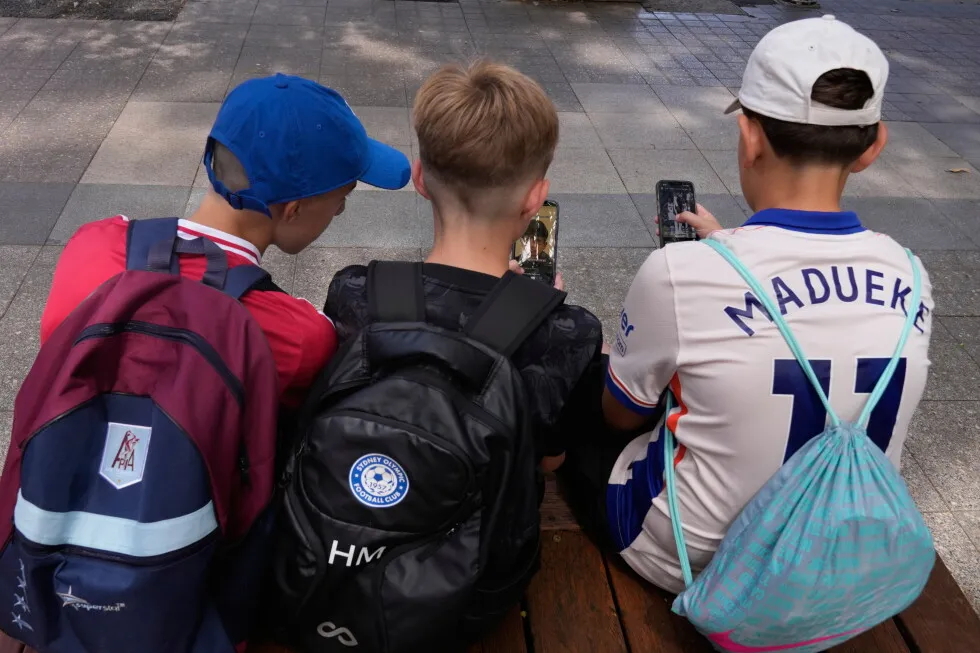
Australia plans to strengthen laws banning children from social media 1 of 2 | Three boys use their phones while sitting outside a school in Sydney, Monday, Dec. 8, 2025. (AP Photo/Rick Rycroft, File) 2 of 2 | Australian e-Safety Commissioner, Julie Inman Grant appears before the Environment and Communications Legislation Committee at Parliament House in Canberra, Australia, Thursday, Oct. 17, 2024. (Mick Tsikas/AAP Image via AP) By ROD MCGUIRK Updated 9:45 AM MESZ, June 26, 2026 Add AP News on Google Add AP News as your preferred source to see more of our stories on Google. Share Share Facebook Copy Link copied Print Email X LinkedIn Bluesky Flipboard Pinterest Reddit MELBOURNE, Australia (AP) — The Australian government plans to strengthen laws that ban children younger than 16 from social media platforms, Prime Minister Anthony Albanese said. Observers said on Friday the government was responding to evidence that the ban on young children holding accounts on platforms including Facebook, Instagram and YouTube had failed since it came into force on Dec. 10 last year. Australia was the first country in the world to pass legislation keeping youth off social media, but others have since followed. Albanese told Parliament on Thursday this government was considering options to strengthen the ban. “We’re working on that as a priority because this is something that other generations didn’t have to deal with, which is why it’s complex,” Albanese told Parliament. He told the Australian Broadcasting Corp. on Friday the government was asking “are the laws as strong as possible?” and did eSafety Commissioner Julie Inman Grant, Australia’s online safety watchdog, “have every power at her disposal?” Britain announced last week plans to ban children under 16 from a range of platforms to protect them from harmful content and excessive screen time. New prime minister says Solomon Islands will review its secretive security treaty with China 2 MIN READ 3 Australian women back from Syria face slavery and terrorism charges over alleged IS links 3 MIN READ Japan and Australia agree to deepen cooperation on energy, defense and critical minerals 2 MIN READ Canada, Brazil and Indonesia have introduced legislation or announced age-based restrictions or requirements for children’s access to social media. France, Spain, Denmark, Thailand and South Korea are among others studying or developing similar approaches. Inman Grant said in April she was considering court action against Facebook, Instagram, Snapchat, TikTok and YouTube, alleging they were not doing enough to keep young Australian children off their platforms. These platforms, as well as X, Kick, Reddit, Threads and Twitch, face fines of up to 49.5 million Australian dollars ($34 million) if they fail to take reasonable steps to remove the accounts of young children. Melbourne’s RMIT University expert on information sciences Lisa Given said the government’s proposed reform was a response to evidence that the ban was failing. The evidence included eSafety’s own data released in March that showed seven in 10 underage children continued to hold accounts on Facebook, Instagram, Snapchat and TikTok since December. Given also pointed to a study published in the British Medical Journal on Wednesday that found 85% of a group of Australian 12 to 17-year-olds were using restricted platforms. “I do think it’s failing,” Given said. “Many kids in the media have reported that they also think that this is really a failed exercise.” The Sydney Morning Herald newspaper reported Inman Grant saying in an interview in early June: “I don’t have potent powers.” “What I would say is a regulator is only as good as the tools and the resources that they’re given,” she is quoted as saying. The Associated Press asked Inman Grant’s office on Friday to comment on the accuracy of that reporting, but her office did not immediately reply. Given said Inman Grant faced a challenge in enforcing legislation that platforms were resisting. “Either the eSafety Commissioner needs more powers or we’ve got to have some other approach to enforcement,” Given said. Given expected the courts would need to decide what constituted “reasonable steps” required by the law to be taken to keep children off platforms. Albanese said as part of increased efforts to enforce the social media ban, his government would proceed with digital duty of care legislation which would hold platforms accountable for foreseeable harms caused by content and algorithms. ROD MCGUIRK McGuirk covers Australian and South Pacific news for The Associated Press. He is based in Melbourne. mailto
SRCAssociated Press (AP)
LANGEN
LEANCenter
WORDS736
ENT12
FRI · 2026-06-26 · 07:53 GMTBRIEF NSR-2026-0626-87555
NSR-2026-0626-87555News Report·EN·Public Health
Australia plans to strengthen laws banning children from social media
The Australian government plans to strengthen laws that ban children under 16 from social media platforms, according to Prime Minister Anthony Albanese. This move comes in response to evidence suggesting the existing ban, implemented in December of the previous year, has been ineffective.
Associated Press (AP)Filed 2026-06-26 · 07:53 GMTLean · CenterRead · 3 min
Associated Press (AP)FIG 01
Reading time
3min
Word count
736words
Sources cited
3cited
Entities identified
12entities
Quality score
100%
§ 01
Briefing Summary
AI-generatedNEWSAR · AI
The Australian government plans to strengthen laws that ban children under 16 from social media platforms, according to Prime Minister Anthony Albanese. This move comes in response to evidence suggesting the existing ban, implemented in December of the previous year, has been ineffective. Data indicates a high percentage of underage children continue to hold accounts on major platforms. The government is reviewing the strength of current laws and the powers of the eSafety Commissioner to enforce them. Other countries are also introducing or considering similar age-based restrictions for children's social media access. Australia aims to hold platforms accountable for harms caused by their content and algorithms through strengthened legislation.
Confidence 0.90Sources 3Claims 5Entities 12
§ 02
Article analysis
Model · rule-basedFraming
Public Health
Legal & Judicial
Tone
Measured
AI-assessed
CalmNeutralAlarmist
Factuality
0.80 / 1.00
Factual
LowHigh
Sources cited
3
Well sourced
FewMany
§ 03
Key claims
5 extracted01
Social media platforms face fines of up to 49.5 million Australian dollars ($34 million) if they fail to remove young children's accounts.
factualeSafety Commissioner Julie Inman Grant
Confidence
1.00
02
Britain announced last week plans to ban children under 16 from a range of platforms to protect them from harmful content and excessive screen time.
factual
Confidence
1.00
03
Australia was the first country in the world to pass legislation keeping youth off social media.
factual
Confidence
1.00
04
The Australian government plans to strengthen laws banning children younger than 16 from social media platforms.
factualPrime Minister Anthony Albanese
Confidence
1.00
05
The government's proposed reform is a response to evidence that the ban was not effective.
factualLisa Given
Confidence
0.90
§ 04
Full report
3 min read · 736 words§ 05
Entities
12 identifiedKey playerOppositionContextPositiveNeutralNegative
Organizations4
§ 06
Keywords & salience
10 termschildren social media ban
1.00
australia
0.90
online safety
0.80
social media platforms
0.70
harmful content
0.60
excessive screen time
0.60
esafety commissioner
0.50
legislation
0.50
age restrictions
0.40
prime minister anthony albanese
0.40
§ 07
Topic connections
Interactive graph Network visualization showing 51 related topics
View Full Graph Person Organization Location Event|Click node to navigate|Edge numbers = shared articles