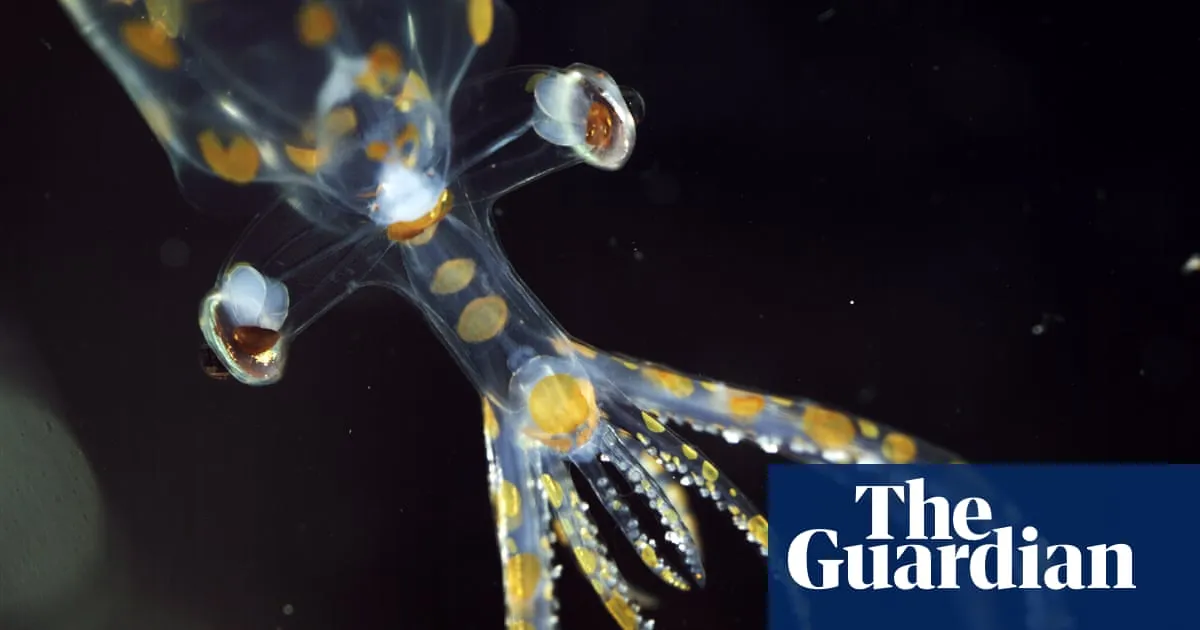
A marine biology expedition in international waters off the coast of Brazil has discovered 31 new species in just two weeks.The researchers believe the speed at which the species were found and identified may be a record, in part because of the cutting-edge technology designed and built by the science and engineering team. For the first time on board a ship, the researchers were able to observe the living 3D cellular structure of microbial life thanks to a technological breakthrough nicknamed the Squid.The research vessel, Falkor (too), in the South Atlantic with two dozen international experts from the US, Australia, Brazil and Japan onboard. Photograph: Alex Ingle/Schmidt Ocean InstituteTwo dozen international experts, from the US, Australia, Brazil and Japan, carried out the survey onboard the Falkor (too), a research vessel operated by the Schmidt Ocean Institute with support from the Australia" class="entity-link entity-organization" data-entity-id="114621" data-entity-type="organization">University of Western Australia and several other institutions.Setting out from Salvador, Bahia, their focus was on the ocean midwater – the area between the seafloor and the sunlit layer closer to the surface. The researchers said this was the largest habitat on Earth, encompassing 90% of the living space on our planet, and also one of the least explored.A Solmissus, or dinner plate jellyfish, preys upon a ctenophore, commonly known as a comb jelly. Photograph: ROV SuBastian/Schmidt Ocean InstituteOne of the seven species of siphonophores discovered during the fortnight-long expedition, which used lasers to scan the creatures’ microscopic details. Photograph: ROV SuBastian/Schmidt Ocean InstituteA female octopus consumes a jellyfish at 800 metres depth. This species is rarely seen alive. Photograph: ROV SuBastian/Schmidt Ocean InstituteAmong the discoveries were an amphipod, a type of crustacean related to crabs and lobsters; a fast-moving gossamer worm; nine jellyfish; seven siphonophores, colonial organisms related to jellyfish and corals; seven comb jellies or ctenophores, famous for the glittering cilia they use to swim; four larvaceans, tadpole-like creatures that live in mucus houses and are more closely related to humans than invertebrates; and two giant rhizarians, single-celled organisms visible to the naked eye.“It was pretty exciting,” said the expedition’s chief scientist, Dr Karen Osborn of the Smithsonian National Museum of Natural History. “The midwater is chock full of incredible animals that we don’t know much about. And this was an area that hadn’t been explored before so there were more opportunities to find new species. This must be close to a record for discoveries of new animals in a short space of time.”Dr Karen Osborn, centre, with other researchers in the wet lab onboard Falkor (too), gathering tiny translucent animals from a large container for further study. Photograph: Alex Ingle/Schmidt Ocean InstituteOne of the technological breakthroughs was the onboard use of a spinning wheel confocal microscope, nicknamed the Squid, which uses lasers to scan microscopic details of how organisms are put together. “That opens up a whole new world of exploring. We could see cells interacting with each other, exchanging material and building skeletons. And we could do that live on the ship, when usually it takes a couple of weeks of staining and mounting to see anything,” Osborn said.The researchers also used prototype imaging systems, genetic analysis, and assembled a team of taxonomic experts for rapid identification of species.The findings contribute to human understanding of the distribution of life in the oceans. “I think about it as a layer cake. It is common to find the same thing at similar depths in distance locations such as Japan and California,” Osborn said.But there is also a huge vertical movement at night when creatures that have been hiding in the depths during the day go closer to the surface to eat under the cover of darkness. This has considerable influence on the drawdown of carbon by the oceans.The expedition coincided with the unveiling of plans by the Trump administration to dismantle one of the world’s most important deep-sea observation systems – the $368m (£278m) Ocean Observatories Initiative, which uses more than 900 instruments to collect data on ocean health, including current patterns, climate variability and marine biodiversity.Osborn said the latest expedition confirmed for her the importance of scientific collaboration and learning more about the ocean. “I think we should be doing this so much more. We need to bring together teams with a common goal to try out new ways of looking at things,” she said.“What humanity has found so far is just the tip of the iceberg. There is an immense amount of life out there solving life’s challenges in unusual ways. Imagine what we can learn from them as we understand them better.”
SRCThe Guardian - World News
LANGEN
LEANCenter-Left
WORDS757
ENT12
FRI · 2026-06-26 · 11:06 GMTBRIEF NSR-2026-0626-87636
NSR-2026-0626-87636News Report·EN·Human Interest
‘Chock full of incredible animals’: marine expedition uncovers 31 new species in two weeks
An international team of marine biologists aboard the research vessel Falkor (too) discovered 31 new species in the ocean midwater off Brazil in just two weeks. This rapid pace of discovery is attributed to cutting-edge technology, including a new microscope nicknamed the Squid, which allowed researchers to observe living microbial structures for the first time on a ship.
Jonathan WattsThe Guardian - World NewsFiled 2026-06-26 · 11:06 GMTLean · Center-LeftRead · 4 min
The Guardian - World NewsFIG 01
Reading time
4min
Word count
757words
Sources cited
2cited
Entities identified
12entities
Quality score
100%
§ 01
Briefing Summary
AI-generatedNEWSAR · AI
An international team of marine biologists aboard the research vessel Falkor (too) discovered 31 new species in the ocean midwater off Brazil in just two weeks. This rapid pace of discovery is attributed to cutting-edge technology, including a new microscope nicknamed the Squid, which allowed researchers to observe living microbial structures for the first time on a ship. The expedition, comprised of experts from the US, Australia, Brazil, and Japan, focused on the largely unexplored midwater habitat. Discoveries included various crustaceans, jellyfish, siphonophores, comb jellies, larvaceans, and rhizarians. The findings highlight the vast, unknown biodiversity in the ocean and underscore the importance of scientific collaboration and exploration.
Confidence 0.90Sources 2Claims 5Entities 12
§ 02
Article analysis
Model · rule-basedFraming
Human Interest
Technology
Tone
Measured
AI-assessed
CalmNeutralAlarmist
Factuality
0.80 / 1.00
Factual
LowHigh
Sources cited
2
Limited
FewMany
§ 03
Key claims
5 extracted01
The midwater is 'chock full of incredible animals that we don’t know much about.'
quoteDr Karen Osborn
Confidence
1.00
02
The midwater is the largest habitat on Earth, encompassing 90% of the living space, and is one of the least explored.
factualresearchers
Confidence
1.00
03
The expedition used a technological breakthrough nicknamed the Squid to observe the living 3D cellular structure of microbial life.
factual
Confidence
1.00
04
A marine biology expedition discovered 31 new species in international waters off the coast of Brazil in two weeks.
factual
Confidence
1.00
05
The researchers believe the speed of discovery may be a record, partly due to cutting-edge technology.
factualresearchers
Confidence
0.90
§ 04
Full report
4 min read · 757 words§ 05
Entities
12 identifiedKey playerOppositionContextPositiveNeutralNegative
Organizations4
Locations5
§ 06
Keywords & salience
10 termsnew species discovery
1.00
marine expedition
1.00
marine biology
0.90
ocean midwater
0.80
cutting-edge technology
0.70
biodiversity
0.70
squid technology
0.60
research vessel
0.50
schmidt ocean institute
0.40
south atlantic
0.40
§ 07
Topic connections
Interactive graph No topic relationship data available yet. This graph will appear once topic relationships have been computed.