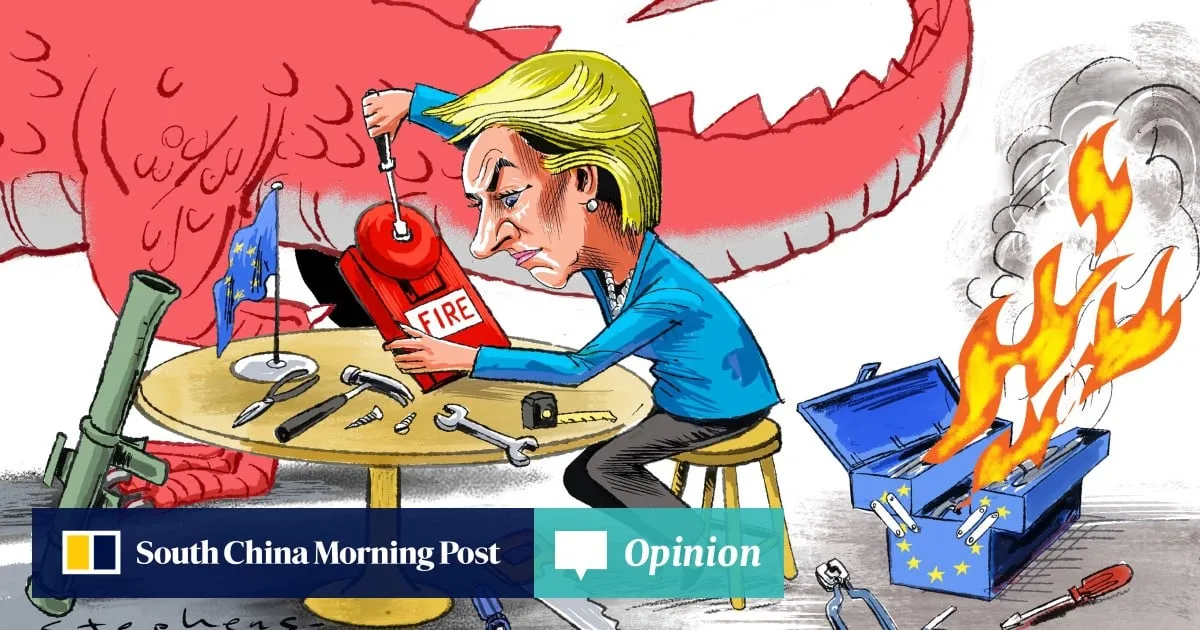
Generals losing a war examine the enemy, battlefield and their own forces. Brussels prefers a different sequence, ordering new weapons first and worrying about the diagnosis later. That instinct was on display at the recent European Council meeting.Faced with a trade deficit it cannot close and dependencies it cannot shake, the European Union agreed on a new label: “global macroeconomic imbalances”. To solve them, European Commission president Ursula von der Leyen was reportedly directed to engage in dialogue with China with an emphasis on results – an admission that years of escalating pressure have produced none. Her other mandate was to develop more economic security tools. No euphemism has ever confessed “we don’t know what to do” this loudly.Europe’s China debate has become detached from any assessment of outcomes. If “de-risking”, anti-subsidy investigations, tariffs, trade defence measures, the “trade bazooka” threat and procurement restrictions have all failed to cut dependence, narrow the deficit or restore competitiveness, why should another layer of instruments succeed?
SRCSouth China Morning Post
LANGEN
LEANCenter-Right
WORDS163
ENT10
SUN · 2026-06-28 · 12:30 GMTBRIEF NSR-2026-0628-88108
NSR-2026-0628-88108Analysis·EN·Political Strategy
China isn’t Europe’s real problem
At a recent European Council meeting, the European Union agreed to label its trade deficit and dependencies as "global macroeconomic imbalances." Facing these challenges, European Commission president Ursula von der Leyen was directed to engage in dialogue with China, emphasizing results, and to develop more economic security tools. The article suggests this approach reflects a preference for ordering new measures before diagnosing the problem, as previous actions like "de-risking," anti-subsidy investigations, and tariffs have not resolved Europe's economic issues with China.
Sebastian Contin Trillo-FigueroaSouth China Morning PostFiled 2026-06-28 · 12:30 GMTLean · Center-RightRead · 1 min
South China Morning PostFIG 01
Reading time
1min
Word count
163words
Sources cited
0cited
Entities identified
10entities
Quality score
100%
§ 01
Briefing Summary
AI-generatedNEWSAR · AI
At a recent European Council meeting, the European Union agreed to label its trade deficit and dependencies as "global macroeconomic imbalances." Facing these challenges, European Commission president Ursula von der Leyen was directed to engage in dialogue with China, emphasizing results, and to develop more economic security tools. The article suggests this approach reflects a preference for ordering new measures before diagnosing the problem, as previous actions like "de-risking," anti-subsidy investigations, and tariffs have not resolved Europe's economic issues with China. The EU's debate on China is described as detached from an assessment of outcomes, with the new directives seen as an admission of uncertainty about how to proceed.
Confidence 0.90Claims 4Entities 10
§ 02
Article analysis
Model · rule-basedFraming
Political Strategy
Economic Impact
Tone
Mixed Tone
AI-assessed
CalmNeutralAlarmist
Factuality
0.30 / 1.00
Opinion-Heavy
LowHigh
Sources cited
0
No named sources
FewMany
§ 03
Key claims
4 extracted01
The EU agreed on a new label 'global macroeconomic imbalances' to address its trade deficit and dependencies.
factual
Confidence
0.90
02
Years of escalating pressure on China by the EU have produced no results in closing the trade deficit or narrowing dependence.
factual
Confidence
0.85
03
Previous EU measures like 'de-risking', anti-subsidy investigations, tariffs, and procurement restrictions have failed.
factual
Confidence
0.80
04
Ursula von der Leyen was directed to engage in dialogue with China with an emphasis on results.
factualreportedly
Confidence
0.80
§ 04
Full report
1 min read · 163 words§ 05
Entities
10 identifiedKey playerOppositionContextPositiveNeutralNegative
Organizations2
§ 06
Keywords & salience
9 termsde-risking
0.90
economic security
0.80
global macroeconomic imbalances
0.80
china
0.70
european union
0.70
trade deficit
0.60
dependency
0.60
trade defence measures
0.50
ursula von der leyen
0.40
§ 07
Topic connections
Interactive graph Network visualization showing 51 related topics
View Full Graph Person Organization Location Event|Click node to navigate|Edge numbers = shared articles