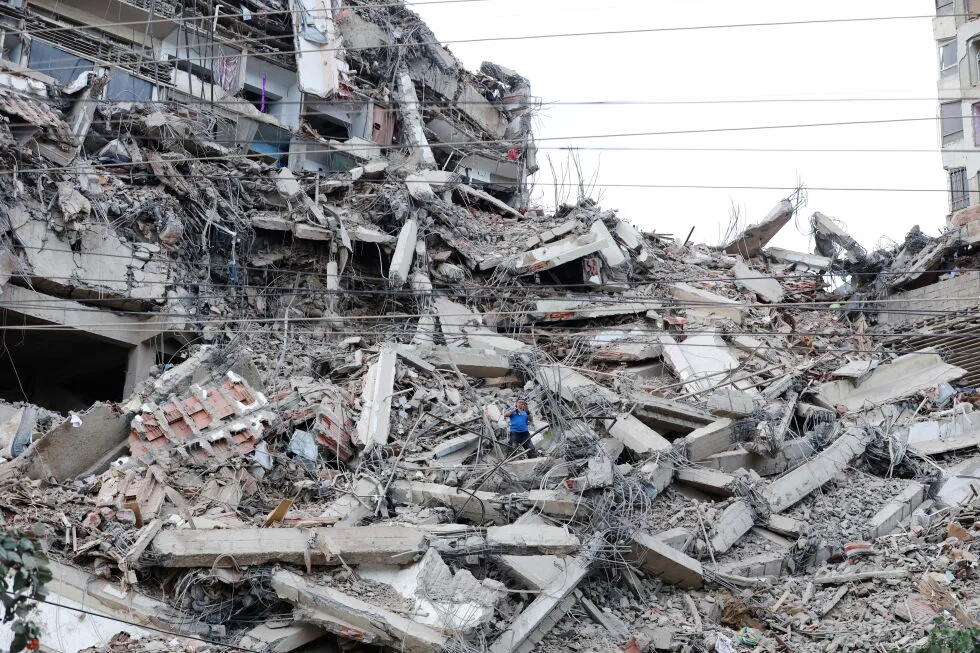
The 2 Earthquakes that struck Venezuela are known as a ‘doublet.’ Here’s how they happen 0 seconds of 1 minute, 28 secondsVolume 0% Press shift question mark to access a list of keyboard shortcuts Keyboard ShortcutsEnabledDisabled Shortcuts Open/Close/ or ? Play/PauseSPACE Increase Volume↑ Decrease Volume↓ Seek Forward→ Seek Backward← Captions On/Offc Fullscreen/Exit Fullscreenf Mute/Unmutem Decrease Caption Size- Increase Caption Size+ or = Seek %0-9 Subtitle Settings OffEnglish(US)_v Font Color White Font Opacity 100% Font Size 100% Font Family Arial Character Edge None Edge Color Black Background Color Black Background Opacity 50% Window Color Black Window Opacity 0% Reset WhiteBlackRedGreenBlueYellowMagentaCyan 100%75%50%25% 200%175%150%125%100%75%50% ArialCourierGeorgiaImpactLucida ConsoleTahomaTimes New RomanTrebuchet MSVerdana NoneRaisedDepressedUniformDrop Shadow WhiteBlackRedGreenBlueYellowMagentaCyan WhiteBlackRedGreenBlueYellowMagentaCyan 100%75%50%25%0% WhiteBlackRedGreenBlueYellowMagentaCyan 100%75%50%25%0% 00:00 01:28 01:28 More Videos 01:00 Rubio comments on US assistance for Venezuela after powerful quakes, meetings with Gulf countries 00:46 Trump praises US military operation in Iran and capture of ex-Venezuelan president Maduro 00:58 AP Top Stories June 25 00:59 UN's World Food Programme distributes food to quake victims in Venezuela 01:59 AP/NORC poll: Who flies the US flag, who won’t and what it signals about America 02:00 Touring Trump's Washington: How the president is putting his imprint on the nation's capital 01:28 World Cup fans go crazy for ‘Canadian clapper’ maple leaf-shaped noisemakers given out in Toronto 01:57 Argentina in Texas raises rivalry among beef lovers at World Cup Close 1 of 5 | Earthquakes typically occur along edges of tectonic plates. But their impacts may be felt in a broader region. (AP video produced by Javier Arciga) More Videos 0 seconds of 26 secondsVolume 90% Press shift question mark to access a list of keyboard shortcuts Keyboard ShortcutsEnabledDisabled Shortcuts Open/Close/ or ? Play/PauseSPACE Increase Volume↑ Decrease Volume↓ Seek Forward→ Seek Backward← Captions On/Offc Fullscreen/Exit Fullscreenf Mute/Unmutem Decrease Caption Size- Increase Caption Size+ or = Seek %0-9 Auto1080p1080p720p540p360p270p180p 00:00 00:26 00:26 More Videos Close 2 of 5 | Aerial images on Thursday show the destruction caused by the earthquake that struck Venezuela in the coastal city of Catia La Mar, north of the capital, Caracas. The overhead view shows several large multi-story buildings that collapsed completely, while others suffered severe damage and caught fire in the city, located in La Guaira state, one of the country’s hardest-hit regions. (AP Video by Juan Arraez) 3 of 5 | A man walks among the rubble of a building that collapsed in Earthquakes the previous day in La Guaira, Venezuela, Thursday, June 25, 2026. (AP Photo/Pedro Mattey) 4 of 5 | A firefighter rescues a dog from a building that collapsed after an earthquake in Caracas, Venezuela, Wednesday, June 24, 2026. (AP Photo/Pedro Mattey) 5 of 5 | Residents walk among the rubble of building damaged in Earthquakes the previous day in Catia La Mar, Venezuela, Thursday, June 25, 2026. (AP Photo/Pedro Mattey) By DÁNICA COTO Updated 9:48 PM MESZ, June 25, 2026 Leer en español Add AP News on Google Add AP News as your preferred source to see more of our stories on Google. Share Share Facebook Copy Link copied Print Email X LinkedIn Bluesky Flipboard Pinterest Reddit SAN JUAN, Puerto Rico (AP) — The two powerful Earthquakes that struck Venezuela’s northern coast, killing more than 180 people, were an event known as a “doublet.” Doublet Earthquakes happen when a pair of similar-sized quakes hit close in location and time, according to the U.S. Geological Survey. On Wednesday evening, a 7.2 magnitude quake hit first, followed by a magnitude 7.5 just 39 seconds later. The deadly one-two punch toppled buildings in Venezuela’s capital, Caracas and beyond. Some 1,500 people were injured and thousands were reported missing. The coastal region of La Guaira, which is north of Caracas, experienced some of the heaviest damage and casualties, officials said. While not as common as a typical earthquake where a main shock is followed by much smaller aftershocks, doublets can happen anywhere in the world, Christine Goulet, director of the USGS earthquake science center in California, told The Associated Press. Doublets indicate a complex fault structure, like the one in Venezuela. Known as the Bocono fault, it runs along the backbone of the Venezuelan Andes for about 300 miles (500 kilometers). A previous doublet — of magnitudes 6.2 and 6.3 — struck an area west of Caracas in September 2025, killing at least one person and injuring more than 100 others. Most of the damage was reported in the states of Zulia and Lara. Asian shares trade mixed as worries over Iran-US deal remain 2 MIN READ Adults arrested after 16 children found in ‘deplorable’ conditions in southern Ohio home 1 MIN READ Japan’s Eiko Kadono, author of ‘Kiki’s Delivery Service,’ still believes in the magic of books at 91 3 MIN READ What caused Wednesday’s double earthquake? Most Earthquakes occur along plate boundaries, which is where tectonic plates meet. A rupture where the Caribbean and South American tectonic plates meet unleashed the two quakes this week. The doublet occurred where the Caribbean plate, located north of Venezuela, moves eastward relative to the South American plate at an average rate of 0.79 inches (2 centimeters) a year. “It’s a large displacement,” Goulet noted. “It’s on the order of the San Andreas fault.” The movement was a shallow strike-slip faulting, which occurs when two blocks of rock slide past one another horizontally. That kind of movement is not more dangerous by default, Goulet said. “A more vertical motion can be more damaging,” she said, adding that other factors, including the length of the rupture, determine the amount of damage. The boundary between the Caribbean and South American plates is less active than others, said David Naar, associate dean at the University of South Florida’s College of Marine Science. In the past century, only seven Earthquakes of magnitude 6 and higher have hit in the immediate vicinity of the most recent ones, according to USGS. These include the 2025 doublet that struck west-northwest of the latest quakes. Individual Earthquakes of magnitude 6 or higher struck in 2009, 1989 and 1975. The most devastating one hit in July 1967. It was a 6.6 magnitude quake that killed hundreds of people. José Vitriago, who lives in Caracas, remembers that one. He was 2 years old. “Our house broke,” he recalled in an interview with state-owned TV station Venezolana de Televisión. Vitriago said the doublet that hit Wednesday “was horrible, horrible.” Overall, five Earthquakes of magnitude 7 and higher have occurred in northern Venezuela or near the coast since 1900, according to USGS. The most catastrophic earthquake occurred in March 1812 along the Bocono fault system, killing an estimated 30,000 people. Scientists cannot predict Earthquakes, but aftershocks are common after big ones. The USGS said there’s a 99% chance of at least one magnitude 4 aftershock hitting Venezuela within the next week, and a 24% chance of a magnitude 6 one occurring. Unlike other countries, Venezuela does not have an early earthquake warning system, which relies on sensors to detect the first waves of an earthquake. “It’s very distressing that there was basically no time to evacuate,” she said. “That’s extremely unfortunate.” This story has been corrected to reflect that Lara and Zulia are states, not towns.
SRCAssociated Press (AP)
LANGEN
LEANCenter
WORDS1 193
ENT12
WED · 2026-07-01 · 03:53 GMTBRIEF NSR-2026-0701-88862
NSR-2026-0701-88862News Report·EN·Human Interest
The 2 earthquakes that struck Venezuela are known as a ‘doublet.’ Here’s how they happen
Two powerful earthquakes, described as a "doublet," struck Venezuela's northern coast on Wednesday evening, resulting in over 180 fatalities, 1,500 injuries, and thousands missing. A 7.2 magnitude quake was followed by a 7.5 magnitude quake just 39 seconds later, causing widespread building collapses, particularly in the La Guaira region.
Associated Press (AP)Filed 2026-07-01 · 03:53 GMTLean · CenterRead · 5 min
Associated Press (AP)FIG 01
Reading time
5min
Word count
1 193words
Sources cited
3cited
Entities identified
12entities
Quality score
100%
§ 01
Briefing Summary
AI-generatedNEWSAR · AI
Two powerful earthquakes, described as a "doublet," struck Venezuela's northern coast on Wednesday evening, resulting in over 180 fatalities, 1,500 injuries, and thousands missing. A 7.2 magnitude quake was followed by a 7.5 magnitude quake just 39 seconds later, causing widespread building collapses, particularly in the La Guaira region. Doublet earthquakes occur when two similarly sized quakes strike close in time and location, indicating a complex fault structure like Venezuela's Bocono fault. This type of event, while not as common as typical main shocks with smaller aftershocks, can happen globally. The quakes were caused by a rupture between the Caribbean and South American tectonic plates. Venezuela lacks an early earthquake warning system, leaving residents with no time for evacuation.
Confidence 0.90Sources 3Claims 5Entities 12
§ 02
Article analysis
Model · rule-basedFraming
Human Interest
Environmental
Tone
Measured
AI-assessed
CalmNeutralAlarmist
Factuality
0.80 / 1.00
Factual
LowHigh
Sources cited
3
Well sourced
FewMany
§ 03
Key claims
5 extracted01
Earthquakes typically occur along edges of tectonic plates.
factual
Confidence
1.00
02
La Guaira state is one of the country’s hardest-hit regions.
factual
Confidence
1.00
03
Several large multi-story buildings collapsed completely, while others suffered severe damage and caught fire.
factual
Confidence
1.00
04
The earthquakes caused destruction in the coastal city of Catia La Mar, north of Caracas.
factual
Confidence
1.00
05
Two earthquakes struck Venezuela and are known as a 'doublet'.
factual
Confidence
1.00
§ 04
Full report
5 min read · 1 193 words§ 05
Entities
12 identifiedKey playerOppositionContextPositiveNeutralNegative
Organizations1
Locations7
§ 06
Keywords & salience
8 termsearthquakes
1.00
venezuela
0.90
doublet
0.80
tectonic plates
0.70
earthquake doublet
0.70
seismic activity
0.60
catia la mar
0.50
destruction
0.40
§ 07
Topic connections
Interactive graph Network visualization showing 6 related topics
View Full Graph Person Organization Location Event|Click node to navigate|Edge numbers = shared articles