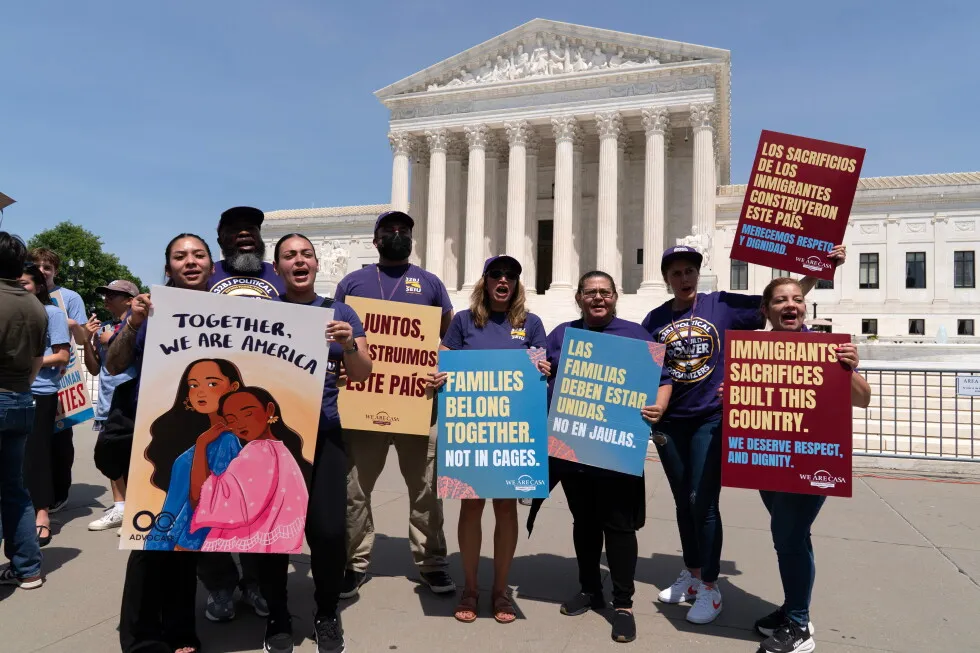
How the Supreme Court became a pivotal force in Trump’s immigration agenda 1 of 3 | Activists celebrate the Supreme Court’s birthright citizenship ruling outside of the Supreme Court on Capitol Hill, Tuesday, June 30, 2026, in Washington. (AP Photo/Jose Luis Magana) 2 of 3 | Congressional Hispanic Caucus Chairman Adriano Espaillat, D-N.Y., center, and other Democratic House members react to the Supreme Court’s decision to uphold birthright citizenship at the Capitol in Washington, Tuesday, June 30, 2026. (AP Photo/J. Scott Applewhite) 3 of 3 | President Donald Trump speaks with reporters in the Oval Office of the White House, Monday, June 29, 2026, in Washington. (AP Photo/Jacquelyn Martin) 1 of 3 | Activists celebrate the Supreme Court’s birthright citizenship ruling outside of the Supreme Court on Capitol Hill, Tuesday, June 30, 2026, in Washington. (AP Photo/Jose Luis Magana) 1 of 3 Activists celebrate the Supreme Court’s birthright citizenship ruling outside of the Supreme Court on Capitol Hill, Tuesday, June 30, 2026, in Washington. (AP Photo/Jose Luis Magana) Add AP News on Google Add AP News as your preferred source to see more of our stories on Google. Share 2 of 3 | Congressional Hispanic Caucus Chairman Adriano Espaillat, D-N.Y., center, and other Democratic House members react to the Supreme Court’s decision to uphold birthright citizenship at the Capitol in Washington, Tuesday, June 30, 2026. (AP Photo/J. Scott Applewhite) 2 of 3 Congressional Hispanic Caucus Chairman Adriano Espaillat, D-N.Y., center, and other Democratic House members react to the Supreme Court’s decision to uphold birthright citizenship at the Capitol in Washington, Tuesday, June 30, 2026. (AP Photo/J. Scott Applewhite) Add AP News on Google Add AP News as your preferred source to see more of our stories on Google. Share 3 of 3 | President Donald Trump speaks with reporters in the Oval Office of the White House, Monday, June 29, 2026, in Washington. (AP Photo/Jacquelyn Martin) 3 of 3 President Donald Trump speaks with reporters in the Oval Office of the White House, Monday, June 29, 2026, in Washington. (AP Photo/Jacquelyn Martin) Add AP News on Google Add AP News as your preferred source to see more of our stories on Google. Share Updated [hour]:[minute] [AMPM] [timezone], [monthFull] [day], [year] Washington (AP) — President Donald Trump’s administration looked to the Supreme Court to greenlight its sweeping hard-line immigration agenda and, by and large, it got the backing it was looking for with one key exception — birthright citizenship. After lower courts repeatedly ruled against the Trump administration, the nation’s top court allowed it to terminate temporary protections for people fleeing war or strife. It gave immigration officers greater leeway in dealing with green card holders returning from abroad, and it allowed the government to limit the number of people who can apply for asylum. In being asked to serve as an enabler of the Republican president’s contentious immigration crackdown, the Supreme Court showed deference to constitutional guardrails in the key case of birthright citizenship that would have redefined who can be an American. In ruling against the administration, the court upheld the idea that people who are born in the United States, regardless of their parents’ immigration status, are Americans.Each decision could have far-reaching consequences for foreigners seeking to live in the country and could help shape public perceptions over whether America remains a beacon for migrants. birthright citizenship is upheld, prompting calls for more restrictionsThe Trump administration had sought to prevent children born to people who are in the United States illegally or temporarily from being entitled to American citizenship at birth.A divided Supreme Court upheld the concept of birthright citizenship, with a bare majority of five justices saying that with very limited exceptions the long-settled understanding of the 14th Amendment, adopted after the Civil War, grants citizenship to anyone born in the U.S.It was a blow to Trump’s immigration agenda, a centerpiece of his second administration. The president signed the order seeking to restrict birthright citizenship on his first day in office, although it never went into effect due to legal challenges. 2 MIN READ 5 MIN READ 3 MIN READ The court’s decision was praised by advocates but led to calls by some Republicans to try to restrict birthright citizenship by other means. Mark Krikorian, who heads the Center for Immigration Studies, which advocates for less immigration, said the decision makes the president’s push for large-scale deportations “all the more urgent,” with the goal of removing people in the country illegally before they have children. Krikorian said the decision means policies governing programs that allow foreigners to come to the U.S. to work or study at university need to be “tightened up” to prevent people from coming to the U.S. and having children who then become citizens. He also suggested the State Department could add a pregnancy question to visa applications of foreigners seeking to get a tourist or other visa to come to the U.S. “I think it’s going to have real policy impact,” Krikorian said. Temporary protections for Haitians and Syrians removedThe court allowed the Trump administration to end legal protections for migrants who have fled violence and natural disaster in Haiti and Syria. The 6-3 decision announced June 25 potentially leaves hundreds of thousands of more people unable to work in the U.S. and vulnerable to deportation by Immigration and Customs Enforcement. Since Trump returned to the White House in January 2025, the Department of Homeland Security has moved to end the protections, including some that had been in place for more than a decade, for people from 13 countries.Republican critics have said that these temporary protections effectively become permanent. But immigration lawyers said countries such as Haiti and Syria remain dangerous.The court’s conservative majority found that the law doesn’t allow courts to question the process that immigration authorities use to revoke the protections. The high court sided with the administration before and allowed the end of the program for people from Venezuela.It’s unclear how quickly the court’s ruling could translate into ICE trying to remove affected Haitians and Syrians from the country although fear of potential deportation has already ricocheted around the Haitian community. David Bier, director of immigration studies at the Cato Institute, a libertarian think tank that advocates for more immigration, said the court’s decision has a far wider impact than just the 350,000 Haitians and 6,000 Syrians covered by the case. Roughly 1 million others are covered by temporary protected status, or TPS, decisions, and Bier said the ruling leaves them without any meaningful way to challenge the administration’s moves.“It just fully closed the door to any challenges,” Bier said. Limits on asylum applicants allowedUnder U.S. law, migrants who set foot on American soil can apply for asylum. Although the number of migrants coming to the southern border has fallen dramatically during the Trump administration, the numbers of asylum seekers had ballooned under previous administrations.Started under Democrat Barack Obama’s administration and then expanded under Trump’s first term, asylum-metering limited how many people could apply for asylum every day at the southern border with Mexico. The ruling cleared the way for the Trump administration to potentially revive the policy, which isn’t in place now, should it choose to do so. The administration argued that asylum-metering was an important tool and that people turned away at the border could come back later. But advocates argued that at the time the asylum-metering was in place it led to chaos and a humanitarian crisis in Mexico as thousands of people waited for days and months in makeshift shelters in Mexico.Court allows administration greater leeway with some green card holdersIn another 6-3 decision, the court sided with the Trump administration in giving greater power to immigration officers when deciding how to treat green card holders returning to the country from abroad. In 2012, Customs and Border Protection officers put lawful permanent resident Muk Choi Lau on immigration parole when he returned from a short trip to China and took away his green card. He had been accused of a counterfeiting crime, although not convicted.Lau argued that the officer overstepped their authority and that when he eventually pleaded guilty to selling counterfeit clothes in New Jersey, the decision gave Homeland Security, then under the Obama administration, an easier path to remove him from the country.Justice Ketanji Brown Jackson, in her dissent, wrote that she was worried that the court had given the government a “massive blank check” in dealing with millions of other lawful permanent residents who want to travel abroad.The American Immigration Council, an advocacy group, wrote in an analysis after the court’s decision that Congress gave lawful permanent residents special protections when they travel that make it harder to detain and remove them from the country. There are exceptions that limit the special protections that green card holders have, including if the person has committed certain crimes in the U.S., the council wrote.The council said there were still a lot of questions as to the effect of the court’s decision but that it expects the government to argue that the decision can be applied more broadly. Santana reports on the Department of Homeland Security, immigration policy and the federal agencies that touch on immigration. She’s reported on refugee resettlement, ICE operations and employment-based immigration and is reachable on Signal at RebeccaSantana.51.
SRCAssociated Press (AP)
LANGEN
LEANCenter
WORDS1 547
ENT12
WED · 2026-07-01 · 11:53 GMTBRIEF NSR-2026-0701-88959
NSR-2026-0701-88959News Report·EN·Political Strategy
How the Supreme Court became a pivotal force in Trump’s immigration agenda
The Supreme Court has largely supported President Trump's immigration agenda, allowing the administration to end temporary protections for individuals fleeing war or strife, granting immigration officers more discretion with returning green card holders, and permitting limits on asylum applications. However, the Court upheld birthright citizenship, ruling that individuals born in the U.S.
By
REBECCA SANTANAAssociated Press (AP)Filed 2026-07-01 · 11:53 GMTLean · CenterRead · 7 min
Associated Press (AP)FIG 01
Reading time
7min
Word count
1 547words
Sources cited
0cited
Entities identified
12entities
Quality score
100%
§ 01
Briefing Summary
AI-generatedNEWSAR · AI
The Supreme Court has largely supported President Trump's immigration agenda, allowing the administration to end temporary protections for individuals fleeing war or strife, granting immigration officers more discretion with returning green card holders, and permitting limits on asylum applications. However, the Court upheld birthright citizenship, ruling that individuals born in the U.S. are citizens regardless of their parents' immigration status, a key exception to Trump's agenda. This decision means the administration's attempt to redefine citizenship for those born in the U.S. to parents in the country illegally or temporarily was unsuccessful. The Court's rulings have significant implications for immigrants and shape perceptions of the U.S. as a destination for migrants.
Confidence 0.90Claims 5Entities 12
§ 02
Article analysis
Model · rule-basedFraming
Political Strategy
Legal & Judicial
Tone
Measured
AI-assessed
CalmNeutralAlarmist
Factuality
0.80 / 1.00
Factual
LowHigh
Sources cited
0
No named sources
FewMany
§ 03
Key claims
5 extracted01
The Supreme Court allowed the government to limit the number of people who can apply for asylum.
factual
Confidence
0.90
02
The Supreme Court gave immigration officers greater leeway in dealing with green card holders returning from abroad.
factual
Confidence
0.90
03
The Supreme Court allowed the Trump administration to terminate temporary protections for people fleeing war or strife.
factual
Confidence
0.90
04
The Supreme Court largely backed President Trump's hard-line immigration agenda.
factual
Confidence
0.90
05
The Supreme Court's decisions were an exception to the Trump administration's agenda regarding birthright citizenship.
factual
Confidence
0.80
§ 04
Full report
7 min read · 1 547 words§ 05
Entities
12 identifiedKey playerOppositionContextPositiveNeutralNegative
People3
Organizations3
Locations4
§ 06
Keywords & salience
8 termstrump immigration agenda
1.00
supreme court
1.00
birthright citizenship
0.90
immigration policy
0.80
donald trump
0.70
legal challenges
0.60
judicial review
0.50
political agenda
0.40
§ 07
Topic connections
Interactive graph Network visualization showing 51 related topics
View Full Graph Person Organization Location Event|Click node to navigate|Edge numbers = shared articles