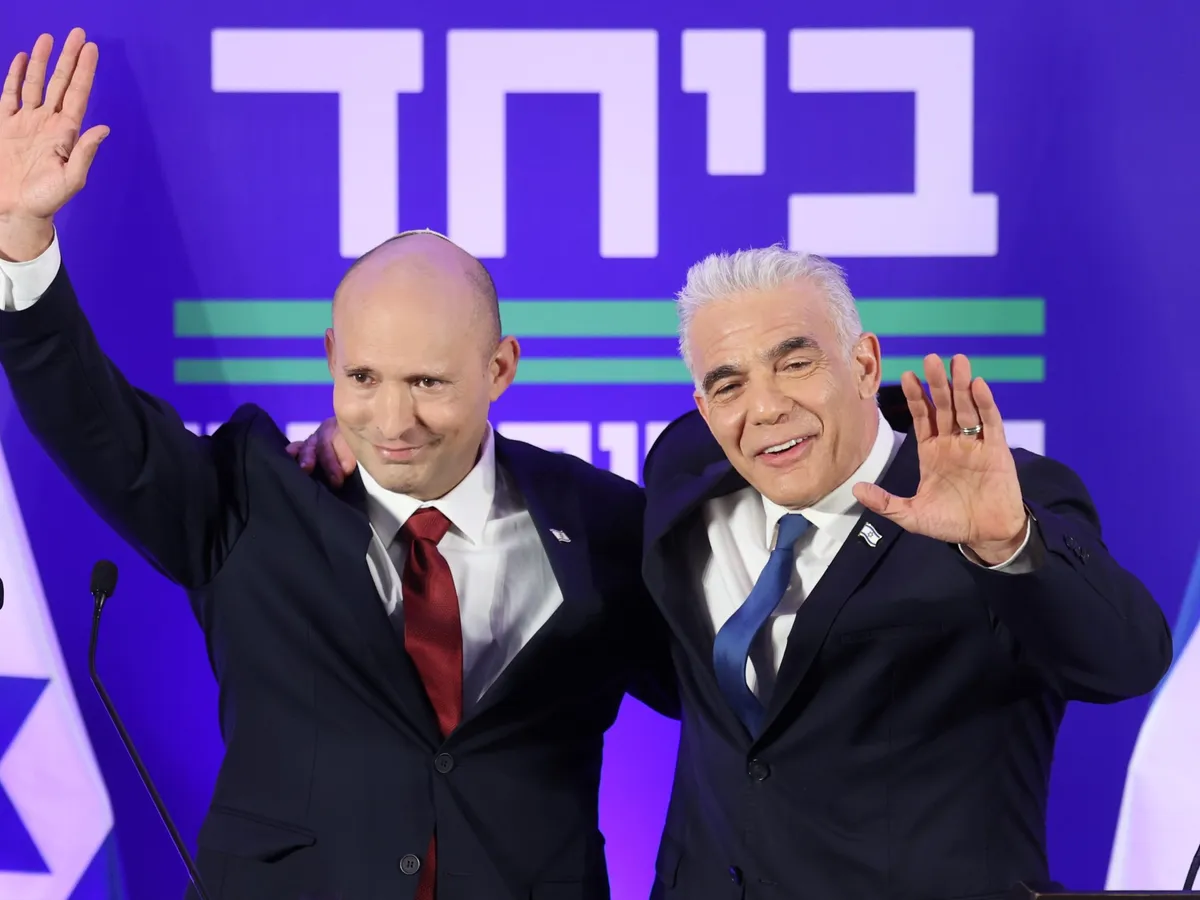
Israeli opposition criticise how Netanyahu has conducted Israel’s wars, but cannot risk opposing the wars in principle.Former Israeli prime ministers Naftali Bennett, left, and Yair Lapid, right, have united to try and overthrow Israeli Prime Minister Benjamin Netanyahu in the next Israeli elections [File: Abir Sultan/EPA]Published On 1 Jul 2026Leading figures from the Israeli opposition have used the country’s prestigious Herzliya Conference to lay out their policy agendas, but analysts and observers noted that their foreign policy positions differ little from those of Prime Minister Benjamin Netanyahu’s ruling far-right coalition.None of the three main opposition figures – former military Chief of Staff Gadi Eisenkot, Yair Lapid and Naftali Bennett, both former prime ministers – offered attendees at Reichman University on Wednesday much criticism of Israel’s recent wars in Gaza, Lebanon and Iran.Recommended Stories list of 4 itemslist 1 of 4Netanyahu caught between the US, Lebanon war, and Iran ceasefirelist 2 of 4‘Not in my name’: The Jewish communities fighting the consensus on Israellist 3 of 4Forever wars: Israel’s cycle of conflict shows no finish linelist 4 of 4How is framework agreement with Lebanon viewed in Israel?end of listInstead, they chose to criticise Netanyahu for the manner in which those campaigns had been conducted and for what they frame as his subservience to United States President Donald Trump, who seems to have prevented Israel from carrying on its wars in Lebanon and Iran at full intensity.Addressing the conference, Bennett – who will run jointly with Lapid at the next elections – limited his criticism of the Israeli government to his insistence that Israel would fight its wars better: “After a thousand days of war, the truth must be told: Hamas is rearming in the south, Hezbollah is growing stronger, attacking our soldiers and threatening our citizens, and the head of the octopus, the regime in Tehran, remains standing,” he said.Eisenkot, who polls show to be one of the favourites to replace Netanyahu when elections are called later this year, was equally damning of the means employed by Netanyahu, accusing him of exaggerating the nuclear threat posed by Iran, but continuing to support in principle the wars Netanyahu has pursued in Gaza, Lebanon and Iran.Former Chief of Staff Gadi Eisenkot’s son was killed fighting in Gaza during Israel’s genocidal war [File: Clodagh Kilcoyne/Reuters]The accusations from opposition figures, like Lapid, that Israel has never been more isolated or regarded as more extremist and unstable by foreign leaders are not without substance. Leaders from across the world have been stinging in their criticism of Israel, with the public mood among its most critical ally, the US, firmly swinging away from its traditional support.However, rather than tempering the dialogue he relies upon to frame his position, Netanyahu continues to echo the kind of rhetoric deployed by other members of his government, such as his National Security Minister Itamar Ben-Gvir or Finance Minister Bezalel Smotrich, that many in Israel’s opposition have seized upon as a point of difference.Speaking on Israel’s Channel 14 on Thursday, Netanyahu told viewers: “It will never end,” he said, staring into the camera. “Listen to me: It will never end. You want to live? You want to live in the Middle East, and, in general, in the world? Be strong. And we are very strong.”Style not substanceBeyond the Israeli mainstream opposition’s stylistic differences with Netanyahu, the substance remains largely the same, parliamentarian Aida Touma-Sliman of the left-wing Hadash Party told Al Jazeera.The opposition “really believe what they’re saying. Politicians like Eisenkot, Lapid and Bennett reflect Israeli society”, she said.Disagreements with the Netanyahu government were confined to domestic issues, while on issues such as the genocide and the multiple attacks on Iran and Lebanon, there was largely unanimity. “They all agree on the campaigns Netanyahu has launched; they only criticise him for the way they’ve been carried out, and for somehow making Israel a proxy of the US, as if that hadn’t always been the case,” she said.Both the attacks on Iran and Lebanon have received overwhelming support from the Israeli public, with the most recent polling on Gaza, where Israel’s war killed more than 73,000 Palestinians, deliberately targeted children according to a UN inquiry, and led to a famine, is mostly restricted to the enclave’s potential as a security threat.Much of this is due to the surge in hard line and uncompromising attitudes that exploded in the wake of the Hamas-led attack of October 7, 2023, which no Israeli politician would want to be seen to oppose, and partly from the growth in racist and right-wing views that have been taking hold across much of Israeli society for decades, Yehouda Shenhav-Shahrabani, one of Israel’s leading sociologists, told Al Jazeera.Eisenkot, Lapid and Bennett “reflect quite precisely the current condition of Israeli society”, he said. “The opposition supported the absurd war with Iran, and criticised Netanyahu only for failing to take into account Trump’s volatility. It supported the war in Lebanon as well, without pushing for a political agreement with the Lebanese government,” he said.Violence and extremism have surged across the occupied West Bank since the October 7, 2023, attack [File: Ronen Zvulun/Reuters]Equally significant, Shenhav-Shahrabani said, was the refusal of much of the opposition to admit lawmakers representing Palestinian citizens of Israel into their ranks. “As if government must remain purely Jewish,” he said. “This is hardly surprising, because all three are also against freedom for Palestinians. So, in short: same lady, different dress.”October 7 shapes all politicsFew in Israel doubt that the implications of the October 7, 2023, attack, which killed 1,139 people and led to the abduction of about 250 more, continue to shape Israeli politics. Through endless television repeats and forensic dissections of the events of that day, as well as what analysts in Israel have described to Al Jazeera as its indelible linking in the minds of many to the Holocaust, where Nazi Germany murdered some six million Jews, the attack continues to define much of Israeli leaders’ political outlook, whatever their party.And yet, argued Nimrod Goren, the president and founder of Mitvim – The Israeli Institute for Regional Foreign Policies, Eisenkot, Bennett and Lapid were still offering an alternative to the highly personalised brand of politics practised by Netanyahu and his allies.While many Israelis had grown more right-wing since October 7, being right-wing and supporting Netanyahu had become two entirely different things, Goren explained. Other figures on the right offered an alternative to the kind of politics practised by Netanyahu and his coalition.Yet even if that remains true, the October 7 attack has fundamentally reshaped Israel’s political landscape, changing many of the assumptions on which the opposition had previously built its platform.“The security mindset shifted,” Goren said. “October 7 was the most horrible day that Israel had experienced since its establishment. Everyone lost something that day. Not just lives and property but a sense of security and mere prospects of having a partner for peace on the other side,” he said of how Israeli attitudes to Palestinians – whose land they have illegally occupied since 1967 – were changed by the events of that day.“It led Israel under Netanyahu to rely more and more on military might,” he said, describing events in Gaza, Lebanon and Iran, to which the opposition now seeks to provide an alternative approach.“October 7 was a mass failure that shouldn’t be repeated,” he continued. “And for many in Israel, this means being more proactive militarily, and not dismissing threats made by rivals in the region.”“It will be up to the current opposition – should it win the upcoming elections – to balance military force and diplomatic engagement, and to prioritise dialogue, agreements and peacemaking,” he added.
SRCAl Jazeera
LANGEN
LEANCenter
WORDS1 271
ENT12
WED · 2026-07-01 · 20:14 GMTBRIEF NSR-2026-0701-89145
NSR-2026-0701-89145Analysis·EN·Political Strategy
Israeli opposition signal foreign policy change in style, but not substance
Israeli opposition leaders, including former prime ministers Yair Lapid and Naftali Bennett, and former military chief Gadi Eisenkot, have presented their foreign policy agendas, but analysts note little substantive difference from Prime Minister Benjamin Netanyahu's government. At the Herzliya Conference, these figures criticized Netanyahu's *methods* in conducting recent wars in Gaza, Lebanon, and Iran, and his perceived subservience to the US, rather than opposing the wars themselves.
Simon Speakman CordallAl JazeeraFiled 2026-07-01 · 20:14 GMTLean · CenterRead · 6 min
Al JazeeraFIG 01
Reading time
6min
Word count
1 271words
Sources cited
3cited
Entities identified
12entities
Quality score
100%
§ 01
Briefing Summary
AI-generatedNEWSAR · AI
Israeli opposition leaders, including former prime ministers Yair Lapid and Naftali Bennett, and former military chief Gadi Eisenkot, have presented their foreign policy agendas, but analysts note little substantive difference from Prime Minister Benjamin Netanyahu's government. At the Herzliya Conference, these figures criticized Netanyahu's *methods* in conducting recent wars in Gaza, Lebanon, and Iran, and his perceived subservience to the US, rather than opposing the wars themselves. They argued that Israel would conduct these conflicts more effectively. While acknowledging global criticism of Israel and its isolation, the opposition's core stance on military actions remains largely aligned with the government's, reflecting a broad consensus within Israeli society following the October 7th attacks.
Confidence 0.90Sources 3Claims 5Entities 12
§ 02
Article analysis
Model · rule-basedFraming
Political Strategy
Conflict
Tone
Measured
AI-assessed
CalmNeutralAlarmist
Factuality
0.60 / 1.00
Mixed
LowHigh
Sources cited
3
Well sourced
FewMany
§ 03
Key claims
5 extracted01
Hamas is rearming in the south, Hezbollah is growing stronger, and Iran remains a threat, according to Naftali Bennett.
quoteNaftali Bennett
Confidence
1.00
02
Gadi Eisenkot accuses Netanyahu of exaggerating the nuclear threat from Iran but supports the wars in principle.
factualGadi Eisenkot
Confidence
0.90
03
Naftali Bennett and Yair Lapid have united to overthrow Benjamin Netanyahu in the next Israeli elections.
factualarticle
Confidence
0.90
04
Israeli opposition figures criticize Netanyahu's conduct of wars but do not oppose the wars in principle.
factualarticle
Confidence
0.90
05
Opposition figures criticize Netanyahu for his subservience to Donald Trump, who allegedly prevented Israel from fighting wars at full intensity.
factualarticle
Confidence
0.80
§ 04
Full report
6 min read · 1 271 words§ 05
Entities
12 identifiedKey playerOppositionContextPositiveNeutralNegative
People5
§ 06
Keywords & salience
10 termsisraeli foreign policy
1.00
netanyahu
0.90
israeli opposition
0.90
israel's wars
0.80
israeli elections
0.80
iran
0.70
lebanon
0.70
gaza
0.70
united states
0.60
herzliya conference
0.50
§ 07
Topic connections
Interactive graph Network visualization showing 51 related topics
View Full Graph Person Organization Location Event|Click node to navigate|Edge numbers = shared articles