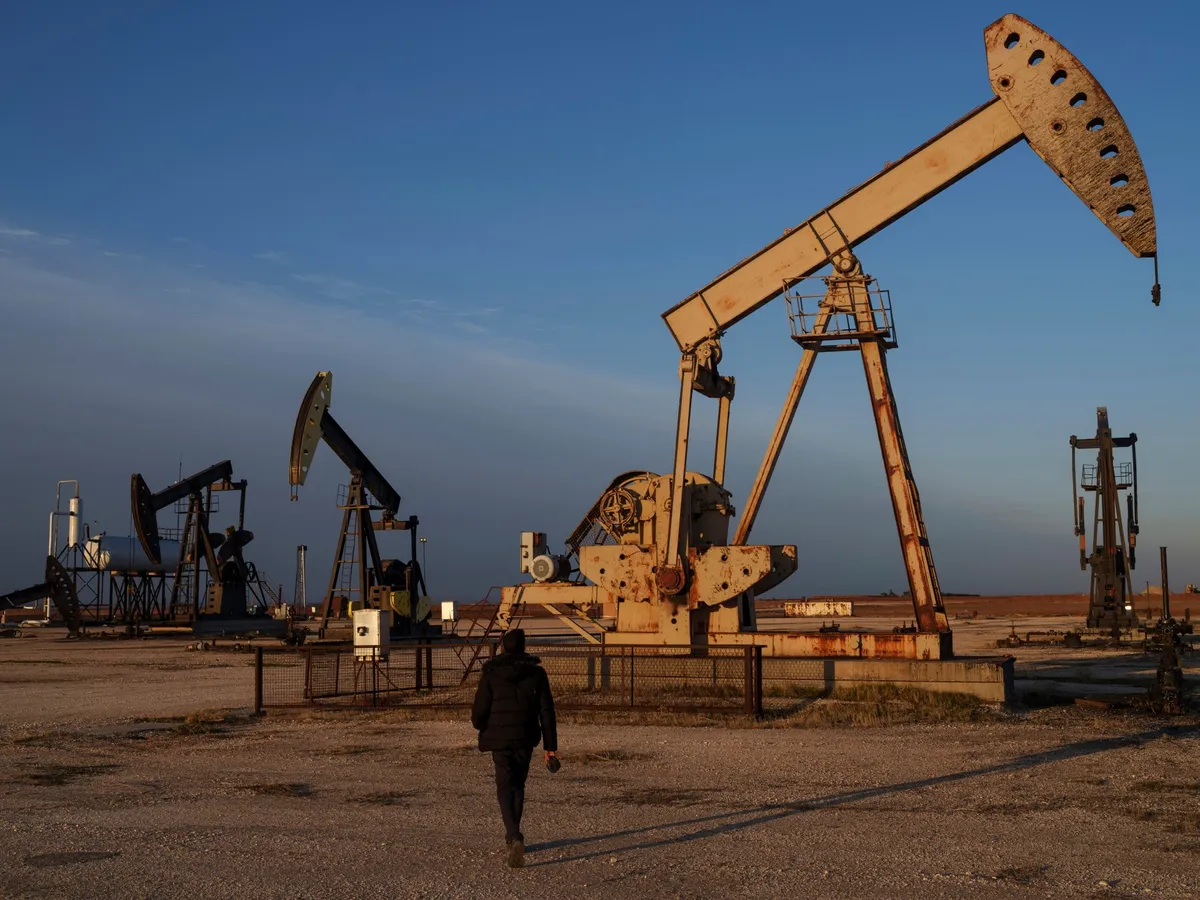
Syrian Government’s control of energy reserves from Kurdish-led SDF has raised hopes of return to pre-war production levels.A worker walks past idle pumpjacks at an oilfield on the outskirts of the northeastern Syrian city of Qamishli, on February 3, 2025 [Bernat Armangue/AP Photo]Published On 20 Jan 2026The Syrian Government’s takeover of key oil and gas fields from the Kurdish-led Syrian Democratic Forces (SDF) in the country’s northeast has raised hopes for the revival of its dilapidated energy sector after years of war and international sanctions.Syrian officials announced on Sunday that the government forces had taken control of several oilfields, including al-Omar, Syria’s largest, and the Conoco gas complex in the country’s north and northeast.Recommended Stories list of 4 itemslist 1 of 4Syria-SDF ceasefire hangs in balance after renewed clashes, faltering talkslist 2 of 4Australian Parliament backs tighter gun, hate crime laws after Bondi attacklist 3 of 4Video: Blast kills seven at hotel restaurant in Afghan capital Kabullist 4 of 4Manhunt for ISIL prisoners in Syria after fighting near jailsend of listDamascus made the announcement after the United States-trained SDF agreed to relinquish control of Deir Az Zor, Raqqa and Hasakah governorates as part of a ceasefire deal.While the return of Syria’s energy reserves to government control marks a pivotal moment for the country’s war-battered economy, Damascus will face hurdles ranging from damaged infrastructure to chronic underinvestment as it looks to kick production into high gear, according to industry experts.“Despite the strategic importance of regaining oil and gas assets, translating sovereignty into production recovery will be gradual and technically complex,” Ahmad al-Dahik, an oil and gas expert based in Qatar, told Al Jazeera.“Oil reservoirs have suffered from unregulated extraction and equipment damage, while pipelines and processing facilities require extensive rehabilitation. Gas, by contrast, is generally less capital-intensive to restore and directly linked to electricity generation, making it the most likely early recovery priority.”Syria’s fossil fuel reservesSyria holds an estimated 2.5 billion barrels of oil and 8.5 trillion cubic feet of natural gas, but the country’s energy sector has been in disarray since its descent into war following a brutal crackdown on largely peaceful antigovernment protests in 2011.While Syria never ranked among the world’s top fossil fuel producers, the country’s pre-war output covered its domestic energy needs and generated significant revenues for government coffers. The country produced about 380,000 barrels of oil and about 25 million cubic metres of gas per day, generating 20-25 percent of state revenues.By 2015, when much of Syria was controlled by ISIL (ISIS), production had plunged to an estimated 40,000bpd, according to an analysis by S&P Global Commodity Insights.Output declined further following ISIL’s defeat by the SDF, standing between 15,000bpd and 30,000bpd in 2019, according to the market analysis firm.“Rehabilitation and new exploration are possible but will take time, and require political stability and a clear regulatory framework,” Carole Nakhle, the CEO of advisory firm Crystol Energy, told Al Jazeera.“Government control could allow more coordinated rehabilitation, but progress will depend on investment, expertise, and access to markets.”The al-Omar oilfield in Deir Az Zor, on January 19, 2026 [Omar Haj Kadour/AFP]Prospect of foreign investmentThe US, European Union and the United Kingdom’s lifting of most sanctions on Syria in response to the fall of al-Assad’s regime in December 2024 has raised the prospect of an influx of investment by foreign companies, which played a central role in the country’s pre-war production.Before the war, a joint venture between the state-run Syrian Petroleum Company (SPC), British multinational Shell, China National Petroleum Corporation and India’s Oil and Natural Gas Corporation was Syria’s single largest oil producer, accounting for more than one-quarter of production.SPC CEO Youssef Qeblawi told reporters earlier this week that Shell had expressed its intention to fully withdraw from the al-Omar oilfield, though the British multinational has not publicly commented on its plans.France’s TotalEnergies, UK’s Gulfsands Petroleum, China’s Sinochem and Canada’s Suncor Energy also oversaw energy projects in Syria until sanctions forced a halt to their operations.The SPC has signed a slew of preliminary agreements or memorandums of understanding with foreign energy firms in recent months, including US-based ConocoPhillips, the UAE’s Dana Gas, Saudi Arabia’s Arabian Drilling, and Qatar’s UCC Holding.In December, Syria and neighbouring Turkiye announced an agreement to strengthen energy cooperation, including through the restoration of a gas pipeline linking Aleppo and the Turkish city of Kilis.Syrian President Ahmed al-Sharaa last month met representatives from Texas-based Chevron to discuss cooperation in the development of the country’s energy reserves.David Butter, an analyst on the Middle East at Chatham House, said he expected UK-based Gulfsands to seek to restart its suspended operations at the Block 26 oilfields in Hasakah, while Egyptian companies such as Enppi and Petrojet could also be interested in investing in the sector.“I would expect the Damascus government to look for private investment in the infrastructure of the east of Deir Az Zor fields and to issue tenders for some specific projects,” Butter told Al Jazeera.“We could see Egyptian companies such as Enppi and Petrojet being involved in contracts.”Nakhle of Crystol Energy said while Syria may be able to attract “smaller, adventurous investors”, leading companies could be reluctant to invest due to uncertainty around the country’s governance and security conditions. Sunday’s ceasefire hangs in the balance following reports of new fighting.“In short, while Syria’s oil and gas sector has potential, rebuilding it will be slow, risky, and heavily dependent on policy, security, and investment conditions,” Nakhle said.Al-Dahik said restoring Syria’s production to pre-2011 levels would likely take years even under favourable conditions.“The restoration of state control over Syria’s main oil and gas assets is a pivotal political and economic moment. Yet hydrocarbons alone cannot drive recovery,” he said.
SRCAl Jazeera
LANGEN
LEANCenter
WORDS941
ENT10
TUE · 2026-01-20 · 10:56 GMTBRIEF NSR-2026-0120-8953
NSR-2026-0120-8953News Report·EN·Economic Impact
Syria’s war-ravaged oil sector faces tough road to recovery, analysts say
Following a ceasefire deal in January 2026, the Syrian government regained control of key oil and gas fields in the northeast from the SDF, including the al-Omar oilfield and Conoco gas complex. This takeover raises hopes for revitalizing Syria's war-ravaged energy sector, which has been hampered by years of conflict and sanctions.
John PowerAl JazeeraFiled 2026-01-20 · 10:56 GMTLean · CenterRead · 4 min
Al JazeeraFIG 01
Reading time
4min
Word count
941words
Sources cited
1cited
Entities identified
10entities
Quality score
100%
§ 01
Briefing Summary
AI-generatedNEWSAR · AI
Following a ceasefire deal in January 2026, the Syrian government regained control of key oil and gas fields in the northeast from the SDF, including the al-Omar oilfield and Conoco gas complex. This takeover raises hopes for revitalizing Syria's war-ravaged energy sector, which has been hampered by years of conflict and sanctions. Syria holds significant oil and gas reserves, but production has been disrupted since 2011. Experts say that while regaining control of these assets is strategically important, Damascus faces challenges in restoring production due to damaged infrastructure, unregulated extraction, and underinvestment. Initial recovery efforts are likely to prioritize gas production due to its link to electricity generation.
Confidence 0.90Sources 1Claims 5Entities 10
§ 02
Article analysis
Model · rule-basedFraming
Economic Impact
Political Strategy
Tone
Measured
AI-assessed
CalmNeutralAlarmist
Factuality
0.70 / 1.00
Factual
LowHigh
Sources cited
1
Limited
FewMany
§ 03
Key claims
5 extracted01
By 2015, production had plunged to an estimated 40,000bpd.
statisticS&P Global Commodity Insights
Confidence
0.90
02
Pre-war output covered domestic energy needs and generated 20-25 percent of state revenues.
factualnull
Confidence
0.90
03
Syrian government forces have taken control of several oilfields, including al-Omar and the Conoco gas complex.
factualSyrian officials
Confidence
0.90
04
Syria holds an estimated 2.5 billion barrels of oil and 8.5 trillion cubic feet of natural gas.
statisticnull
Confidence
0.80
05
Translating sovereignty into production recovery will be gradual and technically complex.
quoteAhmad al-Dahik, an oil and gas expert based in Qatar
Confidence
0.70
§ 04
Full report
4 min read · 941 words§ 05
Entities
10 identifiedKey playerOppositionContextPositiveNeutralNegative
Organizations3
§ 06
Keywords & salience
10 termssyria
1.00
oil sector
0.90
energy reserves
0.80
oil production
0.70
sdf
0.70
economic recovery
0.60
gas fields
0.60
fossil fuel reserves
0.50
infrastructure damage
0.50
international sanctions
0.40
§ 07
Topic connections
Interactive graph Network visualization showing 51 related topics
View Full Graph Person Organization Location Event|Click node to navigate|Edge numbers = shared articles