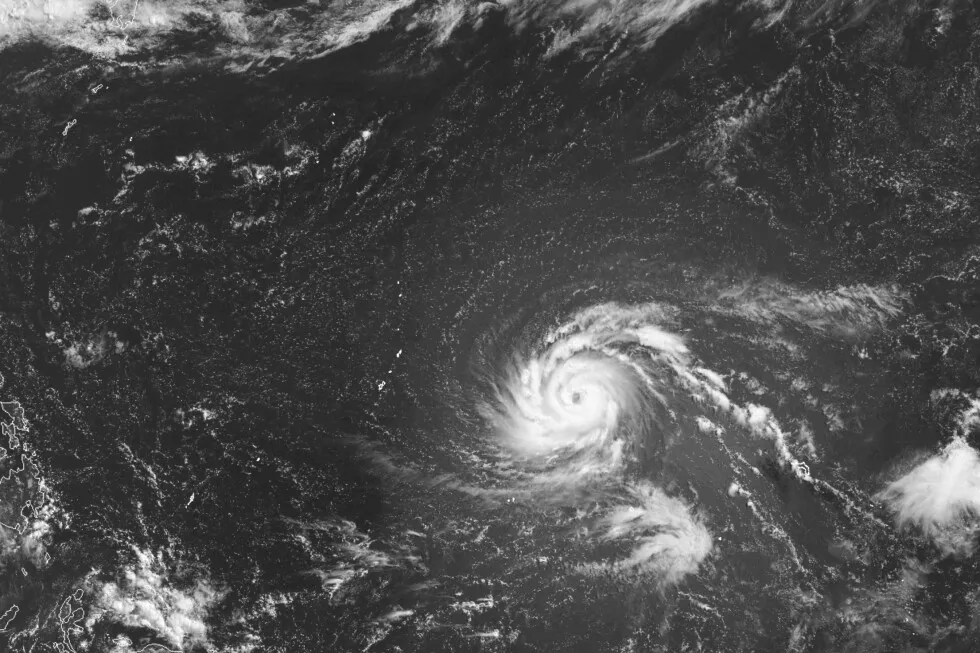
This satellite image from the National Oceanic and Atmospheric Administration shows Typhoon Bavi east of the U.S. Pacific island territory of Guam on Friday, July 3, 2026. (NOAA via AP) By JENNIFER SINCO KELLEHER Updated 3:47 AM MESZ, July 3, 2026 Add AP News on Google Add AP News as your preferred source to see more of our stories on Google. Share Share Facebook Copy Link copied Print Email X LinkedIn Bluesky Flipboard Pinterest Reddit HONOLULU (AP) — Residents of U.S. territories in the western Pacific were bracing Friday for a possible super typhoon, just months after the region was hit by the strongest tropical cyclone on Earth this year. Power still hasn’t been fully restored in the U.S. Commonwealth of the Northern Mariana Islands after that super typhoon, Sinlaku, brought ferocious winds and relentless rains in April. Some people are still living in tents after their homes were destroyed. “We’re getting ready to do this all over again,” said Edwin Propst a former lawmaker who works in the governor’s office on Saipan, where it was already Friday. “The timing is terrible.” Typhoon Bavi was expected to become a super typhoon by Sunday night to early Monday, when it is forecast to reach the Marianas, said Paul Stanko, senior meteorologist with the National Weather Service on Guam. A cyclone becomes a super typhoon when it has maximum sustained winds of 150 mph (241 kph) or stronger. Super typhoons are equivalent to a high-end Category 4 or Category 5 storm, Stanko said. Bavi was 760 miles (1,223 kilometers) east of Guam on Friday with maximum sustained winds of 80 mph (129 kph), the weather service said. Democratic governors press US Postal Service to drop plan tied to Trump’s election order 2 MIN READ Los Angeles Knight Riders play first game in new stadium as Olympic cricket buzz grows 3 MIN READ Judge seeks stronger Trump assurances on plans for DC golf course project 3 MIN READ Some residents are hoping Guam takes the brunt of Bavi to give their neighbors in the Northern Marianas a reprieve while they slowly recover from Sinlaku, Stanko said. “That’s what we’re actually hoping for because then Saipan wouldn’t get it as bad,” he said. “That’s so island-style,” he said. “God bless them for saying that.” Guam is located west of the International Date Line and is known as “Where America’s Day Begins,” as it is hours ahead of Hawaii, Alaska and the U.S. mainland. It is home to two large U.S. military bases. Propst said residents were covering windows with plywood and storing gasoline because there were long lines at gas stations for weeks after Sinlaku. The Rev. Francis Hezel, assistant pastor of Santa Barbara Catholic Church in Dededo, Guam, said he’s hoping no island takes the brunt of the storm. But he said he wasn’t too worried, having lived through numerous typhoons. He was hopeful Bavi would change course. “Right now the pattern is heading towards us, but those patterns change,” he said. Still, church workers and residents were preparing. “This is getting to be the normal thing now, typhoon preparedness,” Hezel said. “It’s happening more frequently.” El Nino increases hurricane season activity in the Pacific. Experts say the El Nino, a natural warming cycle, should further heat a globe already warming from fossil fuel pollution and will likely turbocharge extreme weather across the planet. While Sinlaku didn’t cause on deaths on land, Propst said residents were still mourning the six crewmembers of a cargo ship that overturned during the typhoon. Searchers found one body but the U.S. Coast Guard suspended the more than 100-hour search before finding the rest. Propst said while a lot of progress has been made in recovering from Sinlaku, “we’re not quite there yet.” “A few more months would have been good,” he said.
SRCAssociated Press (AP)
LANGEN
LEANCenter
WORDS635
ENT12
FRI · 2026-07-03 · 01:53 GMTBRIEF NSR-2026-0703-89581
NSR-2026-0703-89581News Report·EN·Human Interest
Possible super typhoon threatens US Pacific territories still recovering from last storm
U.S. territories in the western Pacific are preparing for Typhoon Bavi, which is forecast to become a super typhoon by Sunday or Monday.
Associated Press (AP)Filed 2026-07-03 · 01:53 GMTLean · CenterRead · 3 min
Associated Press (AP)FIG 01
Reading time
3min
Word count
635words
Sources cited
3cited
Entities identified
12entities
Quality score
100%
§ 01
Briefing Summary
AI-generatedNEWSAR · AI
U.S. territories in the western Pacific are preparing for Typhoon Bavi, which is forecast to become a super typhoon by Sunday or Monday. This comes just months after Super Typhoon Sinlaku devastated the Northern Mariana Islands in April, leaving many without power and homes. Residents are bracing for another potential disaster, with some hoping Guam will bear the brunt of Bavi to give the Northern Marianas a reprieve. Typhoon Bavi was 760 miles east of Guam with sustained winds of 80 mph. Experts attribute increased hurricane season activity to El Nino, exacerbated by global warming. Recovery efforts from Sinlaku are ongoing, with some residents still mourning the loss of six crewmembers from an overturned cargo ship.
Confidence 0.90Sources 3Claims 5Entities 12
§ 02
Article analysis
Model · rule-basedFraming
Human Interest
Public Health
Tone
Mixed Tone
AI-assessed
CalmNeutralAlarmist
Factuality
0.70 / 1.00
Factual
LowHigh
Sources cited
3
Well sourced
FewMany
§ 03
Key claims
5 extracted01
Power has not been fully restored in the Northern Mariana Islands after Super Typhoon Sinlaku in April.
factual
Confidence
1.00
02
Super typhoons have maximum sustained winds of 150 mph (241 kph) or stronger, equivalent to a high-end Category 4 or 5 storm.
statisticPaul Stanko, senior meteorologist with the National Weather Service on Guam
Confidence
1.00
03
Residents of U.S. territories in the western Pacific are bracing for a possible super typhoon, months after a previous storm.
factual
Confidence
1.00
04
Some residents are hoping Guam takes the brunt of Bavi to lessen the impact on the Northern Mariana Islands, which are still recovering from Super Typhoon Sinlaku.
quotePaul Stanko, senior meteorologist with the National Weather Service on Guam
Confidence
0.90
05
Typhoon Bavi is expected to become a super typhoon by Sunday night to early Monday, reaching the Marianas.
predictionPaul Stanko, senior meteorologist with the National Weather Service on Guam
Confidence
0.90
§ 04
Full report
3 min read · 635 words§ 05
Entities
12 identifiedKey playerOppositionContextPositiveNeutralNegative
Organizations2
Locations4
Events3
§ 06
Keywords & salience
9 termssuper typhoon
1.00
typhoon bavi
0.90
us pacific territories
0.80
typhoon sinlaku
0.70
tropical cyclone
0.60
northern mariana islands
0.50
guam
0.50
disaster recovery
0.40
meteorology
0.40
§ 07
Topic connections
Interactive graph No topic relationship data available yet. This graph will appear once topic relationships have been computed.