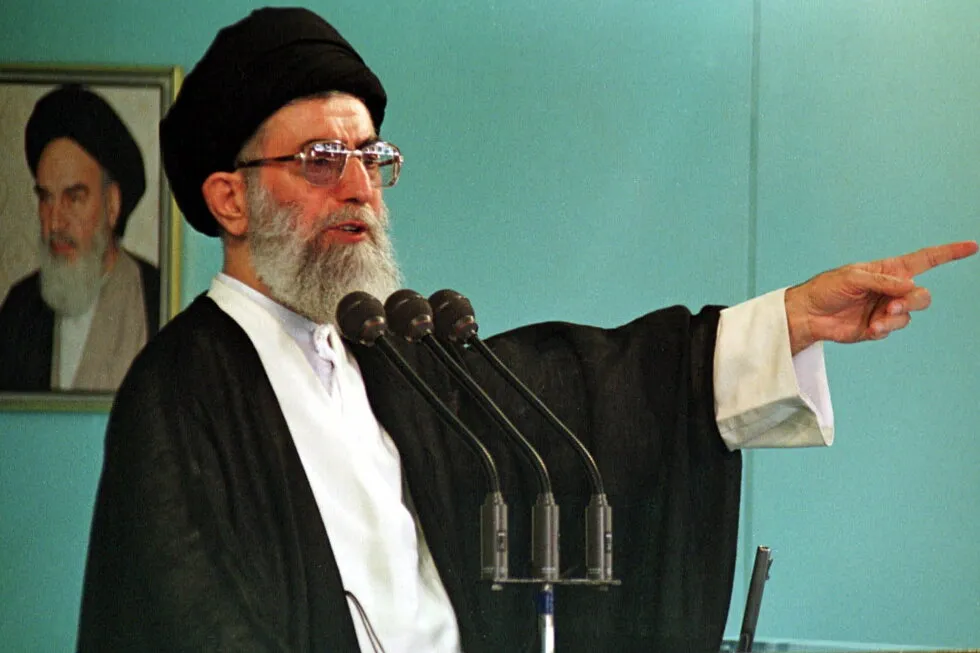
Ayatollah Ali Khamenei, who led Iran with iron fist while confronting the US, will be buried 1 of 3 | Ayatollah Ali Khamenei, then Iran’s supreme leader, speaks during Friday prayers at Tehran University, July 30, 1999. (AP Photo/Kamran Jebreili) 2 of 3 | Ayatollah Ali Khamenei, then Iran’s supreme leader, addresses thousands gathered at Imam Square in Isfahan, Iran, Oct. 30, 2001. (AP Photo, File) 3 of 3 | Ayatollah Ali Khamenei, then Iran’s supreme leader, speaks with the media after he voted in parliamentary runoff elections in Tehran, Iran, May 10, 2024. (AP Photo/Vahid Salemi, File) By JON GAMBRELL Updated 11:07 AM MESZ, July 3, 2026 Add AP News on Google Add AP News as your preferred source to see more of our stories on Google. Share Share Facebook Copy Link copied Print Email X LinkedIn Bluesky Flipboard Pinterest Reddit Dubai, United Arab Emirates (AP) — Ayatollah Ali Khamenei dramatically remolded Iran during more than three decades as supreme leader, turning it into a regional powerhouse and bringing it increasingly into confrontation with Israel and the United States. His dayslong funeral begins Saturday, months after being killed at the start of the U.S.-Israeli war in Iran. Khamenei took the reins after the death in 1989 of Ayatollah Ruhollah Khomeini, the fiery ideologue who led the overthrow of the shah and installed rule by Shiite Muslim clerics. It fell to Khamenei, a stodgier figure with weaker religious credentials, to turn that revolutionary vision into a state establishment. He supported myriad armed groups in the Middle East, pushed ahead with Iran’s nuclear program, and faced down several protest movements with crackdowns. While his clashes with the U.S. and Israel were a source of support at home, they ultimately led to his demise. He built up Iran’s military might, including through proxies After the 1980s war with Iraq, Khamenei turned the paramilitary Revolutionary Guard into the most important body underpinning his rule. The Guard became a military and business behemoth, the country’s most elite force, with hands across Iran’s economic sectors. Under Khamenei’s reign, Iran also shifted fully from conventional warfare to support for proxies, building the “Axis of Resistance.” That included backing the Lebanese militant group Hezbollah, which drove Israel from southern Lebanon in 2000 and has battled Israeli forces repeatedly since. Iran has also supported Yemen’s Houthi rebels, who in 2014 seized the country’s capital and held on for over a decade in a stalemated war, and the Palestinian militant group Hamas, which has fought Israel in the Gaza Strip. Iranian-backed militias also waged an insurgency against U.S. forces in Iraq. The Mideast wars sparked by Hamas’ Oct. 7, 2023, attack on Israel, however, set in motion the collapse of that “Axis of Resistance,” and left Hamas and Hezbollah weaker. What to know about the funeral and burial of Iran’s Supreme Leader Ayatollah Ali Khamenei 3 MIN READ Erdogan’s warm ties with Trump offer Turkey an edge ahead of NATO summit 5 MIN READ Iran prepares for dayslong funeral for late Supreme Leader Ayatollah Ali Khamenei, killed in war 4 MIN READ 64 Khamenei insisted on Iran’s right to a nuclear program For decades, Khamenei shrugged off U.N. sanctions and pushed ahead with Iran’s nuclear program, which the U.S. and its allies say hid a secret project to build a nuclear weapon up until 2003. Khamenei issued a verbal fatwa, or religious ruling, that nuclear weapons are un-Islamic, but vowed the country would never give up its right to develop what he called a peaceful nuclear energy program. Under a 2015 nuclear deal, Iran agreed to drastically reduce its stockpile and enrichment of uranium in exchange for the lifting of sanctions. But since U.S. President Donald Trump withdrew Washington from the accord in 2018, a move welcomed by Israel, Iran has accumulated a stockpile of uranium enriched to nearly weapons-grade levels. Israel and some U.S. officials have expressed concern that Tehran could us that to pursue nuclear arms if it chose. Both the U.S.-Israeli bombing in 2025 and the current war have targeted Iran’s nuclear program. His rule was marked by several mass protests — and crackdowns Political repression and Iran’s faltering economy have fueled successively bigger waves of protests. In 2009, protests broke out when the reformist opposition claimed the reelection victory of hard-line President Mahmoud Ahmadinejad was rigged. Dozens were killed and hundreds arrested in a crackdown. Economic protests broke out in 2017 and demonstrations escalated in 2019 over a rise in government-set gasoline prices. A crackdown killed over 300 people, according to activists. Protests erupted again in 2022 over the death of Mahsa Amini, a young woman detained for not wearing her headscarf properly. More than 500 people were killed and tens of thousands arrested when security forces crushed the demonstrations. In late 2025, economic protests erupted and grew into what appeared to be the biggest protest movement ever. Hundreds of thousands across the country took to the streets, demanding an end to the Islamic Republic. The ferocity of the crackdown — activists say at least 7,000 have been killed — stunned Iranians. Khamenei’s death raises questions about the future of the Islamic Republic. Khamenei’s son, Ayatollah Mojtaba Khamenei, was chosen as the next supreme leader. But he was believed to have been wounded in the strikes that killed his father and has not been seen publicly. As Trump launched the current war, he called on Iranians to “take over your government. ” There has been no sign yet of any such uprising, however, as hard-liners have rallied nightly in the streets of Tehran. What happens after the burial of the elder Khamenei may depend greatly on bodies like the Revolutionary Guard, which has repeatedly shown its willingness to use overwhelming force to maintain power. JON GAMBRELL Gambrell is the news director for the Gulf and Iran for The Associated Press. He has reported from each of the Gulf Cooperation Council countries, Iran and other locations across the world since joining the AP in 2006. twitter instagram mailto
SRCAssociated Press (AP)
LANGEN
LEANCenter
WORDS1 002
ENT12
FRI · 2026-07-03 · 09:23 GMTBRIEF NSR-2026-0703-89696
NSR-2026-0703-89696News Report·EN·Conflict
Ayatollah Ali Khamenei, who led Iran with iron fist while confronting the US, will be buried
Ayatollah Ali Khamenei, Iran's supreme leader for over three decades, is set to be buried following his death during the U.S.-Israeli war in Iran. Khamenei transformed Iran into a regional power, increasingly confronting the U.S.
Associated Press (AP)Filed 2026-07-03 · 09:23 GMTLean · CenterRead · 5 min
Associated Press (AP)FIG 01
Reading time
5min
Word count
1 002words
Sources cited
0cited
Entities identified
12entities
Quality score
100%
§ 01
Briefing Summary
AI-generatedNEWSAR · AI
Ayatollah Ali Khamenei, Iran's supreme leader for over three decades, is set to be buried following his death during the U.S.-Israeli war in Iran. Khamenei transformed Iran into a regional power, increasingly confronting the U.S. and Israel. He strengthened the Revolutionary Guard, supported proxy groups like Hezbollah and Hamas, and advanced Iran's nuclear program despite international sanctions. His rule was also marked by significant domestic crackdowns on protests, including those in 2009, 2017, 2019, 2022, and a major uprising in late 2025. His demise and the ongoing war raise questions about Iran's future leadership and stability.
Confidence 0.90Claims 5Entities 12
§ 02
Article analysis
Model · rule-basedFraming
Conflict
Political Strategy
Tone
Measured
AI-assessed
CalmNeutralAlarmist
Factuality
0.80 / 1.00
Factual
LowHigh
Sources cited
0
No named sources
FewMany
§ 03
Key claims
5 extracted01
The Mideast wars sparked by Hamas’ Oct. 7, 2023, attack on Israel, however, set in motion the collapse of that “Axis of Resistance,” and left Hamas and Hezbollah weaker.
factual
Confidence
1.00
02
He supported myriad armed groups in the Middle East, pushed ahead with Iran’s nuclear program, and faced down several protest movements with crackdowns.
factual
Confidence
1.00
03
Khamenei took the reins after the death in 1989 of Ayatollah Ruhollah Khomeini.
factual
Confidence
1.00
04
His dayslong funeral begins Saturday, months after being killed at the start of the U.S.-Israeli war in Iran.
factual
Confidence
1.00
05
Ayatollah Ali Khamenei dramatically remolded Iran during more than three decades as supreme leader, turning it into a regional powerhouse and bringing it increasingly into confrontation with Israel and the United States.
factual
Confidence
1.00
§ 04
Full report
5 min read · 1 002 words§ 05
Entities
12 identifiedKey playerOppositionContextPositiveNeutralNegative
People2
Organizations5
§ 06
Keywords & salience
10 termsiran
1.00
ayatollah ali khamenei
1.00
supreme leader
0.90
us confrontation
0.80
regional powerhouse
0.70
revolutionary guard
0.60
axis of resistance
0.60
proxies
0.50
nuclear program
0.50
israel
0.40
§ 07
Topic connections
Interactive graph Network visualization showing 51 related topics
View Full Graph Person Organization Location Event|Click node to navigate|Edge numbers = shared articles