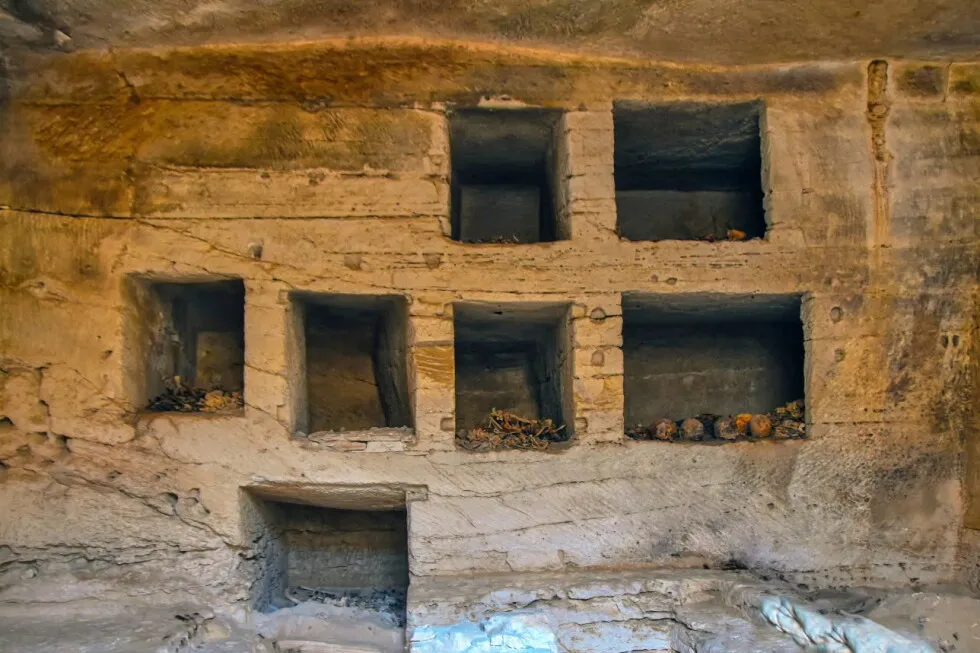
Egypt uncovers lost Byzantine-era city in the Western Desert 1 of 2 | In this photo provided Saturday, July 4, 2026, by Tourism-and-antiquities" class="entity-link entity-organization" data-entity-id="158786" data-entity-type="organization">Ministery of Tourism and Antiquities, some of seven surface limestone-built tombs, discovered in the Marina el-Alamein archaeological site, are seen west of the Mediterranean city of Alexandria, Egypt. (Tourism-and-antiquities" class="entity-link entity-organization" data-entity-id="158786" data-entity-type="organization">Ministery of Tourism and Antiquities via AP) 2 of 2 | In this photo provided Saturday, July 4, 2026, by Tourism-and-antiquities" class="entity-link entity-organization" data-entity-id="158786" data-entity-type="organization">Ministery of Tourism and Antiquities, a recently discovered artifact is displayed in the Marina el-Alamein archaeological site, west of the Mediterranean city of Alexandria, Egypt. (Tourism-and-antiquities" class="entity-link entity-organization" data-entity-id="158786" data-entity-type="organization">Ministery of Tourism and Antiquities via AP) By SAMY MAGDY Updated 4:04 PM MESZ, July 4, 2026 Add AP News on Google Add AP News as your preferred source to see more of our stories on Google. Share Share Facebook Copy Link copied Print Email X LinkedIn Bluesky Flipboard Pinterest Reddit CAIRO (AP) — A well-preserved Byzantine-era residential city in the Western Desert is one of two major archaeological finds announced by Egypt on Saturday. The recent discoveries at the Dakhla Oasis and at the Marina el-Alamein archaeological site, near Alexandria, are the latest findings which the Egyptian government hopes will boost the country’s vital Tourism sector, partially driven by antiquities sightseeing. Along with the strategic Suez Canal, Tourism is a major source of foreign currency in the cash-strapped country. The Tourism and Antiquities Ministry said that the first discovery reveals details of daily life, urban development and economic activities in the Dakhla Oasis in the fourth century, when Egypt was part of the Byzantine Empire. The unearthed quarters included north-south thoroughfares intersected by east-west streets, forming open squares and public spaces, said Hisham el-Leithy, secretary general of the supreme council of antiquities. A basilica church, dating back to the mid-fourth century, stands at the settlement’s head, overlooking its main streets, along with remains of two watchtowers to safeguard the outskirts, said Mahmoud Massoud, who chairs the archaeological mission. Africa’s World Cup surge fades as Ghana falls to Colombia, leaving Morocco and Egypt still standing 2 MIN READ Australia goes for experience in net and a young kicker in shootout loss at the World Cup 2 MIN READ Egypt defender Mohamed Hany becomes first player with two own-goals in the same World Cup 1 MIN READ The oasis, located in Egypt’s western province of New Valley in the Western Desert, is on UNESCO’s Tentative List, a step away from being added to the agency’s World Heritage List. A heavily fortified structure with thick defensive walls, and many houses consisting of reception halls and vaulted roofs were found in the area, Massoud said. Among them were the house of Tisous, identified as a church deacon and dating to the second half of the fourth century, which archaeologists believe served as a house church before the construction of the city’s basilica. Archaeologists also uncovered bread ovens, kitchens and stone grinding tools that had been apparently used to produce food. Also found were well-preserved bronze coins bearing portraits of Byzantine emperors, Latin inscriptions and Christian symbols, alongside a group of gold coins dating to the reign of Roman emperor Constantius II, who ruled between 337 and 361, the ministry statement said. Diaa Zahran, head of the Islamic, Coptic and Jewish Antiquities department, said they found a collection of about 200 pottery fragments which would have been used as writing material. The fragments, known as octraca, have inscriptions detailing commercial transactions, correspondence and other details of daily life, Zahran said. Separately, archaeologists have found 18 ancient tombs in the Marina el-Alamein archaeological site, which is around 100 kilometers (62 miles) west of the Mediterranean city of Alexandria. The findings included 11 rock-cut tombs, with an average depth of 8 meters, and seven surface limestone-built tombs, the ministry said. That has brought the total tombs found in the site to 48, ministry said. In the site, archaeologists found pottery vessels, amphorae, lamps, plates, altars and limestone basins, it said. Mission chief Eman Abdel-Khaliq said they found a 2.5-meter-long granite sarcophagus, with skeleton remains that were currently being studied. Close to the sarcophagus, they found the remains of a plaster sphinx statue, she said Abdel-Khaliq said they also found 4 gold pieces placed inside the mouths of some of the deceased — known as “the golden tongue,” which had been a practice associated with funerary beliefs of that era. Marina el-Alamein is an archaeological site close to the city of Alamein in Egypt’s Northern Coast. Unearthed in 1986, archaeologists believe that the site was the ancient Greco-Roman port city of Leukaspis on the Mediterranean, which was built in the second denture and thrived until the fourth century, the ministry said. Egypt’s Tourism has started to recover after years of years of political turmoil and violence following the 2011 uprising, as well as the coronavirus pandemic. A record 19 million tourists visited Egypt last year, a 21% increase from 2024, according to official figures. The first four months of 2026 saw 6.1 million tourists, compared with 5.7 million during the same period in 2025, the figures showed. SAMY MAGDY Magdy is a Middle East reporter for The Associated Press, based in Cairo. He focuses on conflict, migration and human rights abuses. twitter facebook mailto
SRCAssociated Press (AP)
LANGEN
LEANCenter
WORDS872
ENT12
SAT · 2026-07-04 · 14:23 GMTBRIEF NSR-2026-0704-90026
NSR-2026-0704-90026News Report·EN·Economic Impact
Egypt uncovers lost Byzantine-era city in the western desert
Egypt's Ministry of Tourism and Antiquities announced two significant archaeological discoveries: a well-preserved Byzantine-era residential city in the Dakhla Oasis and 18 ancient tombs at the Marina el-Alamein site near Alexandria. The Dakhla Oasis city, dating to the fourth century, offers insights into daily life, urban development, and economic activities, featuring a basilica church and defensive watchtowers.
Associated Press (AP)Filed 2026-07-04 · 14:23 GMTLean · CenterRead · 4 min
Associated Press (AP)FIG 01
Reading time
4min
Word count
872words
Sources cited
3cited
Entities identified
12entities
Quality score
100%
§ 01
Briefing Summary
AI-generatedNEWSAR · AI
Egypt's Ministry of Tourism and Antiquities announced two significant archaeological discoveries: a well-preserved Byzantine-era residential city in the Dakhla Oasis and 18 ancient tombs at the Marina el-Alamein site near Alexandria. The Dakhla Oasis city, dating to the fourth century, offers insights into daily life, urban development, and economic activities, featuring a basilica church and defensive watchtowers. At Marina el-Alamein, the newly found tombs, including rock-cut and limestone-built structures, bring the total to 48, with artifacts like pottery, lamps, and a granite sarcophagus with skeleton remains. These discoveries are part of Egypt's efforts to boost its tourism sector, a crucial source of foreign currency.
Confidence 0.90Sources 3Claims 5Entities 12
§ 02
Article analysis
Model · rule-basedFraming
Economic Impact
Human Interest
Tone
Measured
AI-assessed
CalmNeutralAlarmist
Factuality
0.90 / 1.00
Factual
LowHigh
Sources cited
3
Well sourced
FewMany
§ 03
Key claims
5 extracted01
A basilica church dating back to the mid-fourth century was found at the settlement's head.
factualMahmoud Massoud
Confidence
1.00
02
The Byzantine-era city in Dakhla Oasis reveals details of daily life, urban development, and economic activities from the fourth century.
factualHisham el-Leithy
Confidence
1.00
03
The discoveries are intended to boost Egypt's vital tourism sector, a major source of foreign currency.
factualArticle
Confidence
1.00
04
Egypt announced two major archaeological finds: a Byzantine-era city in the western desert and another discovery at Marina el-Alamein.
factualMinistery of Tourism and Antiquities
Confidence
1.00
05
The house of Tisous, identified as a church deacon's house and dating to the second half of the fourth century, may have served as a house church.
factualArchaeologists
Confidence
0.90
§ 04
Full report
4 min read · 872 words§ 05
Entities
12 identifiedKey playerOppositionContextPositiveNeutralNegative
Locations8
Topics1
§ 06
Keywords & salience
9 termsbyzantine-era city
1.00
archaeological finds
0.90
dakhla oasis
0.80
marina el-alamein
0.80
egypt tourism
0.70
western desert
0.60
urban development
0.50
daily life
0.40
basilica church
0.40
§ 07
Topic connections
Interactive graph Network visualization showing 51 related topics
View Full Graph Person Organization Location Event|Click node to navigate|Edge numbers = shared articles