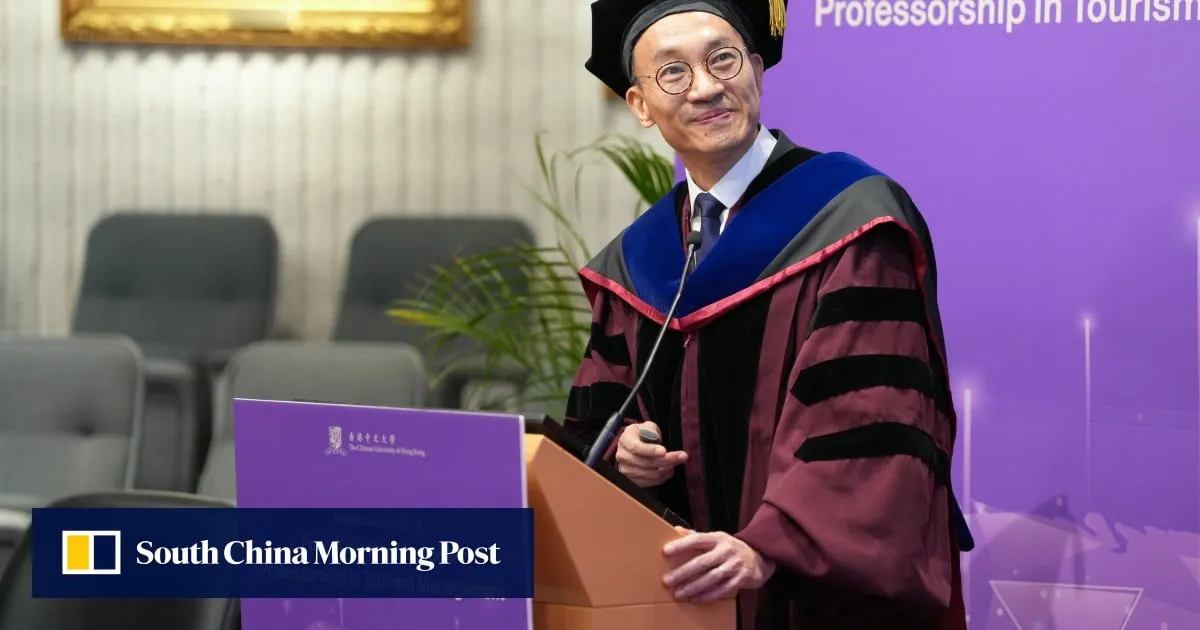
[The content of this article has been produced by our advertising partner.]For two decades, Professor Robert Li’s rigorous, yet practice-grounded research has bridged academia and the hospitality and tourism industry, giving it a new lens for examining its conventional wisdom. Since joining the Chinese University of Hong Kong (CUHK) Business School in January 2025, he has brought what he calls the “compleat scholar” approach to the School, a philosophy that integrates cross-disciplinary academic enquiry with real-world impact.The questions that wouldn’t waitNow the tourism-management" class="entity-link entity-person" data-entity-id="159231" data-entity-type="person">Fung King Hey Memorial Professor of tourism Management, Professor Li’s career did not begin in academia. It started at the Nanjing-municipal-tourism-bureau" class="entity-link entity-organization" data-entity-id="159232" data-entity-type="organization">Nanjing Municipal tourism Bureau, where he worked as a destination marketing specialist who handled tourism planning, event management, promotion and TV travel videos. “I was ‘selling’ something I couldn’t fully define,” he recalls. “What exactly is my city’s image? How do different campaigns and the media shape and maintain that image? How does that image then influence information search behaviour? Why do some messages stick while others disappear?” These questions piqued Professor Li’s curiosity. His encounter with academic work on “destination image” – what people think and feel about a place – sparked his decision to pursue his postgraduate studies in the US and tackle these questions more systematically. Building programmes, not just papers Early in his academic journey, Professor Li noticed that practitioners and academics often work in parallel universes. Academics chase theoretically “interesting” questions while practitioners chase KPIs. He resolved to build a career that would bridge these two worlds. Professor Li developed “research programmes”. Unlike individual studies that answer discrete questions, these are long-term thematic investigations composed of multiple interlinked projects that evolve over a span of years. Through sustained crossdisciplinary collaboration, these programmes create frameworks, tools and evidence that academics and practitioners can apply and refine over time.“This approach fits my personality most naturally,” says Professor Li. “It allows me to pursue multiple interests while building sustained expertise.” He now runs several such programmes in parallel, each one combining conceptual work, methodological innovation and empirical studies. The programmes also draw collaborators from various fields, including computer science, psychology, linguistics, public health and the tourism industry itself.The research they generate doesn’t just generate papers; it reshapes practice. Professor Li’s tourism and well-being research has given employers and tourism boards the language and data to address unhealthy workplace norms regarding vacation time. Other ongoing studies explore travel as a form of “lifestyle medicine”, including projects on depression, loneliness among seniors and even dementia-friendly tourism. Bridging linguistic and cultural dividesProfessor Li makes it a point to ensure that his research findings do not remain trapped in Western journals that are inaccessible to non-English-speaking academics and practitioners. “I consider it important to be academic – to be true to who we are,” he explains. “At the same time, we need to care about what the industry needs and stay bilingual. We should speak both a rigorous academic language and plain language to inform industry, media, government, and the wider community.” Living this philosophy, he led the creation of a WeChat platform that transformed top-tier tourism journal articles into short, accessible stories for Chinese tourism scholars and professionals. Complex findings became digestible insights for people who would happily read a well-told story on their phones, but who might never flip through a scholarly research journal. Such efforts reflect Professor Li’s commitment to being what he calls a “compleat scholar”, a concept, in his words, describing academics who intentionally develop multiple facets of their careers as an integrated whole. For him, this has defined his trajectory and involves different roles within academia (researcher, educator, centre director, journal editor, association leader, and now school director). At the same time, he has not abandoned his original research passion or his roots in practice.Members of the School of Hotel and tourism Management congratulate Professor Li on his inauguration as the Fung King Hey Memorial Professor of tourism ManagementConnecting East and West Among the bridges Professor Li builds, the most important one links East and West. “After spending 23 years in the US, I decided to return to Asia to apply global tourism insights in an Asian context and foster a deeper dialogue between international research and regional practice.” He joined CUHK Business School because he believes the positioning of tourism and hospitality within a business school offers a distinctive advantage. It is more intellectually demanding than operations-focused hospitality programmes, yet more closely connected to the industry than many traditional business disciplines. “As tourism, hospitality, retail, culture, sports, entertainment, and even healthcare increasingly converge around the world, Watch the video the key question for the industry has shifted to how to create experiences people care about,” Professor Li explains. “tourism and hospitality are best understood as a context where core business concepts converge, rather than as a narrow vocational track. That means we design what I call ‘gen business’ subjects. These are general business courses that are packaged and tailored to specific contexts, such as the experience economy.” Hospitality as mindsetThe MSc in Leadership for Experience Economy, which the School of Hotel and tourism Management proposed in 2025 and is set to launch this year, embodies this vision. The programme trains professionals who practice “hospitality thinking” – a mindset he considers essential for the converging experience economy. “The idea of hospitality thinking basically means how open and receptive we are to strangers, which influences how we design and deliver something meaningful that resonates with them.”Within three months, the programme drew over 1,000 applications, a validation of strong demand. In the age of AI, Professor Li hopes to cultivate future talent who have the ability to design meaningful experiences across industries, cultures and contexts, while serving as bridges between Asian and international perspectives.These capabilities will become increasingly vital as China shapes the future of global tourism and hospitality, and Hong Kong is uniquely positioned between East and West to cultivate them.YouTube video player
SRCSouth China Morning Post
LANGEN
LEANCenter-Right
WORDS988
ENT12
SUN · 2026-07-05 · 16:00 GMTBRIEF NSR-2026-0705-90266
NSR-2026-0705-90266Press Release·EN·Human Interest
“Compleat Scholar” bridging tourism, academia and industry
Professor Robert Li, now the Fung King Hey Memorial Professor of Tourism Management at the Chinese University of Hong Kong (CUHK) Business School, champions a "compleat scholar" approach. This philosophy integrates cross-disciplinary academic inquiry with real-world impact, bridging academia and the hospitality and tourism industry.
Advertising partnerSouth China Morning PostFiled 2026-07-05 · 16:00 GMTLean · Center-RightRead · 4 min
South China Morning PostFIG 01
Reading time
4min
Word count
988words
Sources cited
1cited
Entities identified
12entities
Quality score
100%
§ 01
Briefing Summary
AI-generatedNEWSAR · AI
Professor Robert Li, now the Fung King Hey Memorial Professor of Tourism Management at the Chinese University of Hong Kong (CUHK) Business School, champions a "compleat scholar" approach. This philosophy integrates cross-disciplinary academic inquiry with real-world impact, bridging academia and the hospitality and tourism industry. Li's career began in destination marketing, prompting his pursuit of academia to systematically address questions about destination image and marketing. He develops "research programmes" composed of multiple interlinked projects to create applicable frameworks and tools for both academics and practitioners. His research extends to tourism's impact on well-being, addressing workplace norms and exploring travel as "lifestyle medicine." Li also focuses on making research accessible to non-English-speaking audiences, creating platforms like a WeChat service to translate journal articles into digestible stories. He aims to connect global tourism insights with Asian contexts and foster dialogue between international research and regional practice.
Confidence 0.90Sources 1Claims 4Entities 12
§ 02
Article analysis
Model · rule-basedFraming
Human Interest
Economic Impact
Tone
Measured
AI-assessed
CalmNeutralAlarmist
Factuality
0.30 / 1.00
Opinion-Heavy
LowHigh
Sources cited
1
Limited
FewMany
§ 03
Key claims
4 extracted01
Professor Li uses a "compleat scholar" approach integrating cross-disciplinary inquiry with real-world impact.
quoteProfessor Robert Li
Confidence
1.00
02
Professor Robert Li's research bridges academia and the hospitality and tourism industry.
factualarticle
Confidence
0.90
03
Ongoing studies explore travel as "lifestyle medicine", including projects on depression, loneliness among seniors, and dementia-friendly tourism.
factualarticle
Confidence
0.80
04
Professor Li's tourism and well-being research provides data to address unhealthy workplace norms regarding vacation time.
factualarticle
Confidence
0.80
§ 04
Full report
4 min read · 988 words§ 05
Entities
12 identifiedKey playerOppositionContextPositiveNeutralNegative
People2
Organizations3
§ 06
Keywords & salience
10 termstourism management
1.00
academia
0.90
hospitality industry
0.80
destination image
0.70
compleat scholar
0.70
research programmes
0.60
real-world impact
0.50
cross-disciplinary
0.50
destination marketing
0.40
chinese university of hong kong
0.40
§ 07
Topic connections
Interactive graph No topic relationship data available yet. This graph will appear once topic relationships have been computed.