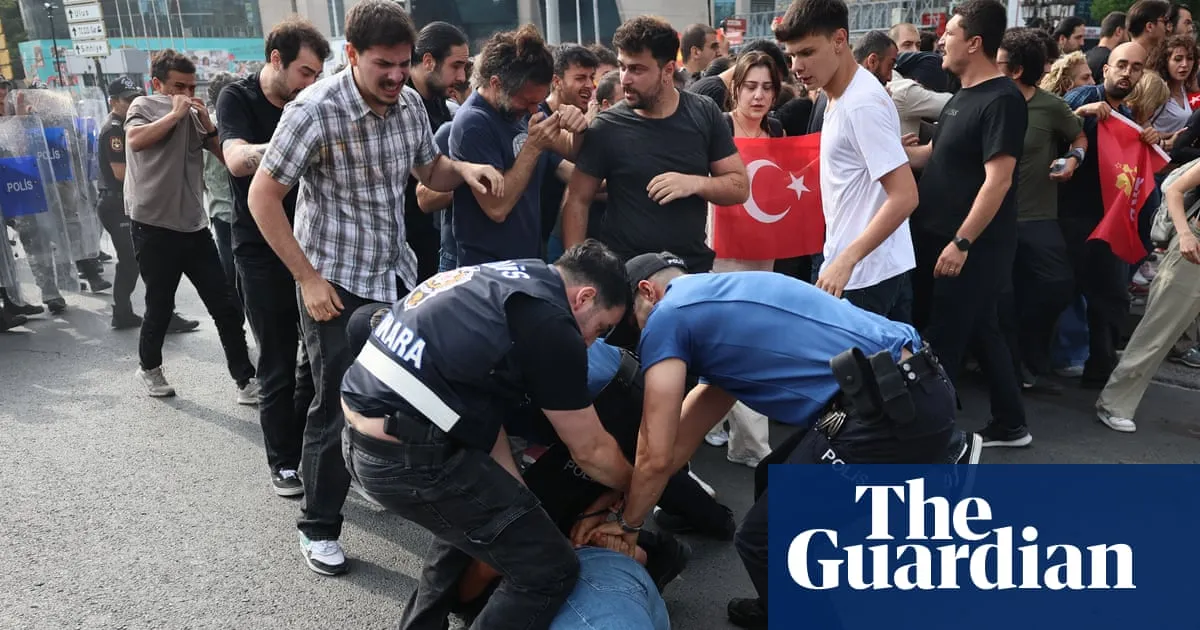
Authorities in Turkey have widened a crackdown on public life, arresting more than 200 people during raids across Ankara last month, jailing a comedian and blocking a cruise ship carrying LGBTQ+ passengers from docking in the run-up to the Nato summit in the capital.The arrests followed a ban on demonstrations in Ankara that was put in place until 10 July. Human Rights Watch (HRW) said this was evidence of Turkey’s “ruthless intolerance of freedom of speech and assembly”. The watchdog group said the Nato summit, which starts on Tuesday, was taking place in the context of intensifying violations of basic rights, “including far-reaching restrictions on the main political opposition party, the media, and freedom of expression in general”.Last week, the standup comedian Deniz Göktaş was arrested and put in pre-trial detention after arriving at Istanbul airport from a holiday. Göktaş was charged with “insulting the president” and “denigrating religious values” in relation to a show in which he referred to the Turkish president, Recep Tayyip Erdoğan, as a dictator and made jokes about suicide bombers. The performance took place in Istanbul on 1 June and a recording was released on YouTube on 24 June. The video has been viewed nearly 9m times.People call for the release of the Turkish comedian Deniz Göktaş in front of a courthouse in Istanbul on Friday. Photograph: Yasin Akgül/AFP/Getty ImagesAccording to the Turkish news outlet Bianet, Göktaş attempted to explain his jokes in his testimony to prosecutors, telling them: “The word ‘dictator’ is a political term, a topic frequently discussed in public, and I have no intention of insulting or belittling anyone with this statement.”In another recent incident, authorities in the coastal town of Aydın blocked a cruise ship operated by Atlantis, a company specialising in gay-friendly holidays, from docking on the grounds that people on board were “known for behaviours” that did “not align with the structure of our society and our moral values”.The US actor and singer Patti LuPone, who was scheduled to perform on the cruise, wrote in a social media post: “The Atlantis cruise I am performing on next week has been banned from entering Turkey … simply because of who is onboard.”This year, Reporters Without Borders accused Turkey of using “all possible means… to undermine critics” as the country fell to 163rd place out of 180 countries on the NGO’s press freedom index.Prosecutions for criticising Recep Tayyip Erdoğan have risen sharply in recent years. Photograph: Piroschka Van De Wouw/ReutersRight groups and opposition parties have long accused the Turkish authorities of muzzling free speech in the country, where prosecutions for criticising Erdoğan have risen sharply in recent years.On Sunday, two journalists were arrested: Buse Söğütlü, the international news editor at online newspaper T24; and Ceren Erdoğdu, a journalist at OdaTV. Söğütlü’s lawyer Erman Öztürk told Agence France-Presse: “We believe it is linked to the Nato summit.” Ezgi Onalan, the head of the Istanbul branch of the Association of Contemporary Lawyers, was also detained, the rights group announced on X.Ankara’s prosecutor’s office said the arrests in late June, which took place during dawn raids, would “decipher the action and activities of terrorist organisations”, and accused those held of links to a number of of socialist and Marxist groups as well as the Islamic State.HRW said authorities had provided no evidence of any crimes committed by people accused of terrorism. Among those detained on suspicion of membership of terrorist groups were the journalist and LGBTQ+ activist Yıldız Tar, two lawyers, an academic and 14 members of an environmental organisation focused on reforestation.skip past newsletter promotionafter newsletter promotionWestern leaders have mostly avoided publicly raising concerns about Turkey’s record on rights and freedoms, instead focusing on increasing security ties with the regional military power and big arms exporter.Some critics of the Erdoğan government believe the relative western silence encourages its authoritarian slide, isolates Turkey’s opposition and ignores Nato’s founding principles of democracy and rule of law. “It remains important for the west to continue to comment on the degradation of democratic institutions in Turkey because the course is not irrevocably set, Turkey is not beyond the pale,” David Satterfield, a former US ambassador to Ankara, told Reuters last week.A view of Atakule, one of the landmark buildings of Ankara, is illuminated in the run-up to the Nato summit, which starts on Tuesday. Photograph: Anadolu/Getty Images“It’s important that Turks hear others talking about their system in this way,” said Satterfield, who is now director of the Baker Institute for Public Policy, a thinktank housed at Rice University in Houston, Texas.In the past year, Turkey’s primary opposition Republican People’s party (CHP) has been subjected to a sustained crackdown. Istanbul’s mayor, Ekrem İmamoğlu, has been arrested and put on trial, as have hundreds of other municipal opposition politicians. In late May, a court unseated the leader of the CHP in a move that critics feared was intended to stifle the party’s ability to challenge Erdoğan.İmamoğlu is standing trial on an array of graft charges. The CHP says he is its chosen candidate for president, even if that means he runs for office from prison.The 56-year-old was ejected from the courtroom during a hearing last week after clashing with the judge, who said he would enforce a 9 July deadline to hear statements from the defence.
SRCThe Guardian - World News
LANGEN
LEANCenter-Left
WORDS877
ENT12
MON · 2026-07-06 · 11:00 GMTBRIEF NSR-2026-0706-90460
NSR-2026-0706-90460News Report·EN·Human Rights
Turkey intensifies crackdown on public life in run-up to Nato summit in Ankara
In the lead-up to the NATO summit in Ankara, Turkish authorities have intensified a crackdown on public life. Over 200 individuals were arrested in raids, a comedian was jailed for allegedly insulting the president, and a cruise ship carrying LGBTQ+ passengers was denied docking.
Ruth Michaelson in IstanbulThe Guardian - World NewsFiled 2026-07-06 · 11:00 GMTLean · Center-LeftRead · 4 min
The Guardian - World NewsFIG 01
Reading time
4min
Word count
877words
Sources cited
5cited
Entities identified
12entities
Quality score
100%
§ 01
Briefing Summary
AI-generatedNEWSAR · AI
In the lead-up to the NATO summit in Ankara, Turkish authorities have intensified a crackdown on public life. Over 200 individuals were arrested in raids, a comedian was jailed for allegedly insulting the president, and a cruise ship carrying LGBTQ+ passengers was denied docking. These actions follow a ban on demonstrations in Ankara. Human Rights Watch criticized these measures as evidence of intolerance towards freedom of speech and assembly, noting a broader context of rights violations, including restrictions on the opposition and media. Journalists and lawyers were among those recently detained. Authorities stated the arrests were to investigate terrorist organizations, though no evidence of crimes was provided by HRW for those accused of terrorism. Western leaders have largely focused on security ties, with some critics suggesting this silence emboldens authoritarian tendencies.
Confidence 0.90Sources 5Claims 5Entities 12
§ 02
Article analysis
Model · rule-basedFraming
Human Rights
Political Strategy
Tone
Mixed Tone
AI-assessed
CalmNeutralAlarmist
Factuality
0.70 / 1.00
Factual
LowHigh
Sources cited
5
Well sourced
FewMany
§ 03
Key claims
5 extracted01
Reporters Without Borders ranked Turkey 163rd out of 180 countries on its press freedom index.
statisticReporters Without Borders
Confidence
1.00
02
Authorities blocked a cruise ship carrying LGBTQ+ passengers from docking in Aydın, citing moral values.
factual
Confidence
1.00
03
Comedian Deniz Göktaş was arrested and charged with 'insulting the president' and 'denigrating religious values'.
factual
Confidence
1.00
04
Human Rights Watch states the Nato summit is occurring amidst intensifying violations of basic rights in Turkey.
quoteHuman Rights Watch
Confidence
1.00
05
Turkey has arrested over 200 people in Ankara and jailed a comedian in the run-up to the Nato summit.
factual
Confidence
1.00
§ 04
Full report
4 min read · 877 words§ 05
Entities
12 identifiedKey playerOppositionContextPositiveNeutralNegative
People3
Organizations3
Locations5
§ 06
Keywords & salience
10 termscrackdown on public life
1.00
freedom of speech
0.90
freedom of assembly
0.90
nato summit
0.80
lgbtq+ passengers
0.70
human rights violations
0.70
press freedom
0.60
insulting the president
0.50
recep tayyip erdoğan
0.50
ankara
0.40
§ 07
Topic connections
Interactive graph Network visualization showing 51 related topics
View Full Graph Person Organization Location Event|Click node to navigate|Edge numbers = shared articles