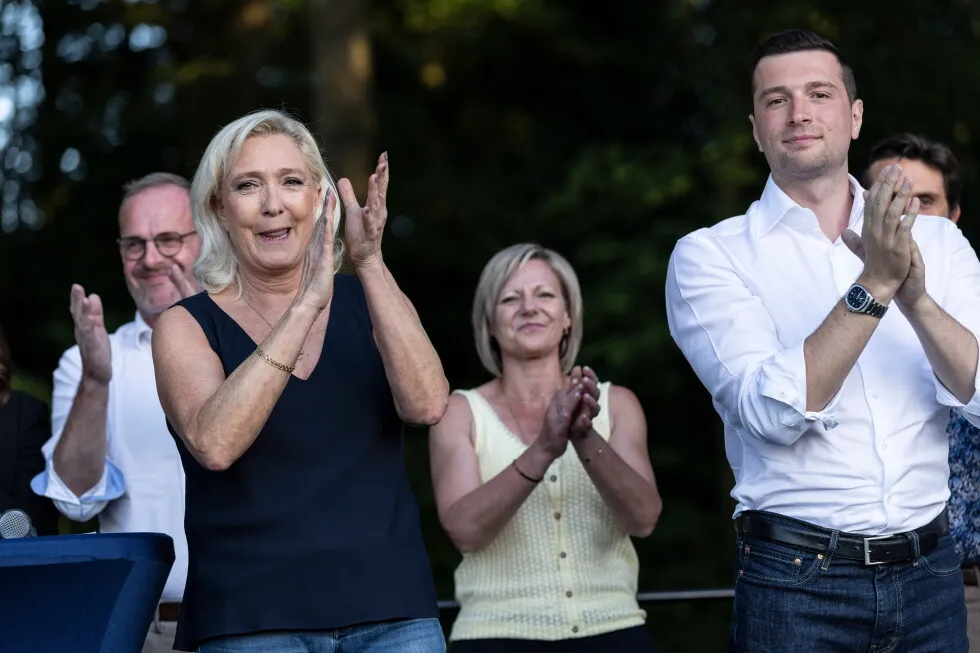
A timeline of Marine Le Pen’s political career and the rise of the French far right 1 of 3 | Far-right party National Rally president Jordan Bardella and far-right leader Marine Le Pen applaud during a rally in Lievin, northern France, Saturday, July 4, 2026. (AP Photo/Jean-Francois Badias) 2 of 3 | Far-right leader Marine Le Pen speaks during a rally in Lievin, northern France, Saturday, July 4, 2026. (AP Photo/Jean-Francois Badias) 3 of 3 | People wave French flags during a rally attended by far-right party National Rally president Jordan Bardella and far-right leader Marine Le Pen in Lievin, northern France, Saturday, July 4, 2026. (AP Photo/Jean-Francois Badias) By SYLVIE CORBET Updated 12:16 PM MESZ, July 6, 2026 Add AP News on Google Add AP News as your preferred source to see more of our stories on Google. Share Share Facebook Copy Link copied Print Email X LinkedIn Bluesky Flipboard Pinterest Reddit Paris (AP) — French far-right leader Marine Le Pen’s political fate is at stake Tuesday when a Paris appeals court is to rule on whether she may be barred to run in the 2027 presidential election. If not, Jordan Bardella, her 30-year-old protege and president of the National Rally party, would replace her on the ballot. Le Pen, 57, has challenged a March 2025 ruling that found her and other members of her National Rally party guilty of misusing European Parliament funds in the hiring of aides from 2004 to 2016. The aides allegedly worked for the party instead of doing parliamentary tasks. If convicted again, she could be sentenced to a ban on holding elected office or have to wear an electronic tag — or both — among other options. Here’s a look at key milestones in the careers of Le Pen and Bardella, and the transformation of the National Rally party into one of France’s major political forces: Marine Le Pen is born on Aug. 5 in Neuilly-sur-Seine, west of Paris, the youngest of three daughters of Jean-Marie Le Pen, who would later lead the far-right National Front party. Jean-Marie Le Pen founds the far-right National Front, building it around anti-immigration and nationalist policies. In the next decades, he repeatedly denies the Holocaust and is convicted multiple times of antisemitism, discrimination and inciting racial violence. What to know: Le Pen’s possible stand-in as presidential candidate is no carbon copy 4 MIN READ 1995: Bardella is born on Sept. 13 in Drancy, northeast of Paris. in France mainland’s poorest region. He grew up in public housing, the son of Italian and Algerian heritage. Jean-Marie Le Pen shocks France by reaching the presidential runoff, losing to Jacques Chirac in a landslide. The result marks the far right’s emergence as a key political force. Marine Le Pen succeeds her father as president of the National Front, launching a long-term effort to broaden the party’s appeal and distance it from its extremist image. She will expel her father from the party four years later after renewed controversial remarks. Marine Le Pen makes her first bid for the presidency, finishing third in the first round with nearly 18% of the vote. Bardella, then 17, joins the National Front. Marine Le Pen reaches the presidential runoff for the first time but loses to centrist contender Emmanuel Macron, who gets 66.1% of the votes, compared to her 33.9%. Bardella is one of the party’s spokespersons, becoming a familiar face on television. The National Front changes its name to National Rally, part of Le Pen’s effort to make the party more acceptable to mainstream voters. Bardella, now 23, leads the National Rally’s list in European Parliament elections. The party arrives ahead in France and he is elected MEP. He also becomes one of the party’s vice presidents. Le Pen reaches the presidential runoff for a second consecutive time, winning more than 41% of the vote against Macron — the strongest showing ever for France’s far right in that election. Bardella becomes president of the National Rally. The National Rally party emerges as the largest single force in Parliament’s powerful National Assembly, but falls short of an outright majority. On March 30, a Paris court convicts Le Pen and other National Rally officials of misusing European Parliament funds, sentences her to prison and bars her from seeking public office for five years with immediate effect. She appeals. The Paris Court of Appeal is to rule Tuesday on Le Pen’s appeal, a decision that could determine whether she remains eligible to run in France’s 2027 presidential election. The presidential election is scheduled on April 18 and May 2 to choose who will succeed Macron, who can’t stand for a third consecutive term. SYLVIE CORBET Corbet is an Associated Press reporter based in Paris. She covers French politics, diplomacy and defense as well as gender issues and breaking news. twitter
SRCAssociated Press (AP)
LANGEN
LEANCenter
WORDS804
ENT12
MON · 2026-07-06 · 10:23 GMTBRIEF NSR-2026-0706-90483
NSR-2026-0706-90483News Report·EN·Political Strategy
A timeline of Marine Le Pen’s political career and the rise of the French far right
A Paris appeals court is set to rule on Tuesday regarding French far-right leader Marine Le Pen's eligibility to run in the 2027 presidential election. Le Pen is appealing a March 2025 conviction for misusing European Parliament funds, which could result in a ban from holding office.
Associated Press (AP)Filed 2026-07-06 · 10:23 GMTLean · CenterRead · 4 min
Associated Press (AP)FIG 01
Reading time
4min
Word count
804words
Sources cited
0cited
Entities identified
12entities
Quality score
100%
§ 01
Briefing Summary
AI-generatedNEWSAR · AI
A Paris appeals court is set to rule on Tuesday regarding French far-right leader Marine Le Pen's eligibility to run in the 2027 presidential election. Le Pen is appealing a March 2025 conviction for misusing European Parliament funds, which could result in a ban from holding office. If she is barred, her protégé Jordan Bardella, president of the National Rally party, would likely replace her on the ballot. The article provides a timeline of Le Pen's career, including her father founding the National Front, her own leadership and presidential bids, and the party's rebranding to National Rally. It also highlights Bardella's rise within the party, culminating in his presidency. The National Rally has become a major political force in France, with Le Pen achieving strong showings in past presidential runoffs.
Confidence 0.90Claims 5Entities 12
§ 02
Article analysis
Model · rule-basedFraming
Political Strategy
Legal & Judicial
Tone
Measured
AI-assessed
CalmNeutralAlarmist
Factuality
0.80 / 1.00
Factual
LowHigh
Sources cited
0
No named sources
FewMany
§ 03
Key claims
5 extracted01
Marine Le Pen succeeded her father as president of the National Front and worked to broaden its appeal.
factual
Confidence
1.00
02
Jean-Marie Le Pen founded the far-right National Front party, building it around anti-immigration and nationalist policies.
factual
Confidence
1.00
03
Le Pen is challenging a March 2025 ruling that found her and other National Rally members guilty of misusing European Parliament funds.
factual
Confidence
1.00
04
If Le Pen is barred, Jordan Bardella would replace her on the ballot for the 2027 presidential election.
factual
Confidence
1.00
05
Marine Le Pen's political fate is at stake Tuesday when a Paris appeals court rules on whether she may be barred from running in the 2027 presidential election.
factual
Confidence
1.00
§ 04
Full report
4 min read · 804 words§ 05
Entities
12 identifiedKey playerOppositionContextPositiveNeutralNegative
People3
Organizations3
Locations5
§ 06
Keywords & salience
10 termsfrench far right
1.00
marine le pen
1.00
national rally
0.90
jordan bardella
0.80
presidential election
0.70
political career
0.60
misuse of funds
0.50
european parliament funds
0.50
anti-immigration policies
0.40
nationalist policies
0.40
§ 07
Topic connections
Interactive graph Network visualization showing 28 related topics
View Full Graph Person Organization Location Event|Click node to navigate|Edge numbers = shared articles