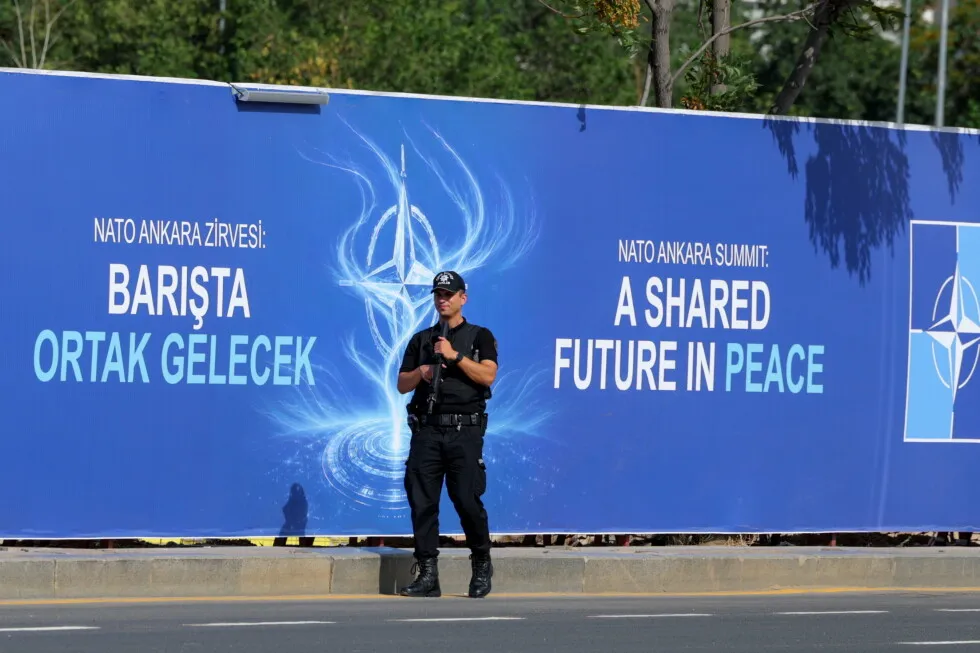
What to know about NATO’s summit in Turkey as America steps back from its defense of Europe 1 of 5 | Police patrol in front of a banner ahead of the NATO Summit in Ankara, Turkey, Sunday, July 5, 2026. (AP Photo/Riza Ozel) 2 of 5 | President Donald Trump meets with NATO Secretary General Mark Rutte in the Oval Office at the White House, Wednesday, June 24, 2026, in Washington. (AP Photo/Jacquelyn Martin) 3 of 5 | Poland’s Prime Minister Donald Tusk, center, French President Emmanuel Macron, right, and German Chancellor Friedrich Merz attend a press conference at the E5 NATO Summit in Berlin, Germany, Wednesday, June 24, 2026. (AP Photo/Ebrahim Noroozi) 4 of 5 | A protestor holds a sign, center, which reads “killer USA”, and another holds a sign, right, which reads “killer NATO out” during a demonstration ahead of the NATO Summit in Istanbul, Turkey, Sunday, July 5, 2026. (AP Photo/Erdem Sahin) 5 of 5 | Police hold up their shields as protestors from the People’s Liberation Party wave flags during a demonstration against the upcoming NATO Summit in Ankara, Turkey, Sunday, July 5, 2026. (AP Photo/Riza Ozel) By LORNE COOK Updated 3:30 AM MESZ, July 7, 2026 Add AP News on Google Add AP News as your preferred source to see more of our stories on Google. Share Share Facebook Copy Link copied Print Email X LinkedIn Bluesky Flipboard Pinterest Reddit ANKARA, Turkey (AP) — U.S. President Donald Trump and his NATO counterparts are gathering in Turkey on Tuesday for a two-day summit that comes at a turning point in the organization’s history as the United States steps back from its traditional security role in Europe. Ahead of the meeting in Ankara, Trump has insisted on “loyalty” after some NATO countries balked at allowing U.S. forces to use their bases for attacks on Iran. He listed big European members Britain, France, Germany, Italy and Spain for criticism. A NATO summit is a highly symbolic moment when the 32 member countries of the world’s biggest military alliance underline their unshakeable commitment to each other’s security. This year, though, the trans-Atlantic bond has rarely seemed more fragile. Still, the meeting is being organized around the theme of a stronger Europe in a stronger NATO. The Trump administration has called for a reboot to a “NATO 3.0,” and it’s hoped that what this really means will become clearer over the next two days. President Recep Tayyip Erdogan is hosting the summit at his vast Bestepe Presidential Compound on the western edge of the Turkish capital, Ankara. A new airport, converted from an old military airfield, has been unveiled especially to host NATO leaders. Security will be high. Air defenses are on alert, and tens of thousands of police will be on duty. Nearby neighborhoods are closed to traffic and some state workers have been given time off to help keep roads unclogged. Public gatherings are banned. More than a dozen people were detained in security sweeps ahead of the summit, including two journalists, the Turkish Journalists Association said. The family of a man shot by the Tennessee National Guard demands release of video 4 MIN READ 11 Trump says he’s building a White House helipad for a new, more powerful Marine One 4 MIN READ 210 UK sanctions Russian labs and people over chemical weapons used on Navalny and Skripal 1 MIN READ On Tuesday evening, Erdogan will host a dinner in his “Winter Garden.” Top officials from Japan, South Korea, Australia and New Zealand will join their NATO partners. Ukrainian President Volodymyr Zelenskyy is scheduled to attend. At they dinner, foreign ministers will hold a NATO Ukraine Council, while the alliance’s defense ministers will meet with their Indo-Pacific counterparts. A separate meeting with officials from Gulf Arab countries will also take place, and Trump will meet with Syrian President Ahmad al-Sharaa. NATO leaders alone will hold a single working session on Wednesday morning. They’ll publish a short statement summarizing the results of their meeting once it’s over. Defense spending, an industry boost and Ukraine support Officially topping the agenda is defense spending — a perennial issue at NATO as the U.S. presses allies to do more. Ahead of the summit, NATO Secretary-General Mark Rutte noted a 20% annual spending hike by European allies and Canada in 2025. This is unlikely to be enough to satisfy the Trump administration, even after the leaders agreed at their last summit to boost investment to the same level as the United States, in gross domestic product terms. The 2026 U.S. military budget is set at $901 billion, or about 3.3% of GDP. NATO also wants to highlight the way it’s converting the billions pouring in from state coffers into new military kit that’s adapted to modern warfare. The summit will be a chance for the organization to showcase new military projects. A defense industry forum will be held on the sidelines of the meeting, on Tuesday, bringing senior NATO and partner officials together with industry leaders, as allies push to ramp up weapons production and spur innovation in new technologies. Another top agenda item is continued support to Ukraine, now in a fifth year of full-scale war with Russia. European allies and Canada are funding most of Ukraine’s needs, including paying for about 90% of the country’s air defenses. The working session is only expected to last about three hours, but most debate is likely to focus on U.S. force levels in Europe and the off-agenda item of fallout from the U.S.-Israel war on Iran. European allies and Canada will want reassurances, or at least clarity, on U.S. force intentions. Since early last year, they have often been blindsided — and sometimes confounded — by Trump’s declarations on cutting troop numbers. Ahead of the summit, the Pentagon surprised the allies by announcing a 6-month review of the U.S. presence. It’s focused on progress Europe makes to defend itself, but also on whether the U.S. has full base access and overflight. NATO played no active role in the Iran war and has no overarching agreement with the United States on the shared use of bases and airspace, although some of its members do. At a public meeting with Rutte on June 24, Trump renewed his criticism of the allies for their reluctance to get involved in the war. “We don’t need their money — we don’t need anything,” he said. “I just want loyalty.” On joining NATO, member countries pledge loyalty equally to each other through a commitment to collective security — the all-for-one, one-for-all pledge enshrined in Article 5 of NATO’s treaty. That guarantee alone underpins everything the organization stands for and does. What further loyalty Trump might require is unclear.
SRCAssociated Press (AP)
LANGEN
LeanCenter
WORDS1,120
ENT12
TUE · 2026-07-07 · 01:53 GMTBRIEF NSR-2026-0707-90683
NSR-2026-0707-90683News Report·EN·Political Strategy
What to know about NATO’s summit in Turkey as America steps back from its defense of Europe
NATO leaders are convening in Ankara, Turkey, for a summit marked by the United States' perceived withdrawal from its traditional security role in Europe. President Trump is demanding "loyalty" from allies, particularly after some countries refused to allow U.S.
Associated Press (AP)Filed 2026-07-07 · 01:53 GMTLean · CenterRead · 5 min
Associated Press (AP)FIG 01
Reading time
5min
Word count
1,120words
Sources cited
0cited
Entities identified
12entities
NEWSAR · AI
NATO leaders are convening in Ankara, Turkey, for a summit marked by the United States' perceived withdrawal from its traditional security role in Europe. President Trump is demanding "loyalty" from allies, particularly after some countries refused to allow U.S. forces to use their bases for attacks on Iran. The summit's theme is a "stronger Europe in a stronger NATO," with discussions expected to focus on defense spending, industry boosts, and continued support for Ukraine. The U.S. is also reviewing its troop presence in Europe, contingent on European defense efforts and base access. The meeting aims to clarify the vision for a "NATO 3.0" and address the evolving trans-Atlantic bond.
Confidence 0.90Claims 5Entities 12
Framing
Political Strategy
Diplomatic
Tone
Measured
AI-assessed
CalmNeutralAlarmist
Factuality
0.70 / 1.00
Factual
LowHigh
Sources cited
0
No named sources
FewMany
01
President Trump has insisted on 'loyalty' from NATO countries regarding basing for attacks on Iran.
quoteU.S. President Donald Trump
Confidence
1.00
02
Security measures for the summit in Ankara include high alert air defenses and tens of thousands of police.
factual
Confidence
0.90
03
The NATO summit in Turkey is themed around a 'stronger Europe in a stronger NATO' and a 'NATO 3.0' reboot.
factual
Confidence
0.90
04
The U.S. is stepping back from its traditional security role in Europe, impacting NATO.
factual
Confidence
0.90
05
More than a dozen people, including two journalists, were detained in security sweeps ahead of the summit.
factual
Confidence
0.80
§ 04
Full report
5 min read · 1,120 wordsKey playerOppositionContextPositiveNeutralNegative
People5
Organizations1
nato summit
1.00
us defense europe
0.90
trans-atlantic bond
0.80
nato 3.0
0.70
security role
0.60
military alliance
0.50
loyalty
0.40
turkey
0.40
§ 07
Connections
Who appears together in the newsIn this articleWider coverageLine weight = articles in common
Laying out network…
Strongest ties articles in common
- 15,009
- 12,269
- 7,769
- 1,161
- 1,112
- 1,038
Recurring context not named in this article
- PVladimir Putinlinks 12
- LIsraellinks 12
- LEuropelinks 12
- OUnited Nationslinks 12
- PVolodymyr Zelenskyylinks 12
- LRussialinks 12
- OEuropean Unionlinks 12
- LUkrainelinks 12