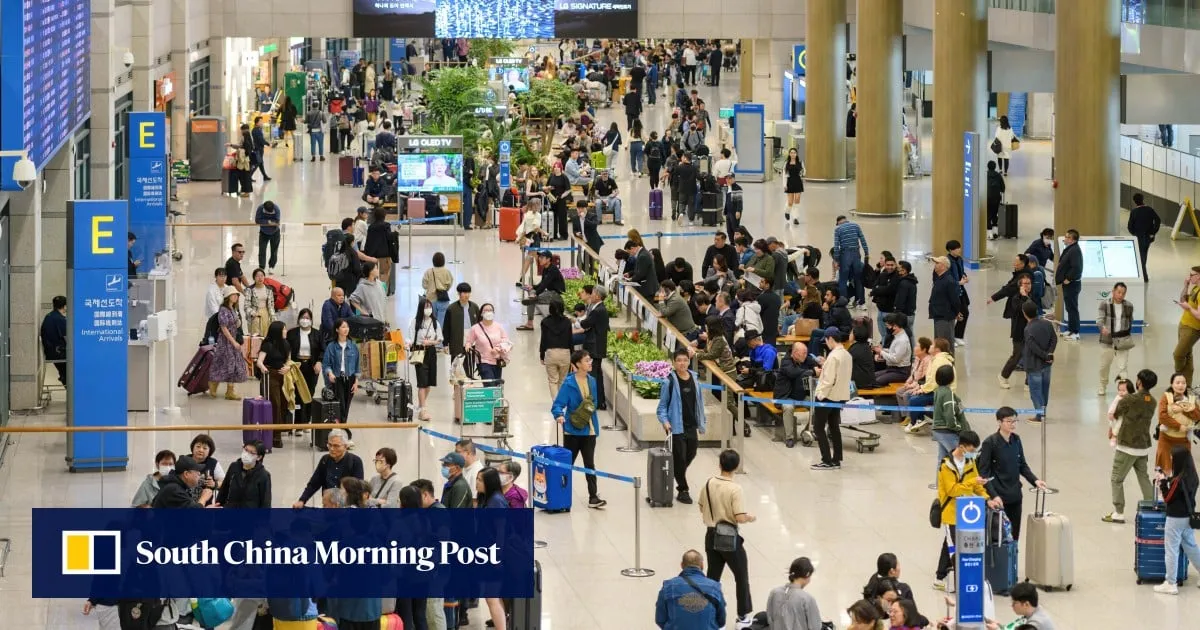
South Korea’s Incheon International Airport achieved a historic milestone in global aviation by recording 1 billion cumulative passengers in the shortest period among the world’s major hub airports, the airport operator said on Tuesday.According to Incheon International Airport Corp (IIAC), the airport crossed the 1 billion passenger mark just 25 years and three months after its opening in March 2001, outpacing all historic rival global hubs.Germany’s Munich Airport required 33 years and 10 months to hit the same metric, while Singapore’s Changi Airport took 35 years and five months. Japan’s Narita International Airport reached the milestone in 39 years and two months, and Dubai International Airport in the United Arab Emirates required 58 years and two months.For context, 1 billion passengers translates to an average of 108,000 travellers daily since the airport’s launch – or 4,513 passengers per hour and around 75 passengers every minute. This is equivalent to one out of every eight people on Earth having used the airport, or that every South Korean has travelled through the gateway roughly 19 times.Vehicles are parked at a long-term car park at Incheon International Airport on August 4, 2024. Photo: The Korea TimesTo commemorate the milestone, the IIAC held an official ceremony on Tuesday at the airport’s Terminal 2. The event was attended by IIAC’s acting President Kim Bum-ho and senior executives from Korean Air.During the ceremony, the airport presented its official 1 billionth passenger – a traveller boarding a flight from Korean Air bound for Tokyo – with a commemorative plaque and complimentary round-trip airline tickets.The IIAC executives also took the opportunity to express formal gratitude to the airport’s 94,000 employees for their years of operational dedication.Last year, Incheon processed 74.07 million international passengers and 2.95 million tonnes of international cargo. This performance solidifies its position as the world’s third-largest airport, according to the Airports Council International.Northeast Asian hubAnnual transfer passenger traffic reached 8.04 million, confirming the airport’s role as the pre-eminent transit hub absorbing long-haul connecting demand in Northeast Asia.The aviation network currently hosts 101 airlines serving 183 cities across 53 countries via passenger and cargo flights. Notably, Incheon offers 31 distinct routes to Japan, outperforming major Japanese domestic hubs such as Narita and Kansai, which operate 17 routes and 12 routes, respectively.In logistics, Incheon processes 99 per cent of South Korea’s total semiconductor exports by monetary value, anchoring the country’s hi-tech trade corridor.Leveraging this operational expertise, the IIAC has successfully exported its “K-airport” operational model overseas, securing 42 airport construction and management contracts across 18 countries, with a cumulative export value of 891.4 billion won (US$583 million).Further ReadingQualitatively, Incheon remains the only airport to win the Airport Service Quality award for 12 consecutive years from 2005 and has held the highest level of the Airports Council International Customer Experience Accreditation for four consecutive years from 2022.This scaling has been supported by timed infrastructure expansions. The completion of the massive Phase 4 construction project in November 2024 elevated total capacity to 106 million passengers annually.A Korean Air plane takes off from Incheon International Airport on April 1. Photo: Yonhap/EPA,This makes Incheon the third-largest air travel infrastructure globally by international capacity, positioning itself just behind Hong Kong’s 120 million and Dubai’s 115 million.Total capital expenditure for phases 1 through 4 reached 18.01 trillion won. The IIAC independently financed 82 per cent through corporate bond issuances and operational revenues, relying on the state treasury for only 18 per cent of funding. This self-financing framework makes Incheon a model for successful large-scale national infrastructure projects worldwide.As a state-owned enterprise, the IIAC has consistently aligned operations with major national events and public policy directives. The airport aided the 2018 Pyeongchang Winter Olympics through the timely opening of Terminal 2, and previously supported the 2002 Fifa World Cup.During the Covid-19 pandemic, the corporation absorbed a cumulative deficit of around 1.7 trillion won to roll out a 2.5 trillion won relief package. Its proactive quarantine measures received international coverage, showcasing South Korea’s infection control standards to global audiences.Building on the milestone, the IIAC plans to enhance intermodal transport connections between the airport and major domestic provinces. These initiatives aim to support the government’s target of attracting 30 million international tourists annually.“Incheon International Airport’s evolution into a premier global hub utilised by 1 billion travellers is a shared achievement driven by consistent government policy, public trust and the relentless efforts of our resident staff,” Kim said.“We will remain committed to ongoing facility investments and digital service innovations to maximise passenger convenience and drive the long-term competitiveness of the national aviation sector.”
SRCSouth China Morning Post
LANGEN
LEANCenter-Right
WORDS756
ENT12
TUE · 2026-07-07 · 07:33 GMTBRIEF NSR-2026-0707-90771
NSR-2026-0707-90771News Report·EN·Human Interest
South Korea’s Incheon airport hits 1 billion passengers in record-breaking time
South Korea's Incheon International Airport has reached a historic milestone, becoming the fastest major global hub to record 1 billion cumulative passengers since its opening in March 2001. This achievement took just 25 years and three months, surpassing rivals like Munich, Changi, Narita, and Dubai.
The Korea TimesSouth China Morning PostFiled 2026-07-07 · 07:33 GMTLean · Center-RightRead · 4 min
South China Morning PostFIG 01
Reading time
4min
Word count
756words
Sources cited
1cited
Entities identified
12entities
Quality score
100%
§ 01
Briefing Summary
AI-generatedNEWSAR · AI
South Korea's Incheon International Airport has reached a historic milestone, becoming the fastest major global hub to record 1 billion cumulative passengers since its opening in March 2001. This achievement took just 25 years and three months, surpassing rivals like Munich, Changi, Narita, and Dubai. The airport operator, Incheon International Airport Corp (IIAC), celebrated this accomplishment with a ceremony and recognized its employees. Incheon is a significant Northeast Asian transit hub, handling substantial international passenger and cargo traffic, and plays a crucial role in South Korea's hi-tech trade. The airport's success is attributed to strategic infrastructure expansions, a strong self-financing model, and its alignment with national events and public policy.
Confidence 0.90Sources 1Claims 5Entities 12
§ 02
Article analysis
Model · rule-basedFraming
Human Interest
Economic Impact
Tone
Measured
AI-assessed
CalmNeutralAlarmist
Factuality
0.90 / 1.00
Factual
LowHigh
Sources cited
1
Limited
FewMany
§ 03
Key claims
5 extracted01
Incheon Airport is the world's third-largest airport according to the Airports Council International.
statisticAirports Council International
Confidence
1.00
02
The IIAC has secured 42 airport construction and management contracts across 18 countries, valued at 891.4 billion won (US$583 million).
statisticIncheon International Airport Corp (IIAC)
Confidence
1.00
03
Incheon Airport processes 99% of South Korea's total semiconductor exports by monetary value.
statisticarticle
Confidence
1.00
04
Incheon processed 74.07 million international passengers and 2.95 million tonnes of international cargo last year.
statisticIncheon International Airport Corp (IIAC)
Confidence
1.00
05
Incheon International Airport reached 1 billion cumulative passengers in 25 years and 3 months, a record for major global hub airports.
statisticIncheon International Airport Corp (IIAC)
Confidence
1.00
§ 04
Full report
4 min read · 756 words§ 05
Entities
12 identifiedKey playerOppositionContextPositiveNeutralNegative
Organizations2
Locations10
II
Incheon International Airport
CityKey Player
8x
100
SK
South Korea
CountryContext
4x
90
CA
Changi Airport
CityContext
70
NI
Narita International Airport
StrategicContext
2x
70
DI
Dubai International Airport
StrategicContext
70
MA
Munich Airport
StrategicContext
70
UA
United Arab Emirates
CountryContext
60
J
Japan
CountryContext
2x
60
G
Germany
CountryContext
60
S
Singapore
CountryContext
60
§ 06
Keywords & salience
9 terms1 billion passengers
1.00
incheon international airport
1.00
global aviation
0.90
record-breaking time
0.80
hub airports
0.70
northeast asian hub
0.60
transit hub
0.50
airport operator
0.40
international cargo
0.40
§ 07
Topic connections
Interactive graph No topic relationship data available yet. This graph will appear once topic relationships have been computed.