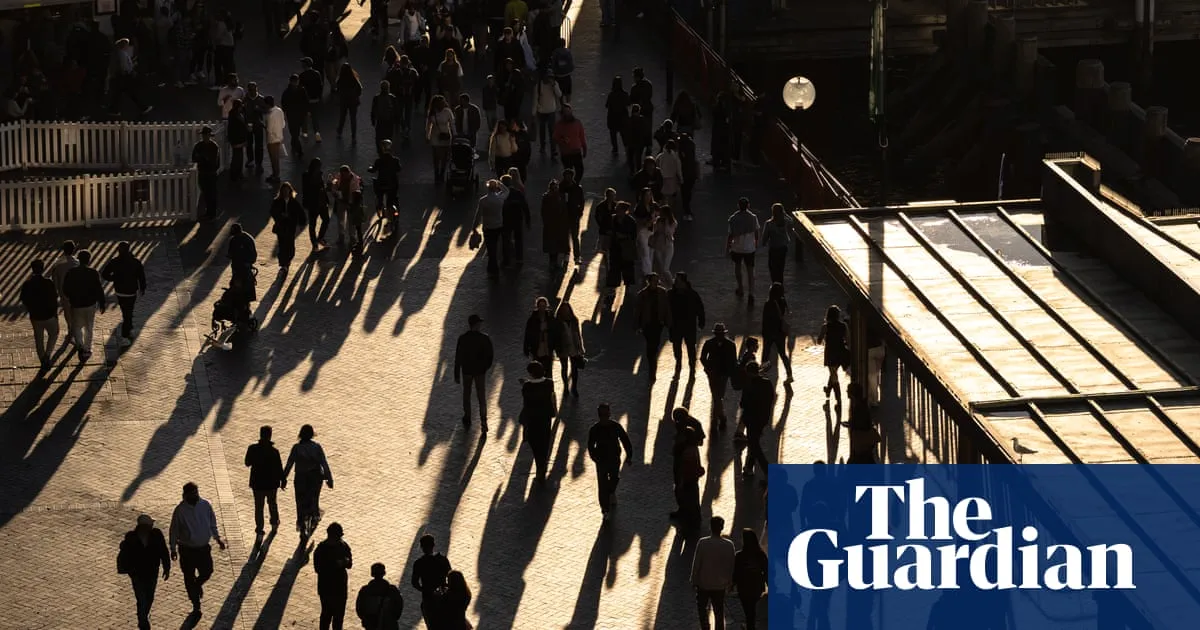
Consumer confidence is at around a 50-year low as many Australians struggle to cope with higher prices after years of above-average Inflation. Photograph: @ Didier Marti/Getty Images View image in fullscreen Consumer confidence is at around a 50-year low as many Australians struggle to cope with higher prices after years of above-average Inflation. Photograph: @ Didier Marti/Getty Images Recession off the cards but Australia faces dreary outlook, economists say De-escalation of war in the Middle East has lowered Oil Prices and eased fears of economic downturn but households are still feeling the pinch Get our breaking news email, free app or daily news podcast Fears of a Recession have fallen away, with economists saying that Australia is set to safely navigate the biggest global oil supply shock in history even as they warn of sub-standard growth in the year ahead. The de-escalation of the Middle East conflict has been accompanied by a major retreat in global Oil Prices back to prewar levels, essentially removing the worst-case scenarios contemplated before Donald Trump’s wobbly ceasefire with Iran was announced in mid-June. Belinda Allen, CBA’s head of Australian economics, said she had never thought a Recession was likely, but that “the impact of the war on energy markets and the economy were less severe than we had anticipated”. “Oil Prices did not rise as much, and the cut to the excise tax blunted the impact on households.” After spiking as high as $US120 a barrel, global Oil Prices have now steadied at about $US72 a barrel, and CBA analysts see them dropping to $US60 by the end of this year – even as they recognise the high risk that the war flares up and again strangles traffic through the Strait of Hormuz. While high Inflation remains a major threat, it is falling – and at about 4% is well down on the May budget’s forecast peak of 5%. Unemployment is up only slightly over the past three months at 4.4%. “We think no more [Reserve Bank] interest rate hikes are needed, but we still see some lingering risks there,” Allen said. A major downturn may have been averted, but Tim Robinson, an associate professor at the Melbourne Institute of Applied Economic and Social Research, warned GDP per person was set to contract for two straight quarters. “Growth is likely to be quite weak for the rest of the year, and because of that, a per capita Recession is likely,” Robinson said. “They [per capita recessions] are not as severe as a conventional Recession – the changes in unemployment tend to be far less severe – but they do constitute a decline in living standards.” Stephen Smith, a partner at Deloitte Access Economics, said his firm had rarely had such a pessimistic outlook for the country’s near term economic trajectory. That pessimism is mirrored among households, where consumer confidence is at around a 50-year low as many Australians struggle to cope with substantially higher prices after years of above-average Inflation. 2:38 $5.4 trillion will soon be inherited in Australia. What does this mean for equality? – video “At the same time, the three interest rate increases so far in 2026 mean that households with an average-sized mortgage have needed to find an additional $350 per month to meet higher repayments,” Smith said – warning the RBA could hike again next month. Falling house prices in some parts of the country, most notably Sydney and Melbourne, are also weighing on sentiment and making Australians less likely to spend. While Allen also sees weak growth this year, “the good news is that 2027 looks a little better”, she said – in no small part due to an expected two interest rate cuts and the ongoing boom in the construction of datacentres. “Clearly that [datacentre building] is being constrained by capacity and energy demand requirements, but it will still add to the economy next year and the year after.” Beyond that, the threats and opportunities of artificial intelligence loom as a gamechanger for the Australian economy from late 2028, said Allen, who was hopeful the technology could prove the antidote to Australia’s weak productivity. “By the time we get to 2028 we start to see these really interesting structural shifts. There’s a lot of defence investment to come, but also NDIS cuts and a lot of uncertainty whether the two largely offset each other.” Explore more on these topics Australian economy Australian politics Economics Business (Australia news) news Share Reuse this content
SRCThe Guardian - World News
LANGEN
LEANCenter-Left
WORDS745
ENT12
TUE · 2026-07-07 · 15:00 GMTBRIEF NSR-2026-0707-90887
NSR-2026-0707-90887News Report·EN·Economic Impact
Recession off the cards but Australia faces dreary outlook, economists say
Economists believe Australia will avoid a recession despite a dreary economic outlook for the coming year. The de-escalation of the Middle East conflict has lowered global oil prices, mitigating fears of a significant economic downturn.
Patrick Commins Economics editorThe Guardian - World NewsFiled 2026-07-07 · 15:00 GMTLean · Center-LeftRead · 3 min
The Guardian - World NewsFIG 01
Reading time
3min
Word count
745words
Sources cited
3cited
Entities identified
12entities
Quality score
100%
§ 01
Briefing Summary
AI-generatedNEWSAR · AI
Economists believe Australia will avoid a recession despite a dreary economic outlook for the coming year. The de-escalation of the Middle East conflict has lowered global oil prices, mitigating fears of a significant economic downturn. While a full recession is unlikely, a contraction in GDP per person is anticipated due to weak growth. Households are experiencing low consumer confidence, struggling with high prices and increased mortgage repayments following several interest rate hikes. Falling house prices in some areas are also impacting sentiment and spending. Economists foresee sub-standard growth for the remainder of the year, though some positive developments are expected in 2027, including potential interest rate cuts and a boom in datacentre construction.
Confidence 0.90Sources 3Claims 5Entities 12
§ 02
Article analysis
Model · rule-basedFraming
Economic Impact
Conflict
Tone
Measured
AI-assessed
CalmNeutralAlarmist
Factuality
0.60 / 1.00
Mixed
LowHigh
Sources cited
3
Well sourced
FewMany
§ 03
Key claims
5 extracted01
Inflation is falling and is at about 4%, down from a forecast peak of 5%.
statistic
Confidence
0.90
02
Global oil prices have retreated to about $US72 a barrel from a spike as high as $US120 a barrel.
statistic
Confidence
0.90
03
Consumer confidence is at around a 50-year low as many Australians struggle to cope with higher prices after years of above-average inflation.
statistic
Confidence
0.90
04
GDP per person is set to contract for two straight quarters, indicating a per capita recession.
predictionTim Robinson
Confidence
0.80
05
Fears of a recession have fallen away, with economists saying Australia is set to safely navigate the biggest global oil supply shock in history.
predictioneconomists
Confidence
0.70
§ 04
Full report
3 min read · 745 words§ 05
Entities
12 identifiedKey playerOppositionContextPositiveNeutralNegative
Organizations2
Locations4
§ 06
Keywords & salience
9 termseconomic outlook
1.00
inflation
0.90
consumer confidence
0.80
recession
0.70
economic growth
0.60
oil prices
0.60
middle east conflict
0.50
interest rates
0.40
gdp per person
0.40
§ 07
Topic connections
Interactive graph Network visualization showing 51 related topics
View Full Graph Person Organization Location Event|Click node to navigate|Edge numbers = shared articles