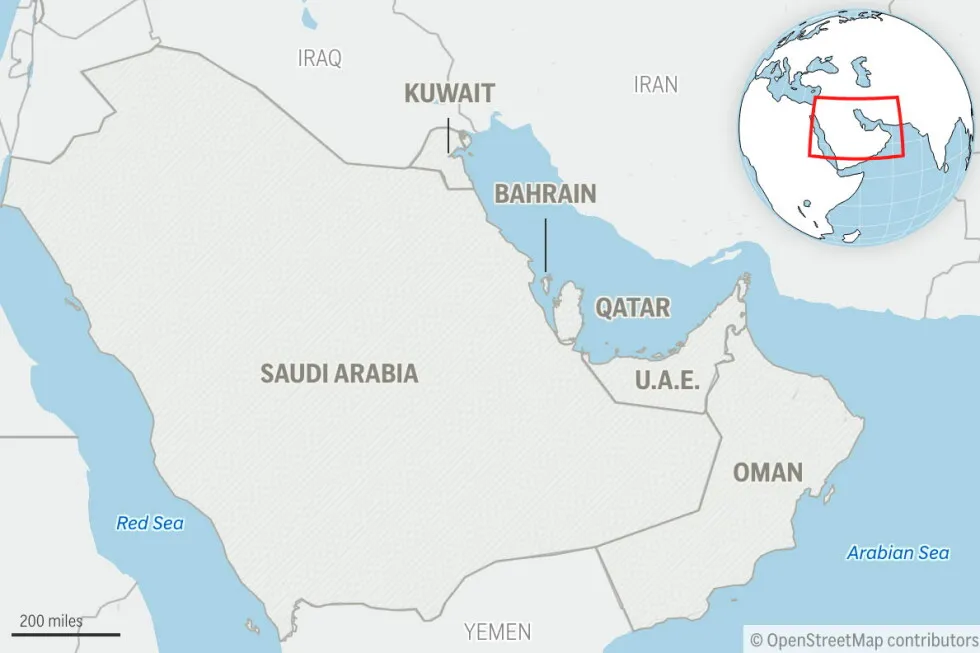
US launches strikes on Iran after 3 ships attacked in Strait of Hormuz; Bahrain and Kuwait targeted 0 seconds of 24 secondsVolume 0% Press shift question mark to access a list of keyboard shortcuts Keyboard ShortcutsEnabledDisabled Shortcuts Open/Close/ or ? Play/PauseSPACE Increase Volume↑ Decrease Volume↓ Seek Forward→ Seek Backward← Captions On/Offc Fullscreen/Exit Fullscreenf Mute/Unmutem Decrease Caption Size- Increase Caption Size+ or = Seek %0-9 Next Up Coffin of late Supreme Leader Khamenei paraded through Tehran 01:07 00:00 00:24 00:24 More Videos 01:07 Coffin of late Supreme Leader Khamenei paraded through Tehran 00:55 Mourners at Khamenei funeral procession in Tehran vow 'revenge' 00:52 AP Top Stories July 3 00:57 Dayslong funeral for late Supreme Leader Khamenei begins in Iran 00:48 Hemingway's 'The Sun Also Rises' still inspires Americans to run with the bulls 00:43 Sons of late Iran Supreme Leader Khamenei among mourners at his funeral 00:55 AP Top Stories July 7 00:58 Orbs on Australia beach could be part of space launch vehicle Close 1 of 4 | The U.S. military attacked Iran early Wednesday after it said Tehran struck three ships in the Strait of Hormuz, part of an American effort that also revoked the Islamic Republic’s ability to openly sell crude oil in the world market. More Videos 0 seconds of 1 minute, 14 secondsVolume 90% Press shift question mark to access a list of keyboard shortcuts Keyboard ShortcutsEnabledDisabled Shortcuts Open/Close/ or ? Play/PauseSPACE Increase Volume↑ Decrease Volume↓ Seek Forward→ Seek Backward← Captions On/Offc Fullscreen/Exit Fullscreenf Mute/Unmutem Decrease Caption Size- Increase Caption Size+ or = Seek %0-9 Next Up Sons of late Iran Supreme Leader Khamenei among mourners at his funeral 00:43 Auto1080p1080p720p540p360p270p180p 00:00 01:14 01:14 More Videos Close 2 of 4 | An official funeral ceremony was held Tuesday night for Iran’s late Supreme Leader Ayatollah Ali Khamenei at Najaf-international-airport" class="entity-link entity-location" data-entity-id="160886" data-entity-type="location">Najaf International Airport in Iraq. 3 of 4 | An Iraqi Shiite soldier chants on the eve of funeral ceremonies for the late Iranian Supreme Leader Ayatollah Ali Khamenei outside the Imam Ali Shrine in Najaf, Iraq, Tuesday, July 7, 2026. (AP Photo/Hadi Mizban) 4 of 4 | In this photo released by Iran’s Supreme Leader’s office, mourners carry the coffin of the late Iranian Supreme Leader Ayatollah Ali Khamenei during funeral prayers held as part of the dayslong funeral ceremonies at the Holy Jamkaran Mosque in Qom, Iran, Tuesday, July 7, 2026. (Office of the Iranian Supreme Leader via AP) By JON GAMBRELL Updated 5:37 AM MESZ, July 8, 2026 Add AP News on Google Add AP News as your preferred source to see more of our stories on Google. Share Share Facebook Copy Link copied Print Email X LinkedIn Bluesky Flipboard Pinterest Reddit DUBAI, United Arab Emirates (AP) — The U.S. military attacked Iran early Wednesday after it said Tehran struck three ships in the Strait of Hormuz, part of an American effort that also revoked the Islamic Republic’s ability to openly sell crude oil in the world market. Iran apparently retaliated with strikes targeting Bahrain and Kuwait. Iran immediately warned Washington it would “take whatever measures it deems necessary,” raising the risks that an interim agreement to halt fighting in the war could break down, putting the Middle East again at risk of a wider conflict. Both Bahrain, home to the U.S. Navy’s 5th Fleet, and Kuwait, home to U.S. Army forces, sounded missile alerts Wednesday morning after the American attack on Iran. The attacks on shipping and the resulting strikes on Iran came during the dayslong funeral for Iran’s Supreme Leader Ayatollah Ali Khamenei, who was killed Feb. 28 in the war’s first moments at age 86. The funeral, which ends Thursday, had been thought to be a period of lower tensions — though mourners have repeatedly called for the killings of U.S. President Donald Trump and Israeli Prime Minister Benjamin Netanyahu. Negotiations to reach a final deal had been due to start after Khamenei’s burial and focus on the toughest matters, including fully reopening the strait and rolling back Tehran’s disputed nuclear program. But the new attacks threw that into question. “The era of bullying and extortion is over,” Iran’s Parliament Speaker Mohammad Bagher Qalibaf wrote on X. “It leads nowhere. We don’t fold.” The NATO summit was supposed to focus on defense spending. Trump’s strikes on Iran changed that 4 MIN READ US airlines’ monthly fuel spending topped $6 billion again in May, up 84% from year ago 1 MIN READ Lawsuit says US illegally shared confidential information on Iranian asylum seekers with Iran 4 MIN READ 116 Overnight US strikes target Iran The U.S. military’s Central Command said American forces launched the strikes “to impose heavy costs for targeting and attacking commercial shipping crewed by innocent civilians in an international waterway.” It said it hit Iranian targets including air defense systems, radars and over 60 small boats used by Iran’s paramilitary Revolutionary Guard. Those boats have been key in harassing ships in the strait. The U.S. military remains “postured and prepared to hold Iran accountable when the agreement is not adhered to or obeyed,” it added, saying this round of attacks had ended. Iran acknowledged the strikes, but offered no word on any losses. Iranian state media reported the sound of explosions in Bandar Abbas, Qeshm and Sirik. Iran’s central military command warned it “will respond decisively to this aggression and terrorist act.” “Under no circumstances will (the Iranian armed forces) allow interference in the affairs of the Strait of Hormuz, nor will they permit others to manage it,” it said. A similar spate of Iranian attacks on shipping and U.S. retaliatory strikes occurred late last month — which similarly drew Iranian attacks on Bahrain and Kuwait. Wednesday’s strikes also came as Trump was in Turkey for a summit of the NATO military alliance. The U.S. also revoked a license that authorized the sale of Iranian oil as part of the interim deal. That had allowed Iran for the first time in years to conduct oil sales openly on the international market for U.S. dollars. Iran long had been suspected of selling sanctioned crude oil at below-market prices to China. The decision came after the strikes on shipping. One tanker was traveling off the coast of Oman when it was hit and caught fire, the United Kingdom Maritime Trade Operations center said. Iranian state television said the liquefied natural gas tanker came under attack after ignoring warnings but did not directly claim the assault. The other two ships sustained some damage, but no one was injured, and both continued on their way in the Strait of Hormuz, the U.K. maritime agency said. Iran has maintained a chokehold on the Strait of Hormuz since the war, disrupting global energy markets as a fifth of all traded oil and natural gas passed through the channel in peacetime. The ships attacked Tuesday all appeared to be using a route close to Oman’s shore, rather than one ordered by Tehran. Tehran repeatedly has declared that only its approved route through the strait is safe and is suspected of attacking other ships that have used the Oman route. Majed al-Ansari, a spokesperson for the Qatari Foreign Ministry, said the Qatari tanker Al Rekayyat was targeted in an “unacceptable attack” on international navigation and global energy security. He said Qatar holds Iran “fully legally responsible.” Iran and the United States agreed as part of the interim deal to allow ships to pass without paying charges for 60 days. But Tehran insisted it must control the vessels’ routes and later charge fees for passage, which would upend decades of practice in the waterway. The U.S. and many Gulf Arab states say they will not agree to Iran charging for passage through the strait. JON GAMBRELL Gambrell is the news director for the Gulf and Iran for The Associated Press. He has reported from each of the Gulf Cooperation Council countries, Iran and other locations across the world since joining the AP in 2006. twitter instagram mailto
SRCAssociated Press (AP)
LANGEN
LEANCenter
WORDS1 328
ENT12
WED · 2026-07-08 · 03:23 GMTBRIEF NSR-2026-0708-91056
NSR-2026-0708-91056News Report·EN·Conflict
Kuwait and Bahrain face incoming missiles after US strikes on Iran
Following U.S. airstrikes on Iran, Kuwait and Bahrain reported incoming missile threats on Wednesday morning, with Kuwait's air defenses engaged.
Associated Press (AP)Filed 2026-07-08 · 03:23 GMTLean · CenterRead · 6 min
Associated Press (AP)FIG 01
Reading time
6min
Word count
1 328words
Sources cited
1cited
Entities identified
12entities
Quality score
100%
§ 01
Briefing Summary
AI-generatedNEWSAR · AI
Following U.S. airstrikes on Iran, Kuwait and Bahrain reported incoming missile threats on Wednesday morning, with Kuwait's air defenses engaged. These events occurred after the U.S. stated Iran attacked three ships in the Strait of Hormuz. The U.S. Central Command stated the strikes were to impose costs for targeting commercial shipping. Iran warned of necessary measures, potentially jeopardizing an interim peace agreement. These developments unfolded during the funeral for Iran's late Supreme Leader Ayatollah Ali Khamenei, with mourners calling for revenge. The escalating tensions cast doubt on upcoming negotiations concerning the strait and Iran's nuclear program.
Confidence 0.90Sources 1Claims 4Entities 12
§ 02
Article analysis
Model · rule-basedFraming
Conflict
National Security
Tone
Mixed Tone
AI-assessed
CalmNeutralAlarmist
Factuality
0.80 / 1.00
Factual
LowHigh
Sources cited
1
Limited
FewMany
§ 03
Key claims
4 extracted01
Funeral ceremonies were held for Iran's late Supreme Leader Ayatollah Ali Khamenei in Iraq and Iran.
factualarticle
Confidence
1.00
02
The U.S. military attacked Iran after Tehran allegedly struck three ships in the Strait of Hormuz.
factualU.S. military
Confidence
0.90
03
The U.S. effort revoked Iran's ability to openly sell crude oil.
factualarticle
Confidence
0.80
04
Kuwait and Bahrain faced incoming missiles following U.S. strikes on Iran.
factualarticle
Confidence
0.70
§ 04
Full report
6 min read · 1 328 words§ 05
Entities
12 identifiedKey playerOppositionContextPositiveNeutralNegative
Locations11
I
Iran
CountryOpposition
6x
90
US
United States
CountryKey Player
3x
90
SO
Strait of Hormuz
StrategicContext
2x
80
B
Bahrain
CountryContext
2x
70
K
Kuwait
CountryContext
2x
70
NI
Najaf International Airport
CityContext
40
HJ
Holy Jamkaran Mosque
CityContext
30
Q
Qom
CityContext
30
N
Najaf
CityContext
30
T
Tehran
CityContext
30
IA
Imam Ali Shrine
CityContext
30
§ 06
Keywords & salience
8 termsus strikes on iran
1.00
strait of hormuz
0.90
kuwait
0.80
bahrain
0.80
incoming missiles
0.70
iran crude oil sales
0.60
ayatollah ali khamenei
0.50
funeral ceremonies
0.40
§ 07
Topic connections
Interactive graph Network visualization showing 51 related topics
View Full Graph Person Organization Location Event|Click node to navigate|Edge numbers = shared articles