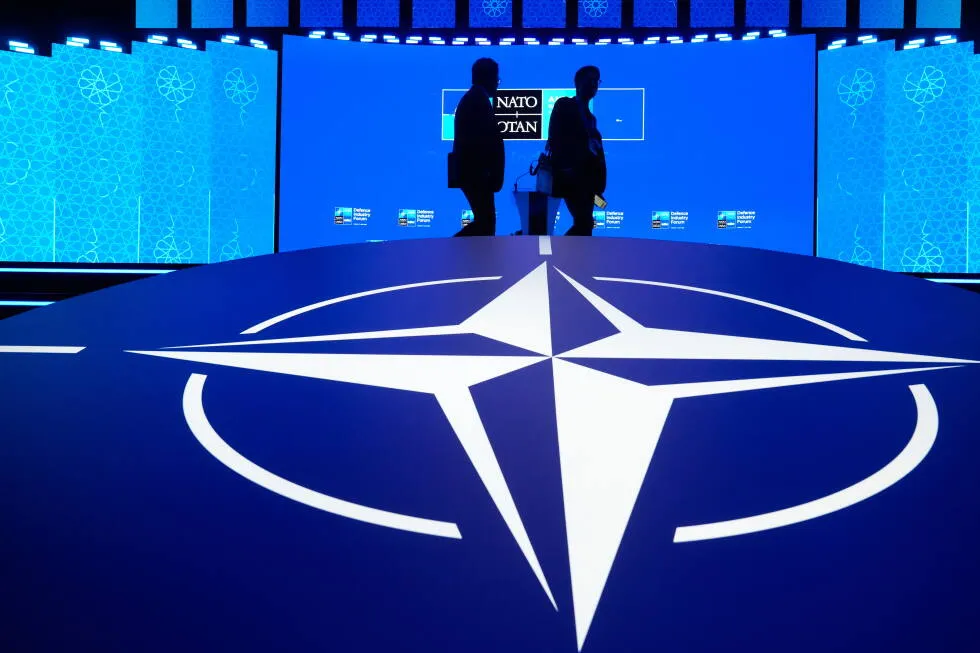
The NATO summit was supposed to focus on defense spending. Trump’s Iran" class="entity-link entity-event" data-entity-id="160885" data-entity-type="event">strikes on Iran changed that 1 of 5 | Two men walk past the NATO logo during the NATO Defense Industry Forum at the NATO summit in Ankara, Turkey, Tuesday, July 7, 2026. (AP Photo/Hussein Malla) 2 of 5 | President Donald Trump shakes hands with Turkish President Recep Tayyip Erdogan at the Bestepe Presidential Palace during a formal welcome for the NATO summit in Ankara, Turkey, Tuesday, July 7, 2026.(AP Photo/Alex Brandon) 3 of 5 | NATO Secretary General Mark Rutte speaks at the opening of the NATO Defense Industry Forum on the sidelines of the NATO summit in Ankara, Turkey, Tuesday, July 7, 2026. (AP Photo/Hussein Malla) 4 of 5 | NATO Secretary General Mark Rutte, center, poses with NATO defense ministers and industry representatives during the opening of the NATO Defense Industry Forum on the sidelines of the NATO summit in Ankara, Turkey, Tuesday, July 7, 2026. (AP Photo/Hussein Malla) 5 of 5 | Ukraine’s President Volodymyr Zelenskyy looks out from his car window as he arrives for the NATO Summit in Ankara, Turkey, Tuesday, July 7, 2026. (Metin Aktaş, Pool Photo via AP) By LORNE COOK and SEUNG MIN KIM Updated 4:56 AM MESZ, July 8, 2026 Add AP News on Google Add AP News as your preferred source to see more of our stories on Google. Share Share Facebook Copy Link copied Print Email X LinkedIn Bluesky Flipboard Pinterest Reddit ANKARA, Turkey (AP) — President Donald Trump surprised NATO leaders he is meeting with in Turkey by launching a series of Iran" class="entity-link entity-event" data-entity-id="160885" data-entity-type="event">strikes on Iran late Tuesday and revoking a license that allowed Tehran to sell its oil on the world market, a major twist for a summit that had been aimed at showcasing how alliance members were stepping up spending on defense and focusing on support for Ukraine’s war with Russia. The strikes were retaliation after three merchant ships were struck in the Strait of Hormuz, and underscored the fragility of an interim deal to end months of fighting between the two countries. Trump launched the attacks shortly after leaving a dinner hosted by Turkish President Recep Tayyip Erdogan where the leaders of the alliance’s 32 member countries had gathered ahead of Wednesday’s talks meant to focus on progress made toward meeting NATO’s spending targets. Trump did not directly address the strikes Tuesday night. It is rare for U.S. presidents to launch military action while outside the U.S., though in 2011 former President Barack Obama authorized strikes in Libya while on a trip to Brazil. US launches Iran" class="entity-link entity-event" data-entity-id="160885" data-entity-type="event">strikes on Iran after 3 ships attacked in Strait of Hormuz; Bahrain and Kuwait targeted 3 MIN READ ABC fights back against FCC regulators in dispute over ‘The View’ and equal time rules 3 MIN READ 21 Immigration agent fatally shot a man in Houston during an enforcement operation 4 MIN READ 93 European allies and Canada had been wary that Trump might raise fresh grievances over the U.S.-Israeli war on Iran, which they were never consulted about. Trump had demanded “loyalty” and branded NATO a “paper tiger” after some allies refused to grant open access to their bases for U.S. forces to attack Iran. On Tuesday, during a meeting with Erdogan, Trump said he had been testing NATO allies when he asked for their help with the Iran war. “Italy turned us down and Germany turned us down and France turned us down,” Trump said. “And that’s OK. But, you know, why are we spending hundreds of billions of dollars and they’re not there for us?” NATO leaders had been trying to show Trump how they were boosting defense NATO summits are designed to be a show of unity aimed at deterring any potential adversary — a resolve more important than ever as Russia continues to wage war on Ukraine, and concerns mount that other European countries could be targeted. In an attempt last month to mollify the U.S. leader, NATO Secretary-General Mark Rutte went to Washington to hail the “Trump Trillion” — the $1.2 trillion that European allies and Canada have added to defense spending since Trump came to power in 2017. As leaders converged on Ankara, Rutte hosted a “big reveal” event to showcase the many deals planned for that money — much of it to be spent on U.S. companies, creating thousands of jobs for Americans. NATO diplomats and officials had hoped that Trump would take the win, but judging by some of his remarks since arriving in Turkey, they are in for yet another dressing down. Trump reopened old wounds over Greenland on the eve of the meeting by insisting that the United States should control the semiautonomous island rather than NATO ally Denmark. NATO is founded on the principle that its 32 members will defend each others’ territory, not threaten to seize it. Trump has long argued that the U.S. carries more than its fair share of the defense burden for NATO. At last year’s summit, the allies had agreed to invest 5% of their gross domestic product on defense — 3.5% on their defense budgets and 1.5% on roads, bridges and ports so troops and equipment can move faster in times of conflict. Rutte had demanded ahead of this year’s meeting that members put forward “clear, concrete and credible plans” to reach the organization’s defense spending targets. New figures released by NATO on Tuesday showed that Slovenia, Belgium, Spain and the Czech Republic could be in hot water with the Trump administration as they struggle to meet the alliance’s old target of investing 2% of their GDP. The Trump administration wants to see a more lean and lethal “NATO 3.0,” with Europe taking responsibility for its own security, including Ukraine, with conventional weapons while America would continue to provide its nuclear umbrella. However, European allies and Canada are still seeking clarity on just how deeply Trump intends to cut U.S. force numbers in Europe. The Pentagon has launched a 6-month review of that presence and the drawdowns could depend on how fast the European allies increase defense spending and whether they are prepared to allow greater use of their bases. President Volodymyr Zelenskyy made a fresh appeal Tuesday for Ukraine to be allowed to join the alliance, saying Ukrainian armed forces are highly experienced and would only boost NATO’s defense capabilities. Zelenskyy, who is expected to meet with Trump in Ankara on Wednesday, highlighted Ukraine’s adaptability and its ability to strike deep inside Russia, hit Moscow’s oil refineries and other energy targets. He said Ukraine’s armed forces are “eliminating” on average 30,000 Russian troops every month. Concern has been mounting among some northern, central and eastern European countries that Russia might be preparing a hybrid attack — a combination of conventional warfare with tactics like cyberattacks — on the continent as Russian President Vladimir Putin struggles to secure victory in Ukraine. Trump will also meet with Syrian President Ahmad al-Sharaa, a former insurgent who led the offensive that unseated autocrat Bashar Assad in December 2024. Despite having once been an al-Qaida fighter, al-Sharaa has won Trump’s backing as he seeks to rebuild Syria and restore its long-shattered ties with the West. Trump has repeatedly suggested that al-Sharaa would do a better job of rooting out Hezbollah in Lebanon than the Israeli army, raising alarms in Lebanon and Israel alike. The Syrian leader has said he has no interest in doing so. SEUNG MIN KIM Kim covers the White House for The Associated Press. She joined the AP in 2022 and is based in Washington. Kim is also a political analyst for CNN. twitter mailto
SRCAssociated Press (AP)
LANGEN
LEANCenter
WORDS1 274
ENT12
WED · 2026-07-08 · 03:23 GMTBRIEF NSR-2026-0708-91057
NSR-2026-0708-91057News Report·EN·Conflict
The NATO summit was supposed to focus on defense spending. Trump’s strikes on Iran changed that
President Donald Trump unexpectedly launched strikes on Iran and revoked oil export licenses during a NATO summit in Turkey. The summit, intended to focus on increased defense spending and support for Ukraine, was overshadowed by these actions.
Associated Press (AP)Filed 2026-07-08 · 03:23 GMTLean · CenterRead · 6 min
Associated Press (AP)FIG 01
Reading time
6min
Word count
1 274words
Sources cited
3cited
Entities identified
12entities
Quality score
100%
§ 01
Briefing Summary
AI-generatedNEWSAR · AI
President Donald Trump unexpectedly launched strikes on Iran and revoked oil export licenses during a NATO summit in Turkey. The summit, intended to focus on increased defense spending and support for Ukraine, was overshadowed by these actions. The strikes were a retaliation for attacks on three merchant ships in the Strait of Hormuz. European allies expressed concern about Trump's unilateral actions and his past criticisms of NATO. Despite efforts by NATO leaders to highlight increased defense investments, Trump also raised grievances about defense burdens and territorial claims, including Greenland. Ukrainian President Volodymyr Zelenskyy used the summit to reiterate his appeal for Ukraine's NATO membership.
Confidence 0.90Sources 3Claims 5Entities 12
§ 02
Article analysis
Model · rule-basedFraming
Conflict
Diplomatic
Tone
Mixed Tone
AI-assessed
CalmNeutralAlarmist
Factuality
0.80 / 1.00
Factual
LowHigh
Sources cited
3
Well sourced
FewMany
§ 03
Key claims
5 extracted01
It is rare for U.S. presidents to launch military action while outside the U.S.
factual
Confidence
1.00
02
European allies and Canada were not consulted about the U.S.-led war on Iran.
factual
Confidence
1.00
03
The NATO summit was intended to focus on defense spending and support for Ukraine.
factual
Confidence
1.00
04
The strikes were retaliation for three merchant ships being struck in the Strait of Hormuz.
factual
Confidence
1.00
05
President Trump launched strikes on Iran and revoked a license for oil sales.
factual
Confidence
1.00
§ 04
Full report
6 min read · 1 274 words§ 05
Entities
12 identifiedKey playerOppositionContextPositiveNeutralNegative
People4
Locations5
§ 06
Keywords & salience
8 termsnato summit
1.00
defense spending
0.90
strikes on iran
0.90
donald trump
0.80
ukraine war
0.70
strait of hormuz
0.60
recep tayyip erdogan
0.50
ankara, turkey
0.40
§ 07
Topic connections
Interactive graph Network visualization showing 51 related topics
View Full Graph Person Organization Location Event|Click node to navigate|Edge numbers = shared articles